
Women's Multivitamin Guide: What to Check Before You Buy
Learn what a women's multivitamin should contain by life stage, which label details to check, and the upper limits to know before daily use.

In nationally representative NHANES data from 2011 to 2014, 34.0% of adult women reported using a multivitamin-mineral product during the previous 30 days, compared with 28.3% of men, according to the NIH Office of Dietary Supplements multivitamin fact sheet for health professionals. Use rises with age, from 26.1% among women aged 19 to 30 to 44.0% among women aged 71 or older. That pattern changes how you should shop. A women's multivitamin isn't one product for one kind of buyer, it's a label that has to fit a particular life stage.
Most labels ask you to trust words like vitality, balance, or complete. Those words don't tell you whether the iron fits menstruating years or postmenopausal years, whether folate is listed in a form you can use, or whether you're doubling up with fortified food. Treat the bottle as something to audit instead. Start with your daily target, read the Supplement Facts panel against that target, then add what you already get from food and other products. That order prevents the two most common mistakes, buying a general product when you need a prenatal one, and stacking several products until a nutrient goes too high.
Daily Nutrient Targets for Women by Life Stage
A multivitamin works as a safety net under an uneven diet, not as a replacement for meals. Women use these products from young adulthood into their seventies, so one "women's" label can't fit every buyer. The same iron amount that makes sense at 30 may be unnecessary at 65, and a dose that's reasonable before pregnancy may fall short during pregnancy.
Start with the row that describes you today. Then judge every label against that row, not against the front-of-pack claim.
The Default Row for Most Adult Women
For women aged 19 to 50 who aren't pregnant or breastfeeding, the National Academies dietary reference values are 18 mg of iron, 400 mcg dietary folate equivalents (DFE), and 600 IU of vitamin D per day. During pregnancy those values are 27 mg iron, 600 mcg DFE folate, and 600 IU vitamin D. During lactation they're 9 mg iron, 500 mcg DFE folate, and 600 IU vitamin D.
Those three nutrients explain most of the difference between women's and men's formulas. Iron needs are higher during the menstruating years because blood loss removes iron. Folate matters for anyone who could become pregnant, even if pregnancy isn't planned this month. Vitamin D stays in the picture across stages, which is why you'll see it in products aimed at very different ages.
| Life stage | Iron (mg/day) | Folate (mcg DFE/day) | Vitamin D (IU/day) |
|---|---|---|---|
| Women aged 19 to 50, not pregnant or breastfeeding | 18 | 400 | 600 |
| Women aged 51 and older | 8 | 400 | 600 to age 70; 800 from age 71 |
| Pregnancy | 27 | 600 | 600 |
| Lactation | 9 | 500 | 600 |
How the Rows Change and Why It Matters
After age 50, the iron target drops to 8 mg per day, shown in the table above. Periods have usually stopped, so the monthly iron loss that drove the higher target is gone. A product built for younger women may therefore supply far more iron than an older woman needs from a supplement, especially if she eats meat or fortified cereal.
Vitamin D moves in the opposite direction later in life, rising to 800 IU per day from age 71. Pregnancy pushes iron and folate up sharply, while lactation brings iron down but keeps folate above the nonpregnant level. None of these shifts is visible from the word "women's" on the front. You only see them when you match the back panel to the correct row.
Practical rule: Find your life-stage row first. Don't compare two bottles until you know which row both bottles should be judged against.
These Are Whole-Day Targets, Not Per-Tablet Targets
The numbers in the table cover everything you take in during the day, food included. They aren't instructions for what a single tablet must contain. If your breakfast cereal is fortified, your plant milk has vitamin D added, and you take a separate supplement, all of those amounts count toward the same daily total.
Say a gummy provides 9 mg of iron per daily serving. For a nonpregnant woman aged 19 to 50, that's half the 18 mg target before she's eaten anything. That may be exactly right if her diet supplies the rest, or too much added on top of a fortified breakfast and a second supplement. The arithmetic is simple, but you have to do it. Reading only the percent on one bottle skips the rest of your day.
A general daily product should also be clearly separated from a prenatal product. If you're planning pregnancy, don't assume any women's multivitamin supplies pregnancy-level iron or folate. Check the intended use on the label and verify the amounts yourself before you rely on it.
Label Ingredients That Matter Most for Women
Read the Supplement Facts panel in a set order and a women's multivitamin becomes much easier to judge. Some entries decide whether the product fits you at all. Others are extras that sound impressive but tell you little because no amount is stated. Work through the decisive ones first.
The checklist below gives you the short version to keep beside you while you read.
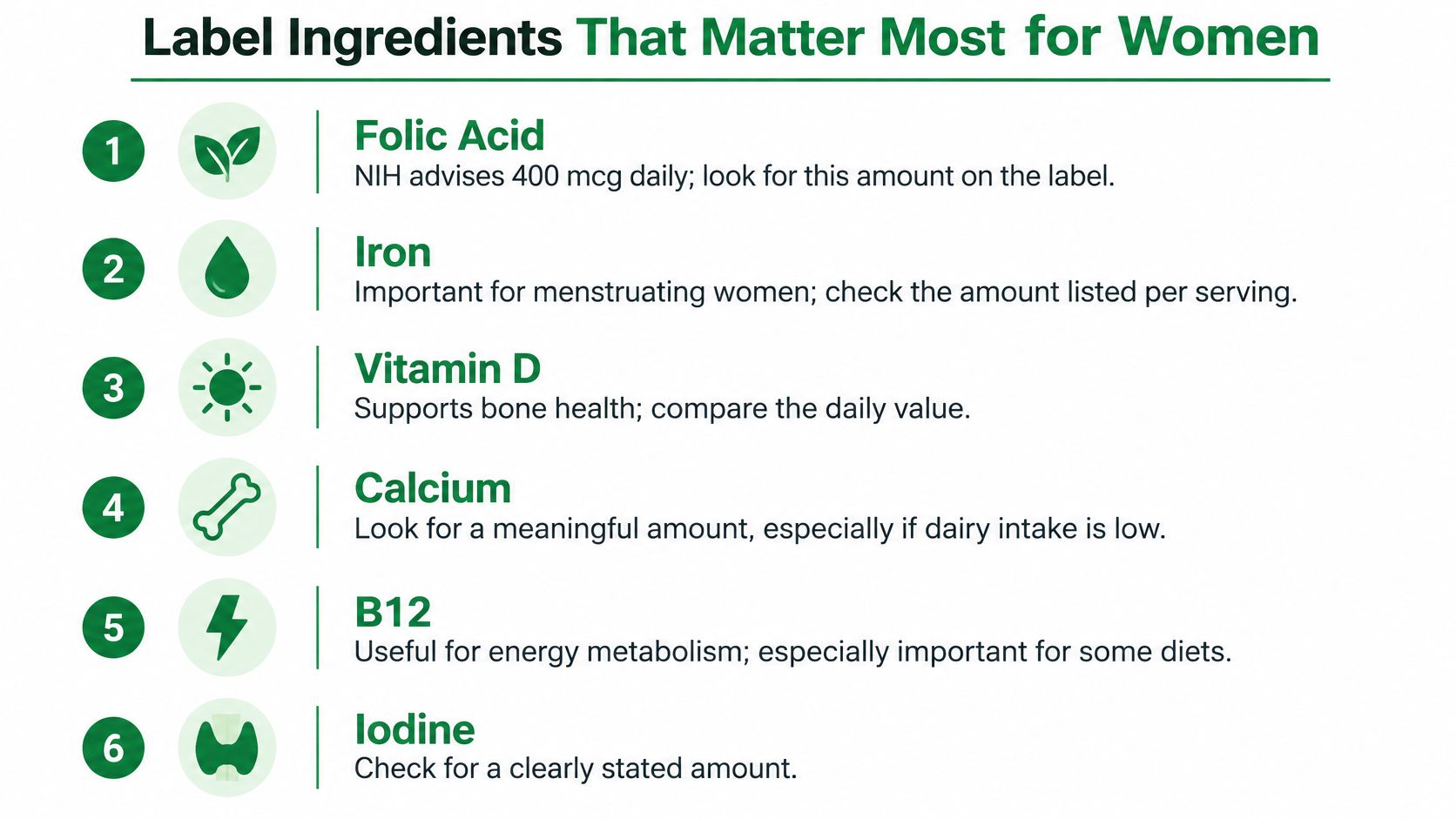
Folic Acid Comes First
If you could become pregnant, folic acid is the most actionable check on the label. The NIH Office of Dietary Supplements folate fact sheet states that women and adolescents capable of becoming pregnant should obtain 400 mcg of folic acid daily from supplements, fortified foods, or both, in addition to naturally occurring food folate, and that this amount lowers the risk of neural-tube defects. The pregnancy folate target is higher, at 600 mcg DFE per day.
Look for the words folic acid and an amount in mcg, not only the word folate. Folate is the general family name, and labels express total folate in DFE because food folate and supplemental folic acid aren't absorbed in the same way. If a label lists folate without identifying the form or the folic acid amount, you can't tell whether it meets the specific advice above. Also check whether the product is positioned for general wellness or for prenatal use. Those are different jobs, and the label should say which one it's doing.
Iron, Vitamin D, and the Minerals Often Left Short
Next, compare iron per daily serving with your life-stage row. Confirm the figure is elemental iron, the amount your body receives, rather than the weight of an iron compound such as ferrous fumarate. Some labels make this clear in parentheses. If they don't, you can't compare two products fairly, because different compounds contain different proportions of usable iron. Many gummies omit iron entirely, so an absent iron line is information too.
For vitamin D, look for vitamin D3 or D2 and read the amount in IU or mcg against your target. D3 and D2 are the two forms you'll meet, and the form should be named. Then check calcium. Calcium is bulky, so a single small tablet or gummy rarely holds a large share of the day's need, and brands often split it across multiple doses. A low calcium figure doesn't make a product poor, but it does mean you shouldn't count on that bottle to cover calcium.
Check iodine separately, because it's frequently missing from gummies. If the line isn't there, the product contributes nothing, whatever the front panel implies about completeness. The same applies to any nutrient you care about. Absence on the panel means absence in the product.
Vitamin A Form and Botanical Amounts
For vitamin A, identify the form before you look at the amount. Beta-carotene is a precursor your body converts as needed. Preformed vitamin A, listed as retinol or retinyl palmitate, is already in active form and carries the pregnancy caution covered in the safety discussion that follows. Many labels blend both, so read the breakdown if it's given. If only a total appears, treat that as a gap in what the label proves.
Botanicals such as maca, damiana, or ginseng need a stated quantity per serving, not only a name in a proprietary blend. A blend total tells you the combined weight of several ingredients without revealing how much of each one you're taking. Without individual amounts, you can't compare products, judge whether the dose is meaningful, or total it against another product containing the same botanical.
A name on a label proves an ingredient is present. Only a stated amount per serving proves how much of it you're getting.
Judge each of these entries against the row you chose earlier. A formula earns its place by matching your targets in forms you can identify, at amounts you can add up. Anything vaguer than that is marketing, however confident it sounds.
Upper Limits and Interactions to Review Before Daily Use
A basic multivitamin isn't automatically safe just because each nutrient looks modest on its own label. The risk is cumulative exposure. You're rarely taking one product in isolation, and nutrients don't know which bottle they came from.
The table below gives daily upper limits for adults from all sources combined. Use it as the ceiling, while the life-stage table gives you the target. Your intake should sit between the two.
| Nutrient | Upper limit (adults) | Why it matters on a label |
|---|---|---|
| Iron | 45 mg per day | Excess causes stomach upset; add fortified foods to the total |
| Folic acid | 1,000 mcg per day | High intake can mask vitamin B12 deficiency |
| Preformed vitamin A (retinol) | 3,000 mcg RAE per day | Excess in pregnancy raises birth-defect risk |
| Zinc | 40 mg per day | High intake can interfere with copper absorption |
| Niacin | 35 mg per day | High doses cause flushing and can affect the liver |
| Vitamin D | 100 mcg (4,000 IU) per day | Stacks quickly with fortified milk and other supplements |
How Overlap Actually Happens
Picture a normal morning. A fortified cereal at breakfast, a women's multivitamin, a beauty supplement for hair and nails, an electrolyte drink after exercise, and perhaps a prenatal left over from an earlier purchase. Each one can add iron, vitamin A, zinc, niacin, or folic acid. No single label looks alarming, but the sum can pass the ceiling in the table.
That's why dose discipline matters for gummies in particular, since they're easy to take casually. If you're unsure how serving size translates into a daily maximum, read the guidance on how many gummy vitamins you can take a day and then total your own products on paper. Write each nutrient once, add every source, and compare the result with the limit before you decide the routine is fine.
Warnings That Need a Clinician, Not a Guess
Some interactions don't depend on dose stacking at all. The NIH multivitamin fact sheet for consumers flags vitamin K interactions with warfarin and warns that excess preformed vitamin A during pregnancy can increase birth-defect risk. It also notes that multivitamins can raise the likelihood of excessive intake of iron, vitamin A, zinc, niacin, and folic acid when combined with other supplements or fortified foods.
If you take warfarin or another anticoagulant, keep vitamin K intake steady and discuss any new multivitamin with your prescriber before starting. Starting and stopping changes the amount of vitamin K your medication was balanced against. If you're pregnant, check whether a formula contains retinol and how much, rather than relying on the total vitamin A figure. Beta-carotene doesn't carry the same concern, which is why the form matters as much as the amount.
High folic acid creates a subtler problem. It can correct the anaemia that would normally signal vitamin B12 deficiency while the underlying deficiency continues. That's a masking effect, not a benefit, and it's one reason more folic acid isn't better once you've reached the recommended intake.
Two rules cover most situations. A general wellness gummy is not automatically a prenatal product, whatever its branding suggests. And pregnancy, nursing, a medical condition, or prescription medication are each reasons to consult a healthcare professional before starting, because they change both the targets and the interaction risks.
How to Compare Two Women's Multivitamin Labels
Shoppers usually compare front-of-pack claims and price, then skip the Supplement Facts panel entirely. That order guarantees a vague decision. Put two bottles side by side and run the same seven checks on both, in the same order, and the better fit usually becomes obvious within minutes.
The process below shows the sequence at a glance before you work through it in detail.
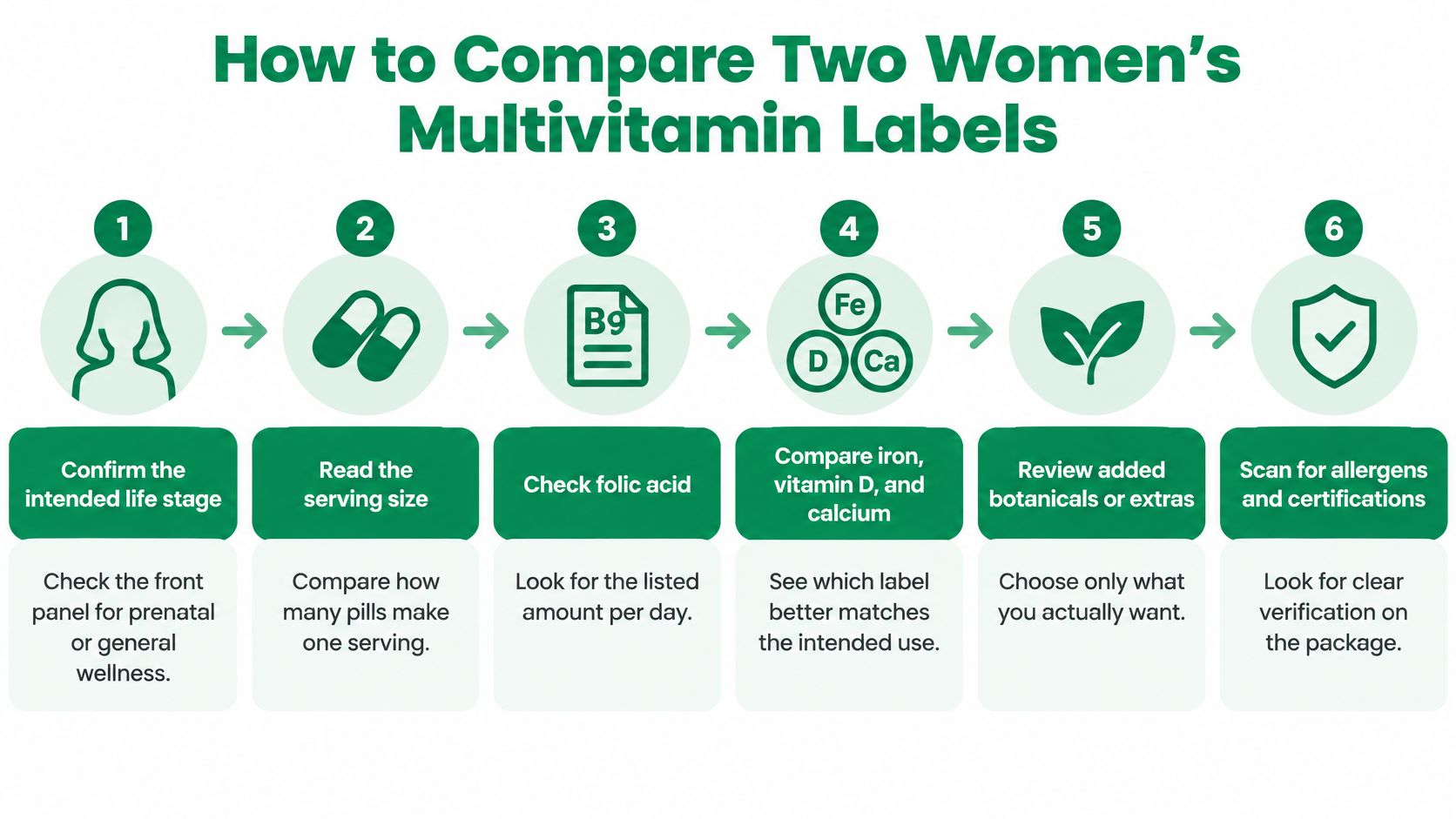
A Seven-Step Routine You Can Reuse
- Confirm the intended life stage: Read the front panel for prenatal or general wellness, and check any age range. If the intended user isn't you, stop there and don't let a good nutrient profile talk you out of it.
- Read the serving size: Note how many tablets or gummies make one serving, how many servings the container holds, and how many doses per day the directions require. Two similar bottles can last very different lengths of time.
- Multiply by the daily dose: If a serving is one gummy but the directions say take two daily, double every amount before comparing. Then set those daily totals against your life-stage row.
- Check % Daily Value carefully: Percentages are calculated against a standard reference that may not match your stage, particularly for iron and folate. Trust the actual mg and mcg amounts over the percentage when the two seem to disagree.
- Note the form of each nutrient: Record folic acid or folate, the iron compound and whether elemental iron is stated, vitamin D3 or D2, the vitamin A source, and whether botanicals carry individual amounts. Form changes both usefulness and risk.
- Look for verification: Search the label for third-party testing, a certification mark, or a GMP manufacturing statement. These don't prove a formula works, but they do speak to whether the contents match the label.
- Compare cost per day: Divide the price by the number of daily doses in the container, not by the number of pieces. A cheaper bottle that requires three doses a day often costs more per day than a pricier one-dose product.
If you're weighing gummies against tablets while you do this, the overview of whether gummy supplements are effective explains what the format can and can't deliver. Format affects which nutrients fit and how stable they remain, so it belongs in the comparison. It shouldn't replace the nutrient arithmetic.
A Short Scoring Example
Say Product A states folic acid in mcg, lists elemental iron, names vitamin D3, separates beta-carotene from retinol, and prints a GMP statement. Product B lists only "folate," gives an iron compound weight, hides botanicals in a blend, and needs three gummies a day. Product A passes five checks you can verify, while Product B asks you to trust it on most of them. Choose the label that lets you complete the audit.
The video below walks through a label reading in real time, which helps if the panel still feels crowded.
After watching, rerun the seven steps on a bottle you already own. You'll usually find at least one amount you'd never read before.
Three Real Profiles and Which Formula Fits
Numbers become useful when they meet a real routine. These three profiles use the same checks and reach three different answers, which is the point. The bottle doesn't change. The woman reading it does.

Planning Pregnancy at 26
She's stopped contraception and wants to be ready. Her first check is 400 mcg of folic acid daily, stated in mcg on the label, because the relevant window opens very early in pregnancy, possibly before she knows she's pregnant. She looks for a product clearly intended for prenatal use rather than a general gummy with appealing branding.
Her second check is vitamin A form. She wants beta-carotene rather than a retinol-heavy formula, and she wants the label to separate the two so she can see the preformed amount. The question she takes to her clinician is specific. Does this product's folic acid and iron match what she'll need once she's pregnant, or will she switch products at a positive test?
Heavy Periods and Fortified Cereal at 42
Her iron target is 18 mg per day, and heavy periods make iron the nutrient she's most concerned about. But she eats fortified cereal most mornings, so part of that target is already covered before any supplement. She writes down the cereal's iron per serving, adds the multivitamin she's considering, and checks the total against both her target and the adult upper limit.
The decision-changing check is the total, not the multivitamin alone. Because symptoms like fatigue have many causes, she asks her clinician whether her iron status should be tested before she raises her intake. Guessing at a higher dose could overshoot without addressing the reason she feels tired. A blood test turns a vague worry into a number she can act on.
Warfarin and a Vitamin D Supplement at 68
She already takes a separate vitamin D supplement and a prescription anticoagulant. Her vitamin D target is 600 IU per day at her age, so a new multivitamin containing vitamin D would stack on top of what she's taking now. She adds both products together before judging either one. Her iron target has also fallen since menopause, so a formula built for younger women may give her iron she doesn't need.
The check that changes everything is vitamin K. A multivitamin containing it could shift the intake her warfarin dose was set against, so she doesn't start, stop, or swap products on her own. She takes the actual label to her prescriber and asks whether the vitamin K amount is compatible with her current dose and monitoring schedule.
The pattern to copy: The label is only half of the decision. Your food, your other supplements, and your medication supply the other half.
The same gummy could suit the 42-year-old, fall short for the 26-year-old, and be a poor idea for the 68-year-old without medical review. That's not a flaw in the product. It's what life-stage auditing is supposed to reveal.
Confirm the Label Before You Choose
Do one thing before you buy anything. Pick your life-stage row, then run the comparison routine on the label in your hand, noting folic acid in mcg, iron, vitamin D, and any preformed vitamin A. Add what you already get from food and other products. If you can't complete that arithmetic from the label, the label hasn't given you enough to decide.
Stop and consult a healthcare professional first if you're pregnant, nursing, managing a medical condition, or taking medication. Those situations change the targets and raise interaction questions that a product page can't settle for you. Bring the label itself to that conversation, not a summary of its claims.
You can apply the same checks to our Femme Fresa Fatale gummies. They're formulated with maca root, damiana, and ginseng as part of a modern sensual wellness ritual, and they're 100% natural, vegan, gluten-free, and made in a GMP-certified facility. They're for adults 18 and older. If you want to understand how we present ingredient and product information, read our explanation of how transparency works before you order.
State the limits plainly too. Femme Fresa Fatale is not intended to diagnose, treat, cure, or prevent any medical condition, and it has not been evaluated or approved by the FDA. The information available here doesn't list its individual nutrient quantities, so you must find those amounts on the product label and check them against your target row yourself. Don't treat any marketing claim, ours included, as a substitute for that check.
Eve's Eden makes sensual wellness gummies for women who want a simple daily ritual built around confidence, connection, and feminine well-being, and the same label-auditing habit you've just learned applies to our products as much as to any multivitamin on the shelf. Read the amounts, match them to your life stage, and ask a clinician when medication or pregnancy is part of the picture. When you're ready to look at the details yourself, visit Eve's Eden to review Femme Fresa Fatale and decide with the label in front of you.