How Does Transparency Work for Wellness Brands
How does transparency work for wellness brands? Learn what ingredient panels, sourcing details, and claim evidence should show before you buy.
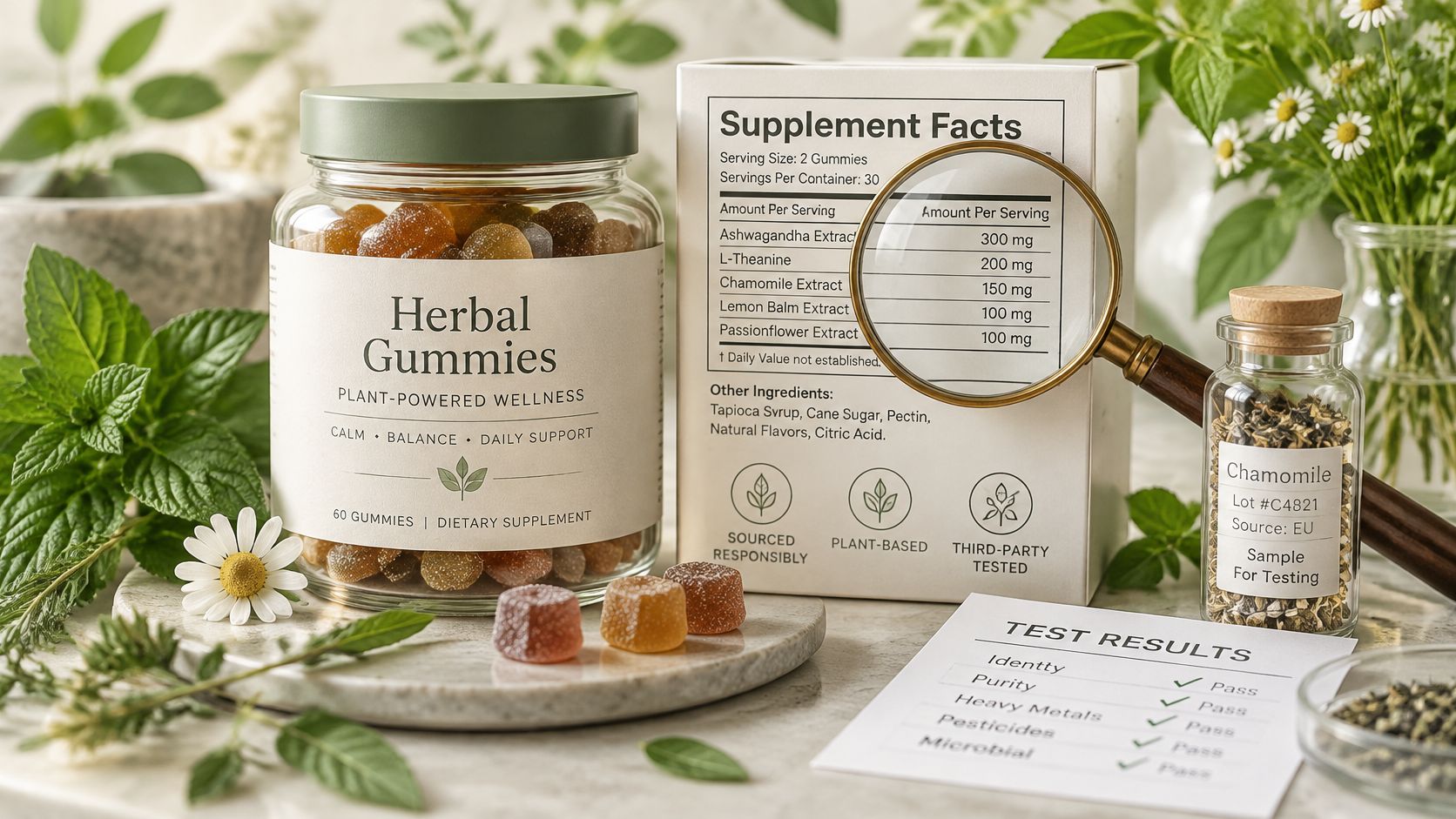
Transparency works when a wellness brand publishes specific facts a buyer can compare, explains how those facts were checked, and offers a route to question or correct them. A long ingredient story isn't enough if you can't match the dose, identify the source, or reach someone who will answer.
For a shopper, the difference is practical. A published fact is something you can read. A usable fact is something you can connect to the product in your hand and use to make a decision.
Why Wellness Labels Still Feel Hard to Read
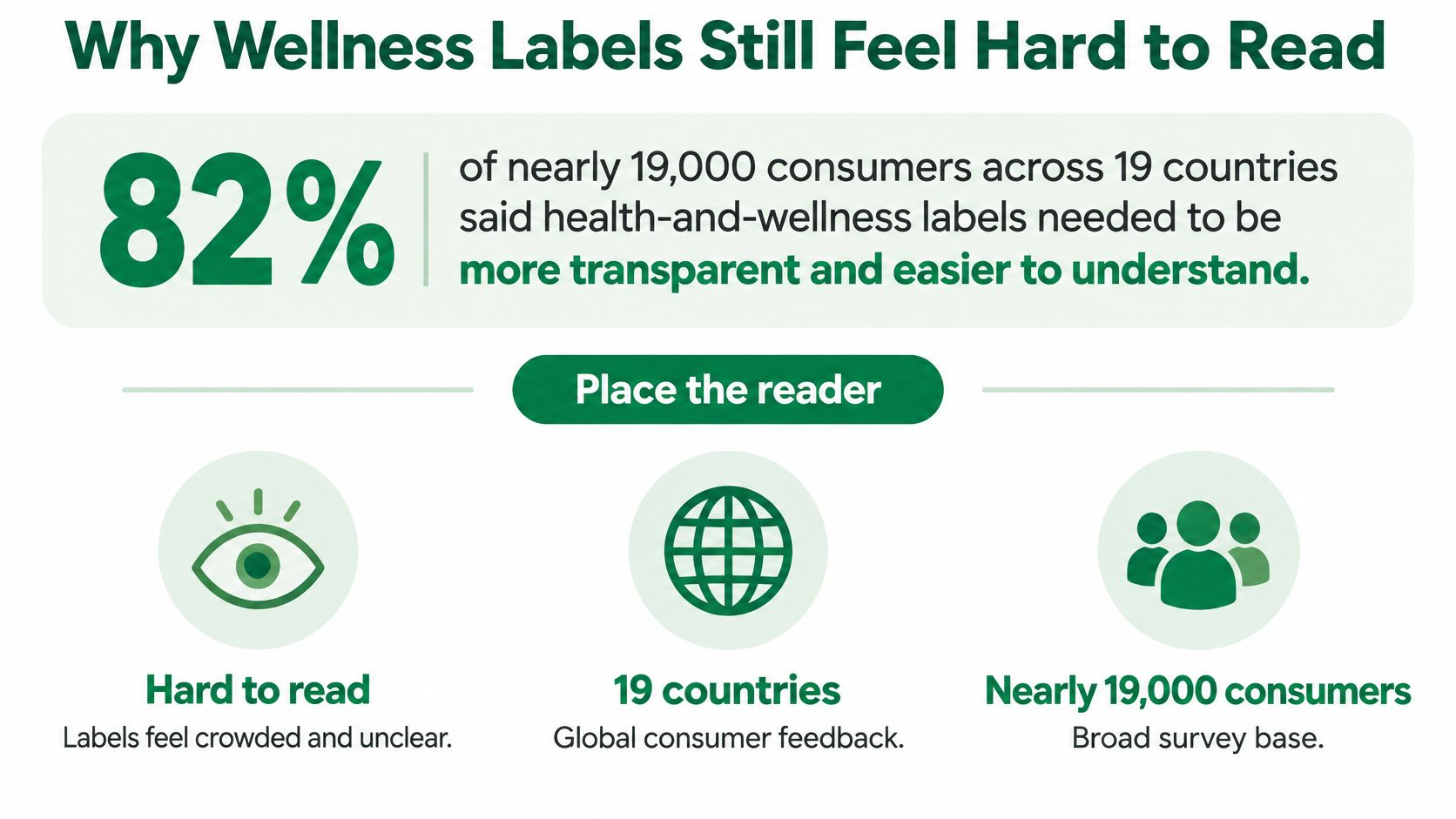
In 2025, 82% of nearly 19,000 consumers across 19 countries surveyed by NielsenIQ said health-and-wellness-product labels needed to be more transparent and easier to understand. That finding reframes transparency as a reading and decision-making problem, not a demand for more information.
Say you're comparing gummies for everyday mood and confidence. The front of one bottle describes a botanical's growing region and its place in traditional wellness, while the back contains a dense Supplement Facts panel. You can understand the story without knowing how much of the botanical you'd take.
The useful questions concern what's in the product, where it comes from, and what supports the benefit claim. Those questions connect the appealing front label to the less glamorous details that determine whether you can evaluate it.
Language matters, too. A statement about supporting normal mood or well-being isn't a diagnosis or a promise to treat a medical condition. Don't read a broad wellness benefit as evidence that a gummy will address a persistent symptom.
From an appealing story to a practical check
You don't need to become a formulation scientist to read more critically. You need a manageable way to sort the information:
- Identify the jobs: Separate what the brand discloses, how someone checks it, and what happens if it's wrong.
- Read the fields: Look up serving size, ingredient form, amounts, testing scope, and contact details.
- Check the comparison: When a study supports a claim, compare its ingredient and dose with the label.
A beautiful sourcing paragraph can provide context. It can't substitute for an amount, a relevant test, or a clear response when you ask a question.
Disclosure Verification and Remedy
A restaurant's window menu is disclosure. A kitchen inspection is verification. A manager who addresses a bad dish and provides an appropriate refund offers remedy.
For wellness products, the same distinction helps answer the question, how does transparency work beyond a promise of openness?
Disclosure tells you what the brand says. Verification checks whether the statement matches the product. Remedy gives someone responsibility for addressing a mismatch.
Disclosure makes the statement inspectable
A useful disclosure includes the Supplement Facts or nutrition panel, ingredient forms and amounts, other ingredients, allergen information, and the precise benefit language. It also separates sourcing details from general descriptions of care or quality.
The brand should publish these essentials without making every shopper request them. The distinction between proactive disclosure and request-based access also appears in the public-information framework described by the Congressional Research Service: some information is routinely published, while other records are available through a defined request process.
That's an operational analogy, not a claim that supplement businesses follow government records laws. The practical lesson is that routine facts and follow-up questions need different, complementary routes.
A proprietary blend that gives only a combined weight creates a disclosure gap. You may know what ingredients are present without knowing how much of each you're buying.
Verification connects the statement to evidence
Verification asks whether someone can check botanical identity, ingredient amount, or named contaminants. For a product claim, it also asks whether the cited evidence concerns a comparable ingredient, dose, and intended use.
A laboratory report and a clinical study answer different questions. A lot test may help establish composition or contaminant results; it doesn't, by itself, demonstrate a benefit for mood or confidence.
When evaluating women's health products, keep those questions separate. An accurately manufactured gummy can still carry a benefit claim that reaches beyond the evidence presented.
Remedy makes correction possible
A meaningful response route should identify who handles quality questions, how to report an adverse effect, and where to find applicable refund or recall information. A storefront with no way to question a claim leaves this job unfinished.
The accountability distinction matters. The World Bank's governance methodology review discusses why transparency's benefits depend on people's ability to use information and on credible accountability mechanisms, rather than publication alone.
For a shopper, remedy might mean a corrected product page, an explanation of a test result, or instructions for handling an affected purchase. It shouldn't mean receiving the same marketing paragraph in response to every question.
Finally, a claim about a finished gummy can't rest automatically on a study of an isolated nutrient in a different formulation. The brand needs to explain the connection, including where the comparison stops.
Ingredient Sourcing and Claim Fields to Scan
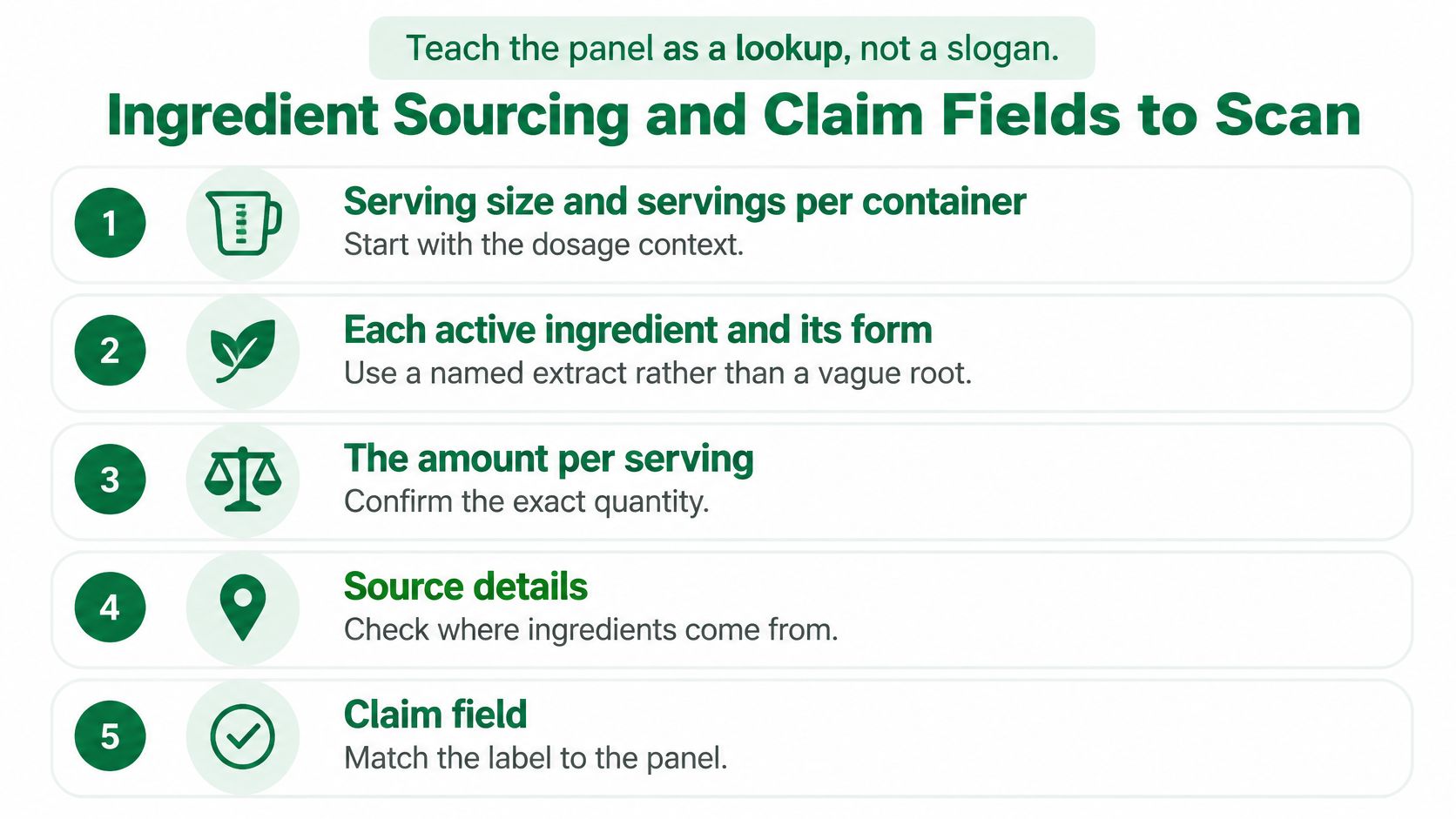
Treat the panel as a lookup tool, not a slogan. Keep the physical label or a readable label image beside the product description so you can compare the fields directly.
What a usable wellness disclosure includes
| Field | Usable detail | Not enough |
|---|---|---|
| Serving size | Gummies or capsules per serving, daily directions, and the gram or milligram serving | Take daily without an amount |
| Active ingredient | Common name, botanical or extract identity, and milligrams per serving | A blend total without per-ingredient amounts |
| Standardization | Named marker compound and percentage, with an extract ratio where relevant | Potent extract without a marker |
| Sourcing | Country or region, farm or supplier standard, and extraction method | Thoughtfully or premium sourced |
| Testing | Finished-lot tests for identity, potency, and named contaminants | Lab tested without a stated scope |
| Claim evidence | Relevant study of the same ingredient near the label dose, presented as support rather than treatment | A disease promise or an unexplained dose mismatch |
| Contact | Identified quality or customer-service contact and an adverse-event route | A storefront without a way to question a claim |
Read amounts before descriptions
Start with serving size and servings per container. A usable panel lets you connect the suggested routine to the amount listed; vague daily directions leave you guessing whether the ingredient quantity refers to a gummy, a serving, or the whole container.
Next, identify each active ingredient's form. A named botanical extract is more informative than a root name alone, especially when the page cites evidence about a particular preparation.
Then check the amount per serving and any stated standardization. A marker-compound percentage describes a feature of an extract; an extract ratio describes a different relationship and shouldn't be treated as interchangeable with that percentage.
A proprietary blend needs particular attention. Its total weight doesn't reveal the contribution of each ingredient, so you can't reliably match an individual botanical to a study.
Read the supporting fields as carefully
Check other ingredients, sweeteners, and allergen notes against your own dietary needs. For a daily gummy, the delivery ingredients are part of what you consume, not decorative details beneath the active panel.
Sourcing should identify something you can evaluate: a region, a supplier standard, or an extraction method. Organic or wildcrafted descriptions don't reveal the ingredient amount, and a place name alone doesn't establish finished-product quality.
For testing, look for the test type and the material tested. An identity test on incoming botanical material and a contaminant test on a finished lot provide different information.
Finally, compare the benefit wording with the evidence description. A study of a nutrient doesn't establish that every gummy containing it delivers the studied amount or outcome.
- A useful match: The page identifies the ingredient form, amount, evidence boundary, and relevant testing scope.
- A reason to pause: The description substitutes naturalness, potency language, or a study badge for those fields.
Keep this checklist beside the product page. Use a dose comparison when a benefit claim points to a study or an ingredient-specific effect.
How to Match a Claim to the Dose
Start with the claim exactly as written, not the outcome you hope to get. Supporting everyday well-being and treating a medical condition are different propositions, and your comparison should preserve that distinction.
This process checks whether the evidence presented is relevant. It doesn't establish that a supplement is suitable for your health history, medications, pregnancy status, or symptoms.
Follow the claim to its evidence
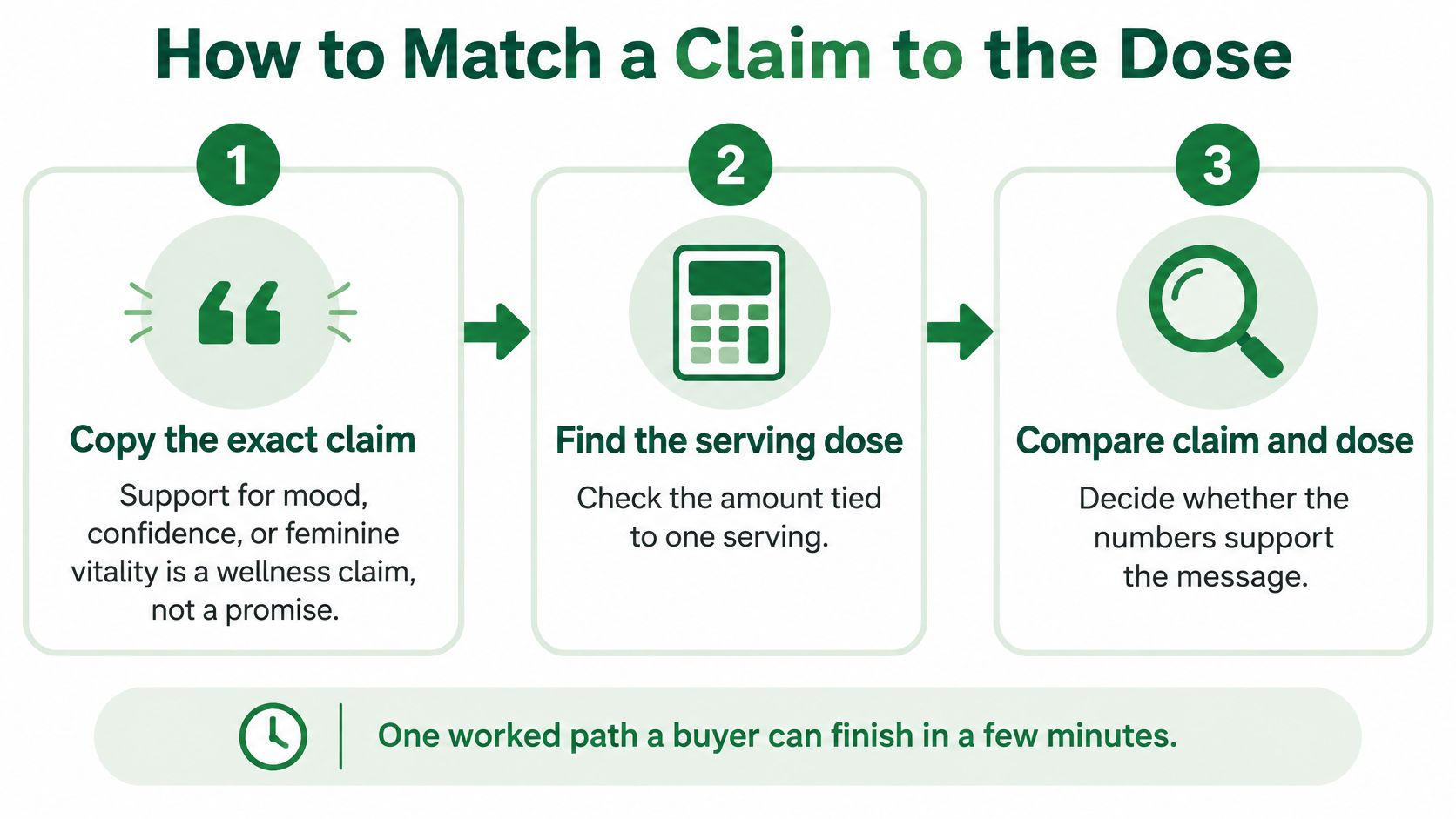
Copy the exact claim. Write down the wording about mood, confidence, or feminine vitality. Don't strengthen support language into a guaranteed result.
Find the ingredient tied to it. Record the ingredient's full form, extract identity where available, and amount per serving. If the page never makes that connection, note the gap.
Calculate the suggested daily amount. Use the label's serving directions, not an assumption about what a single gummy contains. Don't multiply again if the panel already states the full daily serving.
Check the study match. Compare ingredient form, dose range, participant population, and measured outcome. A result in a narrowly defined group may not answer your question about general daily confidence.
Identify what kind of support is offered. Traditional use or an explanation of a nutrient's normal role can provide context. Neither means the finished gummy underwent a clinical trial.
Find who checked the amount. Look for an in-house assay, an identified independent laboratory, or an explanation of the testing method. If none is stated, don't fill in the missing assurance yourself.
Write a precise question. Ask which lot a report covers, which extract the study used, or how the formulation relates to the cited dose. A focused question makes a substantive answer easier to recognize.
Choose your next action. Buy only if the available information meets your needs, ask before buying when a material detail is missing, or skip the product.
A hypothetical extract comparison
Suppose an ashwagandha-style gummy lists an amount per gummy, and its directions call for several gummies each day. After calculating the daily amount, you find that the cited trial used a higher dose of a differently standardized extract.
That comparison gives you a question, not an equivalence. Ask how the brand connects its extract and daily amount to the trial, rather than assuming that similar ingredient names mean similar formulations.
The same discipline applies to high-potency gummies. A potency description isn't a substitute for the quantities and ingredient specifications needed to evaluate it.
Practical rule: A missing ingredient amount stops the dose check. Don't increase your intake to imitate a study.
Product Pages That Show Their Work
Consider these hypothetical shopping scenes. Each page may contain true statements, but the reader can reach different conclusions from what's available.
The open panel
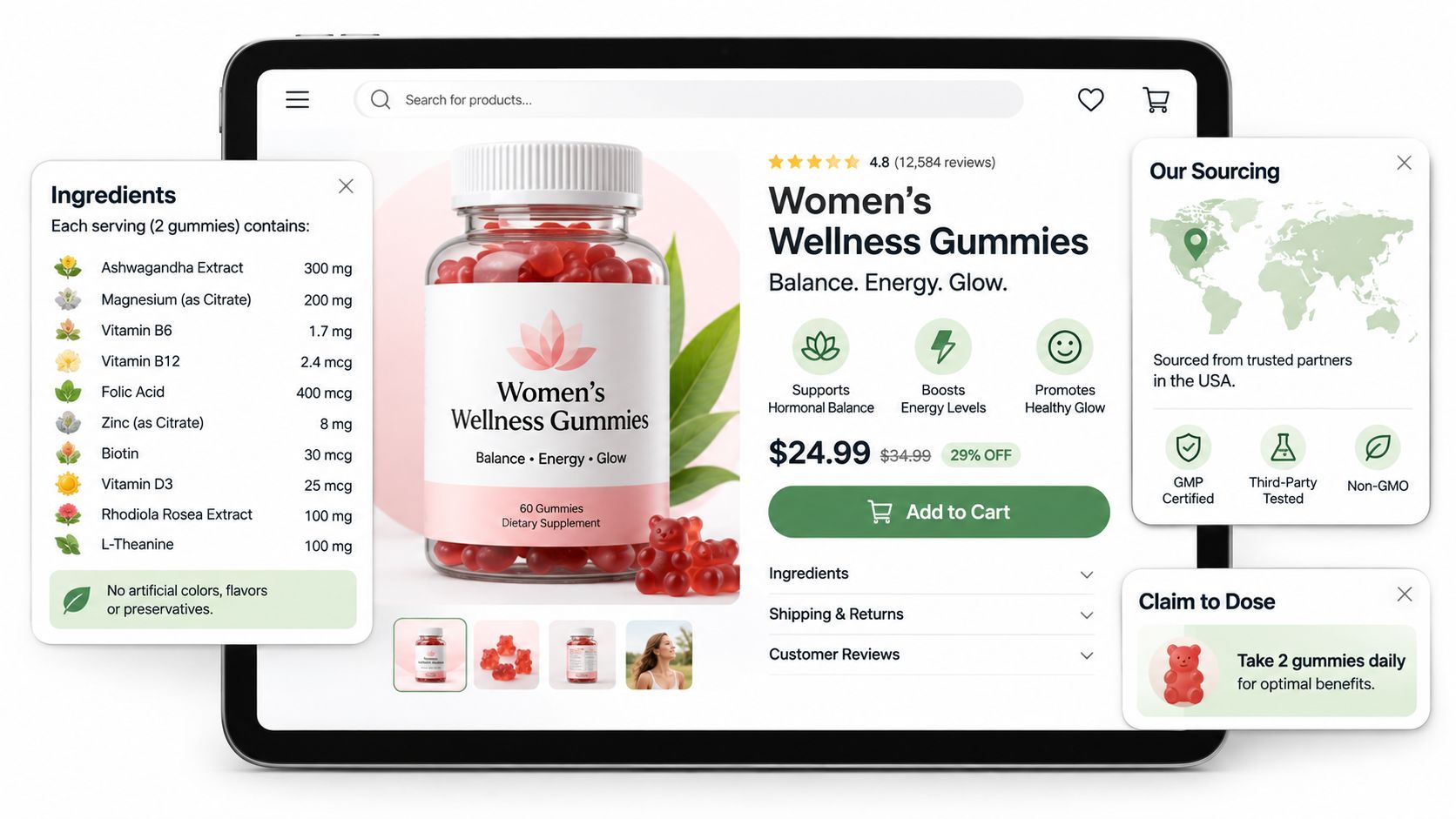
A daily women's wellness gummy page lists botanical and nutrient amounts, gives readable serving directions, and provides a lot-test summary. Its benefit description stays with support for mood and confidence instead of promising a cure.
You can inspect the formulation and see what the testing addresses. You still need to evaluate whether the evidence is relevant to the benefit and whether the supplement fits your circumstances.
Verdict: There's enough detail to begin an informed assessment, not enough to assume a personal result.
The sourcing story
Another page names a growing region and explains an extraction method. The photographs and production description provide useful origin context, but the actives sit inside a blend without individual amounts.
You can conclude that the brand has disclosed aspects of sourcing. You can't determine whether the daily dose of a particular ingredient resembles the dose discussed in its evidence.
Verdict: The origin may be clear while the formulation remains difficult to assess.
The claim stack
A third page promises support across a long list of wellness concerns. Its evidence consists of a statement about clinically studied ingredients, without identifying which study supports which benefit.
You don't have to conclude that every claim is false. You do have to recognize that the page hasn't supplied a traceable connection between its claims and its gummy.
Verdict: The evidence presentation isn't sufficient for a dose-specific buying decision.
Applying the comparison to sensual wellness
For a gummy positioned around everyday confidence and intimate well-being, look for a clear boundary between routine wellness support and medical outcomes. A useful page also makes the panel accessible and states whether its testing concerns the finished batch.
When comparing online supplement stores, check whether you can find these details before reaching checkout. Ease of ordering and ease of evaluating the product are separate qualities.
A retail package may have less room than a website, but the descriptions shouldn't contradict each other. If serving directions, ingredient forms, or benefit wording differ, save both versions and request clarification before deciding which information to rely on.
Openness That Does Not Help You Choose
More text doesn't necessarily give you more control over a purchase. A page can be candid about selected details while leaving the decisive question unanswered.
More words aren't more usable facts
A lengthy farm story might explain climate, harvesting, and tradition while omitting ingredient amounts. Even if every sentence is accurate, you still can't compare the formulation with another product.
The useful correction isn't to remove the story. It's to place the necessary quantities where the shopper can find them without searching through promotional prose.
A published-information system has a similar scope problem: the OECD's discussion of public-information transparency distinguishes the availability of basic institutional information from more sensitive information about decision-maker activity. For a wellness shopper, the analogous question is whether the brand publishes the details that matter to the decision, rather than only the easiest details to share.
Different assurances answer different questions
Keep these common substitutions separate:
- Sourcing isn't contaminant testing: A botanical description or a statement about avoiding harsh chemicals doesn't identify a heavy-metal or microbial test, its scope, or its result.
- A study badge isn't a product result: Evidence about another extract or participant group may explain an ingredient's potential without establishing the advertised finished-product outcome.
- A clean ingredient list isn't a complete record: A short list can be easy to read while leaving testing, evidence limitations, and responsibility unclear.
These distinctions don't require a brand to publish every supplier contract or internal document. Commercial confidentiality, personal information, and technical complexity can justify limits on disclosure.
But those limits shouldn't prevent a clear account of what the buyer will consume, what the evidence supports, what quality checks cover, and who handles questions. Uploading a pile of raw files without explaining their relevance can be as unhelpful as publishing too little.
Can an ordinary buyer understand what the product does and doesn't claim, identify the uncertainty, and act if the record turns out to be wrong?
That's a more demanding test than counting certificates, paragraphs, or reassuring adjectives. It asks whether the information helps you make and revisit a choice.
Check the Panel Before You Buy
Before checkout, open the label image, the evidence description, and the quality information in separate tabs. Keep a short note of anything you can't resolve rather than relying on your memory of the product story.
Use a buy-or-ask check
- Amounts: Can you identify the amount of each relevant active per serving and connect it to the daily directions?
- Claim fit: Does the evidence address the advertised benefit at a relevant dose and form, without turning wellness support into a treatment promise?
- Sourcing: Does the page identify an origin, supplier standard, or preparation detail that helps you assess the ingredient?
- Test scope: Can you tell what was tested and whether the information covers the finished lot?
- Reply path: Is there an identified person, team, or inbox that can handle a lot-specific quality question?
As a shopping rule, if several essential checks remain unresolved, treat the page as a marketing introduction rather than sufficient support for purchase. Ask a focused question or choose a product you can assess more clearly.
Practice without granting a brand an exception
Use our daily gummy, Femme Fresa Fatale, as a practice case for evaluating confidence, mood, and feminine-wellness positioning. At Eve's Eden, we develop our products with intentional ingredients and put quality, transparency, and innovation at the forefront, but that statement of intent isn't a substitute for your inspection.
Read the current Supplement Facts, sourcing notes, and any study references yourself. This article doesn't establish the current formula, individual ingredient quantities, or clinical outcomes for the finished product.
Use our contact and policy pages when a claim or batch question remains unclear. If a finished-lot test summary isn't posted, request it before buying and assess whether the response answers your actual question.
Keep the distinction between missing information and a confirmed problem. An absent report doesn't prove a product failed testing, but it does limit what you can independently conclude.
Don't buy on the story alone. Buy when the panel, the supporting evidence, and the reply path agree.
Eve's Eden offers sensual wellness supplements intended to support everyday confidence, vitality, and feminine well-being. Visit Eve's Eden to review the current product information, check the panel against your priorities, and bring any unresolved ingredient or testing questions to us before you buy.