High Potency Gummies Explained: How to Read the Label
High potency gummies can mean very different doses. Learn how to read serving size, mg per gummy and safety limits before you buy or take them.
You're comparing gummy bottles, and one promises high potency while another advertises a large milligram total. You turn them over, hoping the labels will settle the question, only to find amounts listed per gummy, per serving, and per container. Which number tells you what you'd really take?
The answer starts with the ingredient, not the promise on the front. High potency gummies can mean different things across vitamins, cannabis, and botanicals. A useful comparison asks what's inside, how its amount is measured, and how many pieces the directions call for.
What High Potency Means for Gummies
Two identical words can describe three different things. "High potency" on a gummy label only means something inside a specific product category, and a nutrient percentage, a THC amount, and a botanical extract weight each answer a different question. Your real dose is simpler than any of them: milligrams per gummy multiplied by how many gummies you take.
For vitamins and minerals, the phrase has a defined basis. FDA guidance on dietary supplement claims permits high-potency wording for an individual vitamin or mineral present at at least 100% of its Reference Daily Intake, or RDI, per reference amount customarily consumed. That benchmark applies ingredient by ingredient, so a heavier gummy is not automatically a more potent one.
| Product type | Potency is measured as | Threshold or limit | Example |
|---|---|---|---|
| Vitamin and mineral gummies | Nutrient amount and percentage of Daily Value per serving | The FDA nutrient benchmark described above, assessed ingredient by ingredient | A vitamin meeting the benchmark, rather than a large total gummy weight |
| Cannabis gummies, United States | Milligrams of THC per serving and per package | Jurisdiction-specific serving and package rules | A per-gummy amount that must be distinguished from the package total |
| Cannabis edibles, Canada | Milligrams of total potential THC per immediate container | A national container limit, described below | The limit applies across the container, regardless of gummy count |
| Botanical or herbal gummies | Milligrams of blend or extract, ideally with quantified marker compounds | No universal high-potency benchmark established by the nutrient rule | A blend weight without amounts for its individual ingredients |
Why the wording doesn't travel well
Canada set a clear regulatory benchmark when cannabis edibles became legal for non-medical sale on October 17, 2019: Canada's cannabis product composition requirements cap each immediate container at 10 milligrams of total potential THC, including the potential conversion of THCA into THC, regardless of how many pieces are inside. U.S. states take a different approach, setting their own caps on THC per serving and per package, and those caps vary enough that a package legal in one state can exceed another state's limit. A number that means one thing in Toronto can mean something else in Denver.
None of those figures describe your dose on their own. A package total covers everything in the container. A serving amount covers the labeled portion. Divide the package total by the gummy count to get the per-gummy amount, then multiply by how many you take.
Comparison rule: Name the category first, then the measure. Compare the same ingredient on the same basis, and run the math: milligrams per gummy times gummies taken is the dose, whatever the front label promises.
Read the Panel and Check the Label Before You Buy
Start with the back label, even if the front sounds reassuring. The Supplement Facts panel is where you can connect ingredient amounts to a defined serving. FDA labeling requirements call for serving size, servings per container, dietary ingredients, and their quantities, subject to proprietary-blend exceptions.
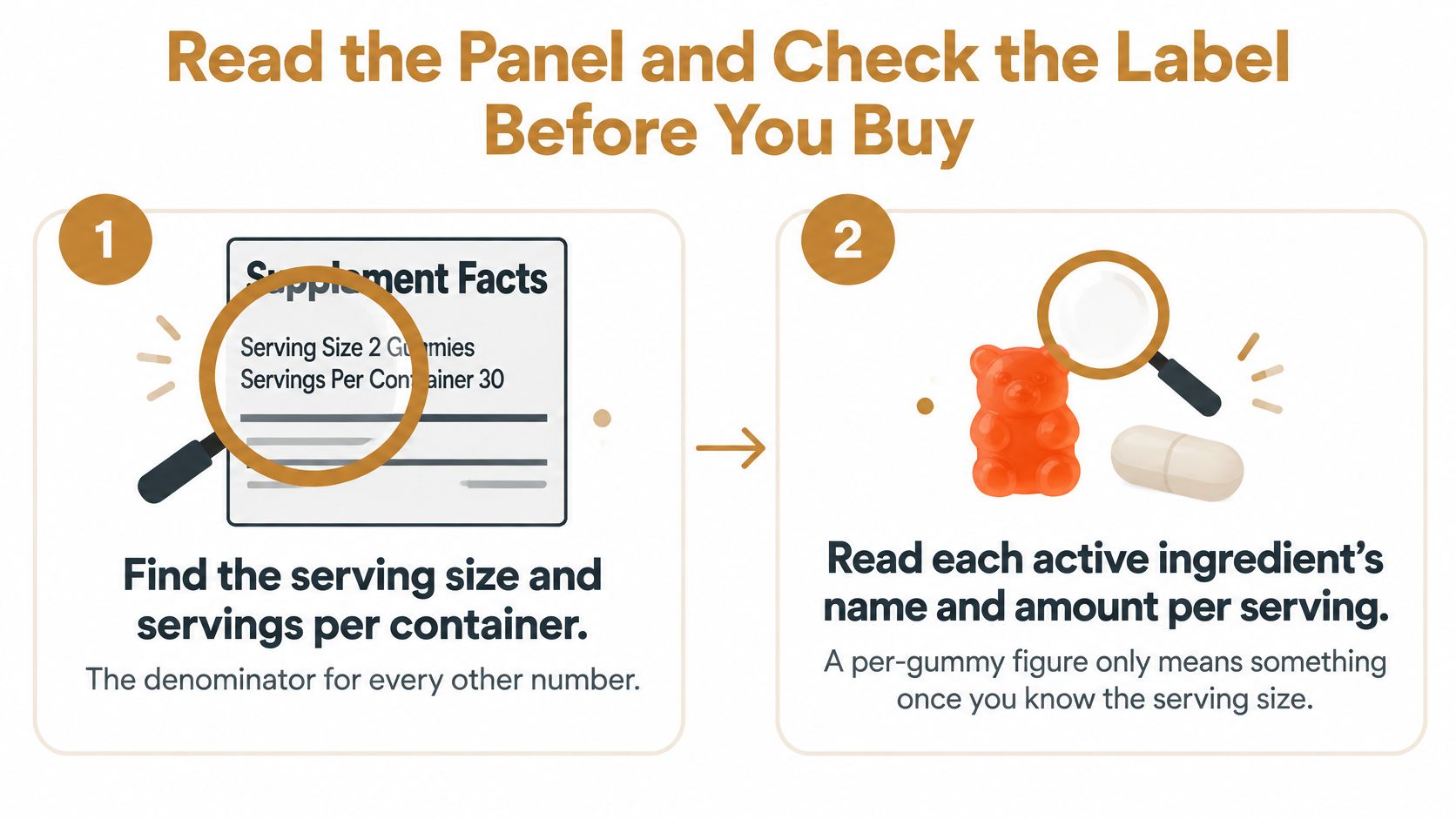
Follow the label in order
Find the serving size and servings per container. Serving size is the denominator for the ingredient amounts that follow. Servings per container tells you how many of those labeled portions the bottle contains, not necessarily how many gummies are inside.
Read each active ingredient's name and amount. Check whether the amount is stated per gummy or per serving before comparing products. If the front uses one basis and the panel uses another, reconcile them before making a decision.
Look at the Daily Value column where applicable. For vitamins and minerals, this gives the nutrient amount context against the reference used for labeling. The FDA high-potency benchmark described above concerns individual nutrients, not the combined weight of the gummy or a promise of better results.
For botanicals, look beyond extract weight. Standardization identifies a specified concentration of a marker compound, while a quantified marker amount helps describe what the extract delivers. A large extract weight alone doesn't establish equivalent active-compound exposure.
Recognize what a proprietary blend leaves unanswered. A combined weight doesn't tell you the amount of every ingredient inside it. You can know the total blend amount and still lack the information needed to assess an individual botanical.
Match the panel to the directions. Don't assume the serving size is permission to repeat servings whenever you want. Read the recommended use, warnings, and any restrictions together.
Check the evidence behind the label. Look for relevant finished-product batch testing, a genuine independent verification mark if one is claimed, and a measured basis for shelf life. A logo without information about what was verified doesn't answer all those questions.
A botanical label in practice
Our Femme Fresa Fatale gummy contains 200 mg of botanical ingredients per gummy, formulated to support energy, mood, and confidence. That total describes the combined botanical amount, but it doesn't disclose how much of each ingredient is present.
For this worked case, individual ingredient quantities and finished-product clinical studies aren't available to establish potency or efficacy independently. The appropriate conclusion is not enough information to judge each active, rather than assuming that the total proves a particular effect.
Whether you're shopping online or using our guide to finding a health and wellness store near you, use the same label check. Before buying, write down serving size, servings per container, the amount per serving of your ingredient of interest, and its percentage Daily Value where one applies. If a figure isn't disclosed or a Daily Value doesn't apply, record that explicitly rather than guessing.
Converting Gummies, Servings and Packages Into Real Doses
Two bottles can contain the same total amount of an ingredient while providing different amounts per serving. That's why the largest number on the package isn't necessarily the number most relevant to your use.
Keep the units attached throughout the calculation. Milligrams per gummy describes a piece, milligrams per serving describes the labeled portion, and milligrams per package describes the full container. Dropping those last words is how a correct number becomes a misleading comparison.
Do the arithmetic in this order
First, identify the milligrams of the ingredient in each gummy. Multiply that amount by the number of gummies in the labeled serving:
Milligrams per gummy × gummies per serving = milligrams per serving
Then check the container total:
Milligrams per serving × servings per container = milligrams per package
These are calculation rules, not dosage recommendations. They also work in reverse: divide a package total by servings per container to check the amount per serving, provided both figures describe the same ingredient.
Same package, different dose
The following is a qualitative worked comparison, not a description of actual products.
| Measure | Product A | Product B |
|---|---|---|
| Milligrams per gummy | Higher ingredient amount per piece | Lower ingredient amount per piece |
| Gummies per serving | Fewer pieces | More pieces |
| Milligrams per serving | Higher after multiplying by serving size | Lower after multiplying by serving size |
| Servings per container | Fewer labeled servings | More labeled servings |
| Milligrams per package | Same total ingredient amount | Same total ingredient amount |
The matching package totals don't make the servings equivalent. Nor would comparing gummy counts alone establish which serving contains more of the ingredient.
Watch the wording around portions
A front label that says “per gummy” and a panel that says “per serving” may both be accurate, but they aren't interchangeable. If a serving is described as a fraction of a gummy, check the directions carefully rather than treating a whole piece as the intended portion.
Compare the ingredient amount in the recommended serving, not the amount you could consume by finishing the package.
Keep the calculation ingredient-specific. Adding together unlike ingredients into a single impressive milligram total doesn't create a meaningful measure of shared strength. Stay within the label directions, and don't treat arithmetic as a reason to increase intake.
Why the Same Gummy Can Vary Batch to Batch
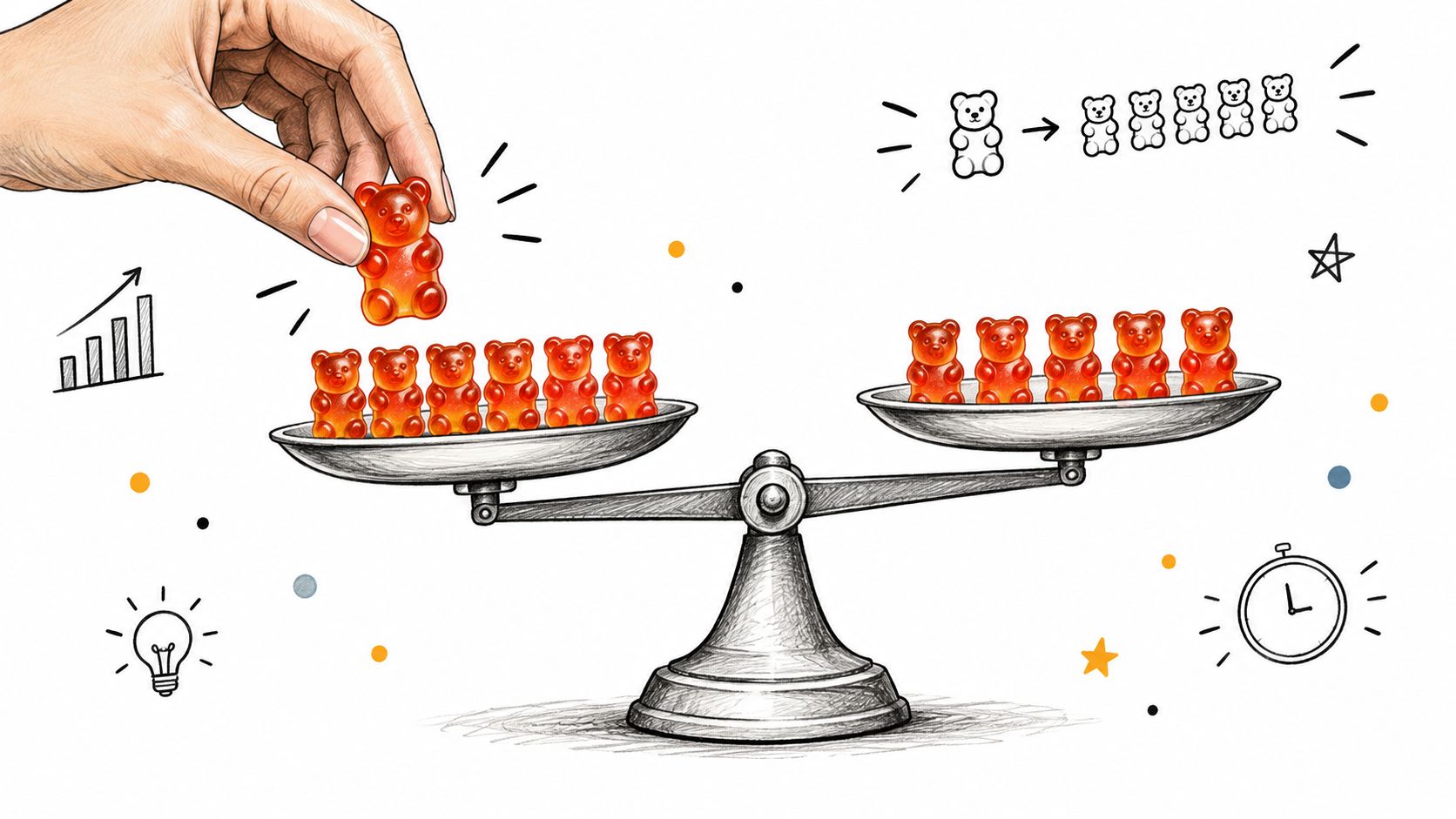
Think about a jar that sits in storage before you open it. The manufacturer needs evidence that the labeled ingredient amounts remain within specification through that period, not just that a freshly made sample passed a test. If someone takes several pieces, even a small error in each piece also changes the total amount consumed.
Good manufacturing practices, often shortened to GMP, address supplement identity, purity, quality, strength, and composition. The FDA's dietary supplement questions and answers explain this quality-control framework. Independent USP verification adds laboratory testing, facility audits, documentation review, and ongoing testing of products taken from store shelves.
Raw materials and storage create different challenges
Botanical concentrations can vary between raw-material lots, while some active ingredients can decline during storage. Manufacturers therefore need controls for both what enters production and what remains in the finished gummy through expiry.
- Batch testing: Representative finished gummies should be checked for identity, potency, microbial and chemical contaminants, and relevant physical properties.
- Stability testing: Heat, humidity, light, packaging barriers, gummy water activity, and ingredient degradation all deserve examination.
- Controlled overages: An extra amount added to offset validated storage loss must remain safety-constrained. It shouldn't substitute for a poorly controlled process.
Water activity concerns how available water is within the product, not whether a gummy merely feels moist. Package barrier performance concerns how well the container protects its contents under the conditions being evaluated.
A useful quality question: Was the labeled shelf life supported by measurements on the finished product in its packaging?
A gummy can meet its specification when manufactured and still fall short before expiry if stability hasn't been demonstrated. Treat potency as a claim that requires batch control, suitable packaging, and appropriate storage throughout the product's life.
When High Potency Becomes a Risk
The relevant safety question isn't whether a label sounds strong. It's whether the amount you plan to take is appropriate for the ingredient and for you. Start by calculating daily intake from the serving directions, then account for other products containing the same active.
Amount per serving × servings taken daily = daily intake from that product
That calculation gives you an amount to assess, not a verdict that it's safe. For nutrients with an established Tolerable Upper Intake Level, or UL, the comparison requires the nutrient's actual quantity and the applicable limit. A Daily Value percentage isn't a substitute for that assessment.
Check the full routine
A multivitamin, a fortified food, and a separate gummy may contribute the same nutrient. Reviewing each label in isolation can miss the combined intake.
- Vitamin and mineral gummies: Check the actual amount of each relevant nutrient, then discuss applicable upper limits with a pharmacist or clinician when you're unsure.
- Cannabis gummies: Keep THC amounts separate from other ingredients and consider the number of pieces consumed, rather than relying on the package description.
- Botanical gummies: Don't interpret an absent Daily Value or an undisclosed individual amount as evidence of safety.
The nutrient benchmark explained earlier is a labeling benchmark, not a personal safety ceiling. Likewise, a package that complies with a legal limit doesn't establish that every possible portion is suitable for every person.
Avoid using extra pieces as an experiment
If you aren't getting the result you expected, taking more isn't a neutral adjustment. You're changing exposure to the ingredients, potentially without enough information about their individual quantities.
Treat the label directions as an upper boundary for self-directed use, not a target everyone must reach. If the directions are unclear or your routine includes overlapping supplements, pause and have a pharmacist review the labels together before adding the gummy.
Common Misconceptions About High Potency Gummies
A shelf can make "high potency" look like one promise. It is closer to three different labels sharing a phrase: a vitamin may use it beside a Daily Value percentage, a cannabis product usually means milligrams of THC or CBD per piece, and a botanical may use it for an extract ratio or the total blend. The dose that reaches you is still arithmetic: milligrams per gummy multiplied by how many gummies you take.
- “The phrase means the same thing everywhere.” Check which yardstick the product is using before comparing jars. A percent Daily Value, cannabinoid milligrams per piece, and a botanical extract ratio answer different questions.
- “The front panel tells the dose.” Front labels often feature a bottle total or a serving larger than one gummy. Find the amount per gummy, confirm the serving size in pieces, then multiply by the portion you would realistically take.
- “A larger headline number settles it.” A bigger figure can reflect a different unit, a different ingredient form, or more pieces per serving. Convert each product to the same per-gummy basis before judging strength.
Before buying a specific gummy, verify four items on the label or product page: the named active and amount per piece; the pieces in the suggested serving and the resulting serving dose; the number of servings in the package so bottle totals are not mistaken for one dose; and the evidence behind the claim, including whether it concerns the finished product, the same dose, and people like you. If any one of those is missing, treat “high potency” as a marketing phrase until the arithmetic and evidence catch up.
Safety Checks That Depend on the Product and the Person
Our use policy is adults only, aged 18 and over. We advise consulting a healthcare professional before use, especially if you're pregnant, nursing, have a medical condition, or take medication. Don't exceed the recommended dosage, and keep gummies out of reach of children.
Our gummies aren't intended to diagnose, treat, cure, or prevent any medical condition, and the product hasn't been evaluated or approved by the FDA. Those limitations matter: wellness positioning isn't clinical proof, and it shouldn't replace assessment of a health concern.
Match your situation to an action
Use this table as a prompt for a decision before taking a gummy. It isn't a substitute for individualized advice, and the adult-use policy above shouldn't be treated as a universal age rule for unrelated product categories.
| Situation | Why it changes the risk | What to do |
|---|---|---|
| Under the stated adult-use age | Use would fall outside our adult-only policy | Don't give the product to minors |
| Pregnant or nursing | Suitability requires a specific review rather than an assumption based on wellness positioning | Ask a healthcare professional before first use |
| Medical condition | The ingredient list needs to be considered alongside the condition and its treatment | Confirm suitability with your clinician |
| Taking medication | Compatibility can't be established from the front label | Have a pharmacist review the combination |
| Exceeding label directions | You'd be using the product outside its recommended dosage | Stay within the directions |
| Young children in the home | Safe storage needs to prevent unintended access | Keep gummies out of reach |
Bring useful information to the conversation
Take the full label, directions, and a list of your medications and other supplements to the pharmacist. Include products used occasionally, not just those you take every day, so the review reflects your actual routine.
If you're comparing mood support supplements, describe what you want support with rather than asking only which product is strongest. That makes the conversation about suitability instead of marketing intensity.
Our policy is to discontinue use and consult a healthcare professional if an adverse reaction occurs. You don't need to keep taking a product to prove that it doesn't suit you.
Before the first dose, identify the row that matches your circumstances and follow its action. If you can't resolve an ingredient, serving, or compatibility question, leave the purchase or first use until you can.
Eve's Eden offers women's sensual wellness supplements positioned to support confidence, connection, and feminine vitality. Visit Eve's Eden to explore the offering, then use your serving-size notes and safety checklist to decide whether it fits your routine.
Composed with the Outrank tool