
Health and Wellness Store Near Me: How to Choose Well
Searching for a health and wellness store near me? Learn to find local retailers, check stock, vet supplement quality, and get discreet help.
You've typed health and wellness store near me, your phone filled with pins, and every listing claims to be close, well stocked, and highly rated. That doesn't tell you which one sells the product you want, explains its label clearly, or lets you ask a personal question without looking over your shoulder. This guide treats distance as a starting point, then helps you check stock, quality, claims, and service before you spend money.
Finding the Right Health and Wellness Store Near You
The map rarely shows one obvious answer. You might see a pharmacy two minutes away, a supplement shop across town, a natural grocer you already visit, and a small boutique you've never noticed. The nearest pin feels efficient, but it may carry a narrow range, have your product out of stock, or offer no one who can explain how a supplement fits alongside your current medicines.
The number of choices isn't surprising. The global wellness market reached an estimated $1.8 trillion in 2024, with the United States accounting for approximately $480 billion and growing by about 5% to 10% per year, according to the same market estimate. Those broad figures cover nutrition, fitness, appearance, self care, and personal well being, not supplement stores alone, so they don't predict what any individual shop sells. They do explain why wellness products now appear in so many retail settings and why a simple distance search produces such mixed results.
A Better Way to Use the Search
Treat the search as two jobs. First, locate plausible stores. Second, decide whether a store deserves your trust for the specific purchase you have in mind.
That second job matters because wellness is a wide label. A store that's excellent for protein powder may be a poor place to discuss feminine vitality. A boutique with a calm consultation corner may not stock everyday vitamins. A pharmacy can check medicine interactions but may give you little privacy at a busy counter.
Practical rule: proximity tells you how quickly you can get there. It tells you nothing about what's in stock, whether the label is transparent, or whether staff can help you discreetly.
As you compare listings, keep four questions in view. Can you confirm the exact item is available? Does the product disclose what it contains and in what amount? Are its claims framed responsibly? Can you ask questions in a setting that feels respectful? A store that answers those questions well is usually worth a slightly longer trip. A store that's merely close is only the first filter, and it's a weak one on its own.
What a Health and Wellness Store Actually Offers
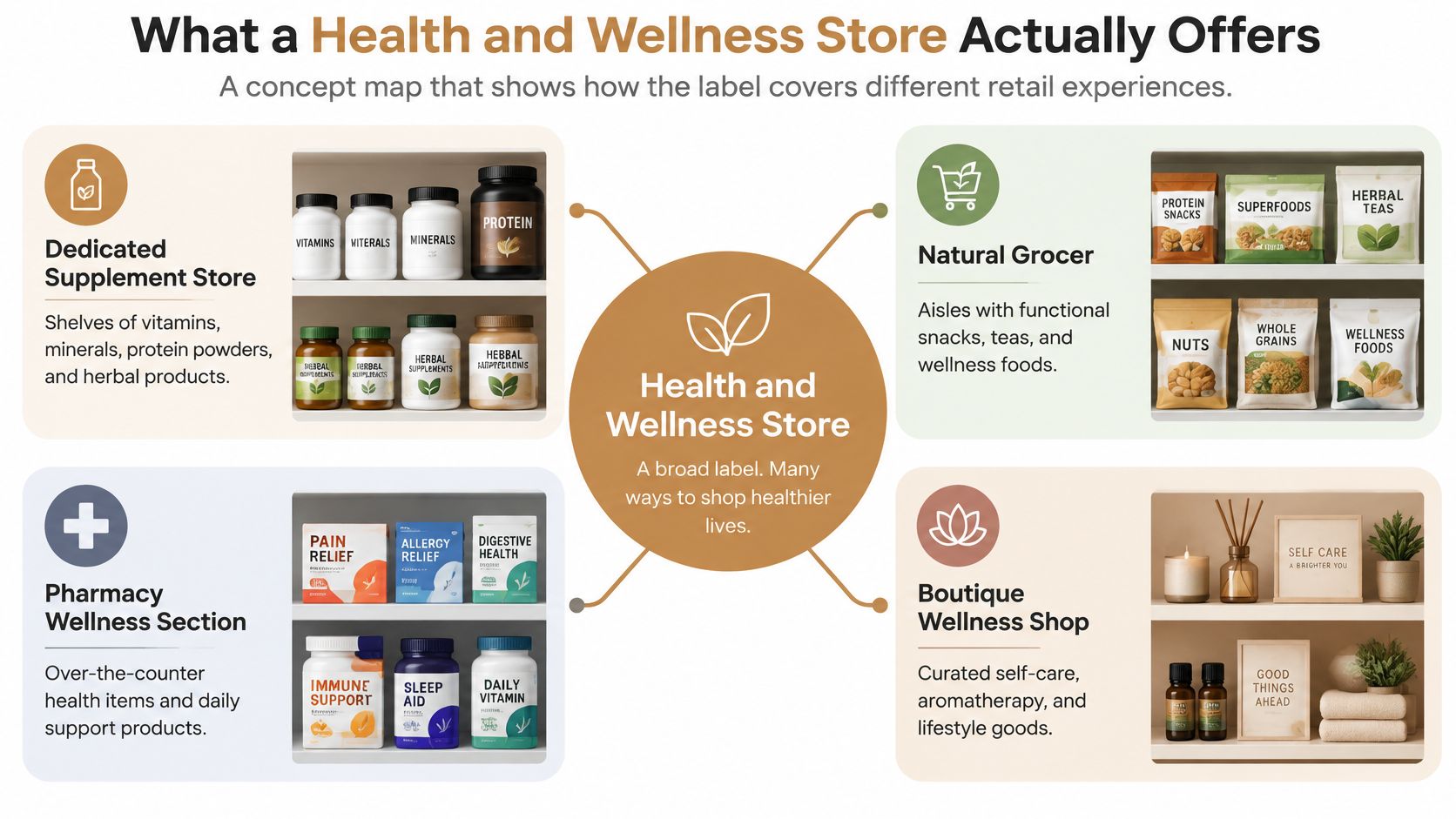
The phrase covers at least four different kinds of shopping experience. Knowing which type you're entering helps you set realistic expectations about product range, staff knowledge, privacy, and price comparison. It also prevents a common mistake: assuming every retailer with wellness in its name sells the same products or provides the same guidance.
The Four Common Store Types
- Dedicated supplement stores: These focus on vitamins, minerals, herbal products, protein powders, and targeted formulas. You'll usually find the broadest supplement selection here, although staff expertise can vary and advice may lean toward selling a particular brand or bundle.
- Natural food stores with wellness aisles: These combine groceries with teas, functional snacks, personal care items, and a smaller supplement section. They're convenient if you're already food shopping, but a specific gummy or botanical formula may not be part of their limited range.
- Pharmacy wellness sections: These place daily support products near over the counter health items and prescription services. Their strongest advantage is access to a pharmacist who can review potential interactions, especially if you take prescription medicines or use several supplements.
- Specialty boutiques: These curate self care, aromatherapy, lifestyle goods, and sometimes women's or sensual wellness products. The range is narrower, but the setting may feel calmer and suit shoppers who want a less clinical conversation.
None of these formats is automatically best. Your choice depends on whether you prioritize range, professional medicine advice, routine convenience, or a private and carefully curated experience. For sensitive purchases, atmosphere and staff conduct can matter as much as shelf size.
Supplement shopping itself is already mainstream. In the United States, 52% of adults reported taking at least one dietary supplement in 2011 to 2012, while almost 18% used natural products other than vitamins and minerals in the 2012 survey data summarized alongside the federal supplement framework. The Dietary Supplement Health and Education Act was approved on October 25, 1994, creating a dedicated federal statutory framework for these products. That history explains why supplements sit in ordinary retail aisles rather than only in clinics. It also means you should expect to do some label reading yourself, because being sold in a familiar store doesn't answer every question about evidence, suitability, or interactions.
Think of the store type as your first sorting tool. Once you know what kind of retailer you're considering, you can search with a clearer purpose instead of chasing every pin on the map.
How to Find Local Wellness Stores and Check Stock
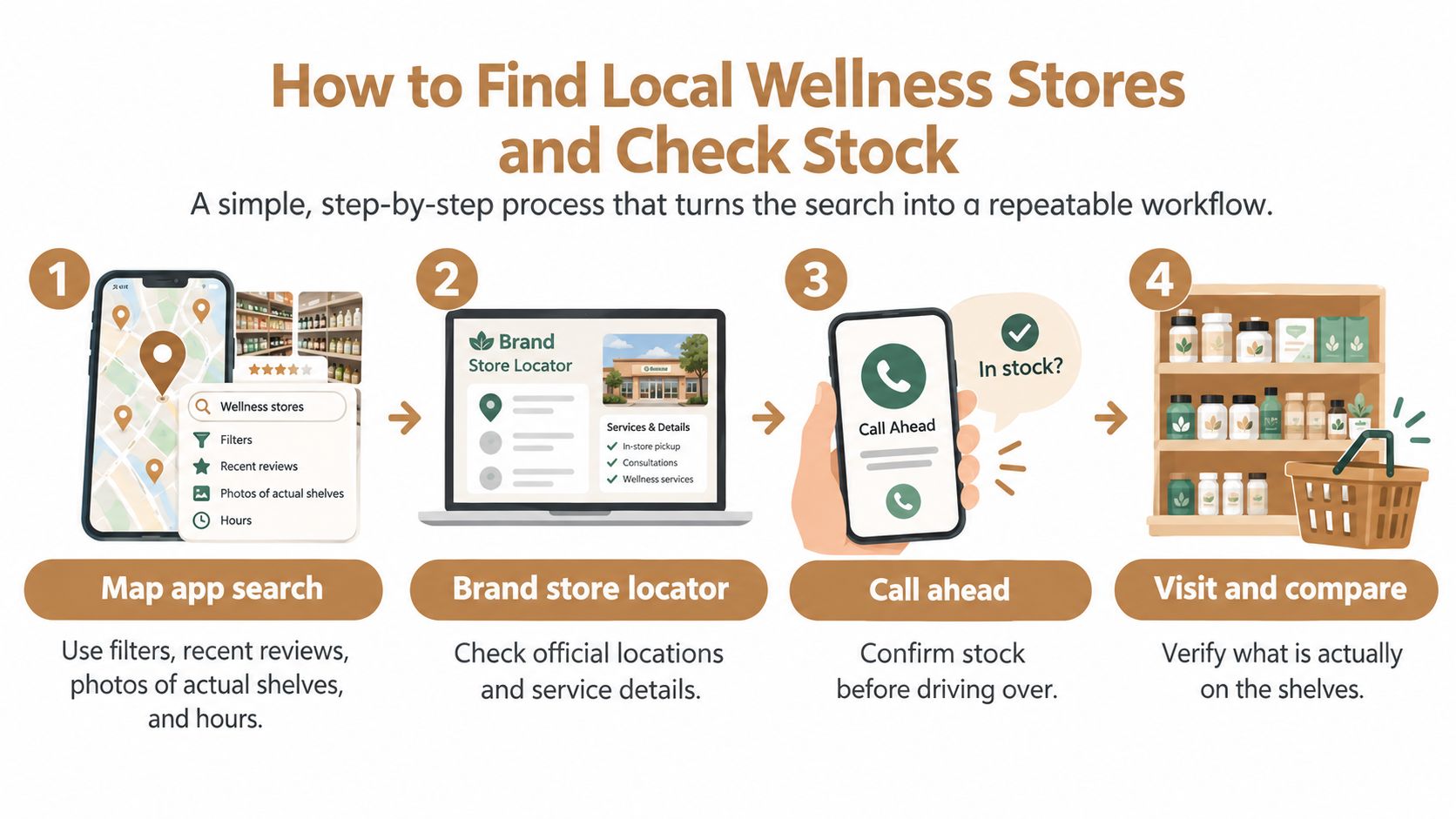
A reliable search has a sequence. Start broad, narrow the list with evidence from the listing, verify the exact item through the brand or retailer, and confirm by phone before you travel. That order saves you from the most common wasted trip: finding a well reviewed store that doesn't stock the product you came for.
Step One and Two
Begin in your maps app, but look past the star rating. Check whether reviews are recent, whether shoppers mention the supplement department specifically, and whether uploaded photos show real shelves rather than only a storefront. Confirm opening hours and look for practical details such as parking, step free access, consultation services, or a pharmacy counter. A listing that names brands carried is more useful than one that promises a huge selection without detail.
Next, use the brand's own store locator when you have a product in mind. We offer a store locator feature on our website for shoppers who want to check local retail availability before travelling. A locator is a stronger signal than a general search result because it connects a named brand to a named retailer, but it still may not reflect today's shelf count. Stock moves, deliveries run late, and a location can carry a brand without carrying every product or flavor.
Step Three Is the Phone Call
Call the specific branch. It's the highest yield step because a staff member can look at the shelf, check the system, and sometimes place the item behind the counter under your name.
Use a short script so you don't forget the details:
- Name the exact product: Give the full product name and format, such as gummies, capsules, powder, or pack size.
- Ask about this branch: Say you're checking stock at that location today, not asking whether the chain carries it somewhere.
- Request a hold: Ask whether staff can set one aside and ask how long they'll keep it.
- Confirm the basics: Check closing time, price, and where in the store you'll find it.
Here's wording you can copy: "Hi, I'm looking for [full product name]. Do you have it in stock at your store today, and could you set one aside for me to collect this afternoon?" If the answer is vague, ask the person to check the shelf or inventory system. If it's unavailable, ask whether another nearby branch has it or whether an order can be transferred.
A useful stock check names a specific product, a specific branch, and a specific time window. "We carry wellness items" isn't confirmation.
When you arrive, compare the item in your hand with the product name you asked about. Similar packaging, different pack sizes, and related formulas sit close together on crowded shelves. A thirty second check prevents an avoidable return trip.
How to Vet Supplement Quality on the Shelf
Finding the store doesn't finish the job. Once you're standing in the aisle, the label becomes your main source of information. Read it slowly, because attractive front panel language can hide missing doses, unnamed blends, weak contact details, or claims that sound more certain than the evidence behind them.
Your Shelf Side Checklist
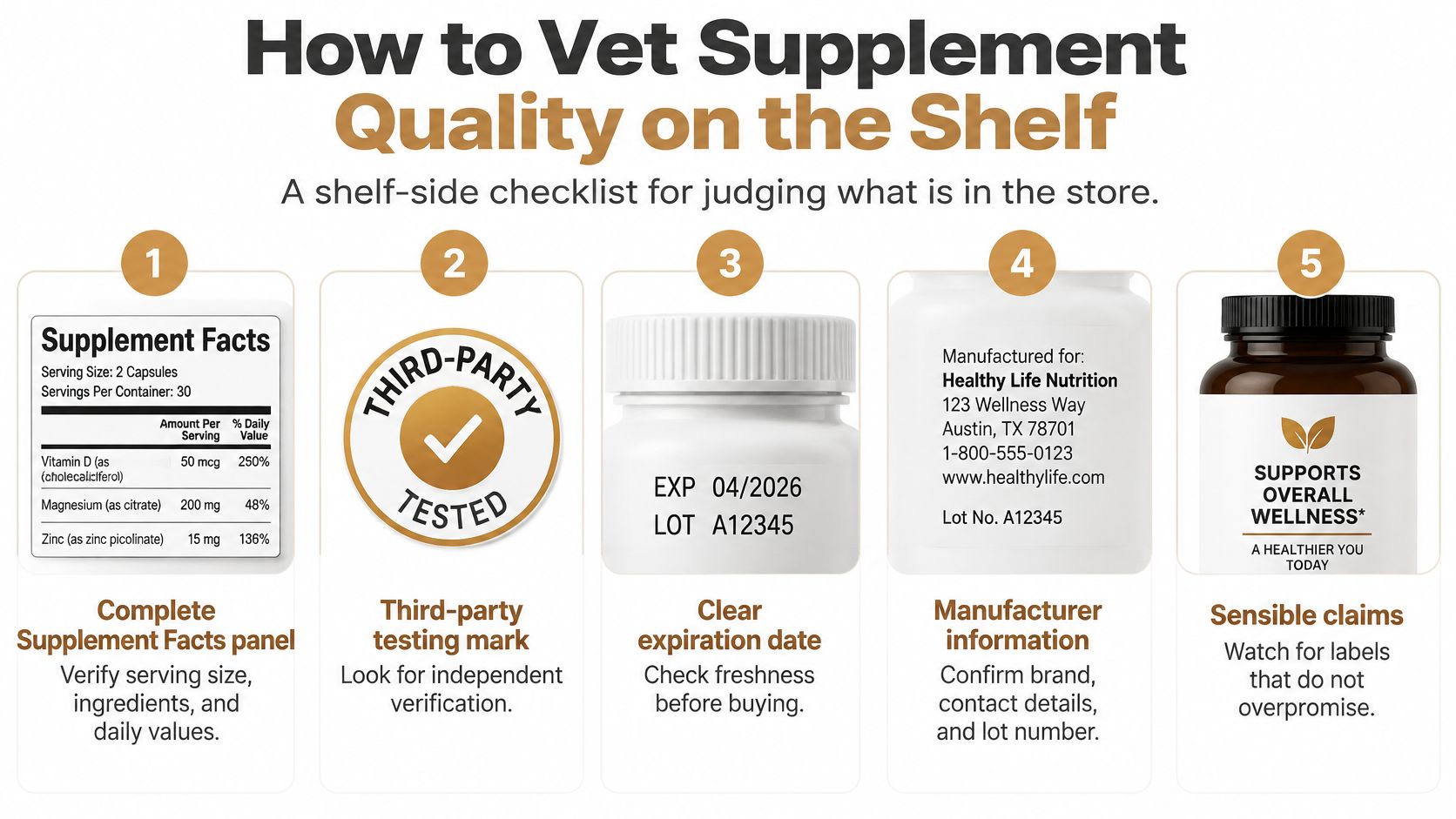
- Complete Supplement Facts panel: Look for serving size, servings per container, ingredient names, and amounts. The U.S. consumer guidance summarized by the Office of Dietary Supplements' need to know fact sheet emphasizes complete label information and manufacturer accountability. If the panel is missing or hard to read, put the product back.
- Explicit active ingredient quantities: Check whether each key ingredient has its own amount. A proprietary blend with only a combined total makes it harder to compare products or discuss the formula with a clinician.
- Manufacturer and batch details: Confirm there's a company name, a way to contact the manufacturer or distributor, and a lot or batch number. Check the expiration date and make sure seals and packaging are intact before you pay.
- Manufacturing controls: In the United States, supplement manufacturers must follow FDA Good Manufacturing Practices intended to help ensure identity, purity, strength, and composition. Ask staff whether a certificate of analysis or independent testing information is available.
- Independent certification: A recognized quality seal can indicate that a product was manufactured appropriately, matches its label, and avoids harmful contaminant levels. It does not prove that the product works for a particular health outcome or guarantee that it's suitable for everyone.
A concrete example helps. Each Eve's Eden Femme Fresa Fatale gummy contains 200mg of botanical ingredients formulated to support energy, mood, and confidence, and our products are manufactured in the United States in GMP certified facilities. That gives you two checkable points: a stated amount per gummy and a manufacturing standard. You should still read the full label for the complete ingredient list, directions, warnings, and the other details on the checklist.
Questions for Staff
Ask direct questions and notice whether the answers stay factual. Can you show me the ingredient amounts? Is independent testing information available? Who manufactured this, and how would I report a problem? What does the store do if a product is recalled or past its date?
If you take prescription medicines, use several supplements, are pregnant or nursing, or manage a medical condition, don't rely on a sales conversation alone. Ask a pharmacist or your clinician to review potential interactions and whether daily use makes sense for you. A good retailer won't pressure you to skip that step.
Why Nearby Does Not Always Mean Trustworthy
A stocked shelf can create a false sense of security. It's easy to assume that someone has verified safety and effectiveness before a product reaches a respected local store. That's not how you should evaluate supplements, and even trained clinicians can have gaps in this area.
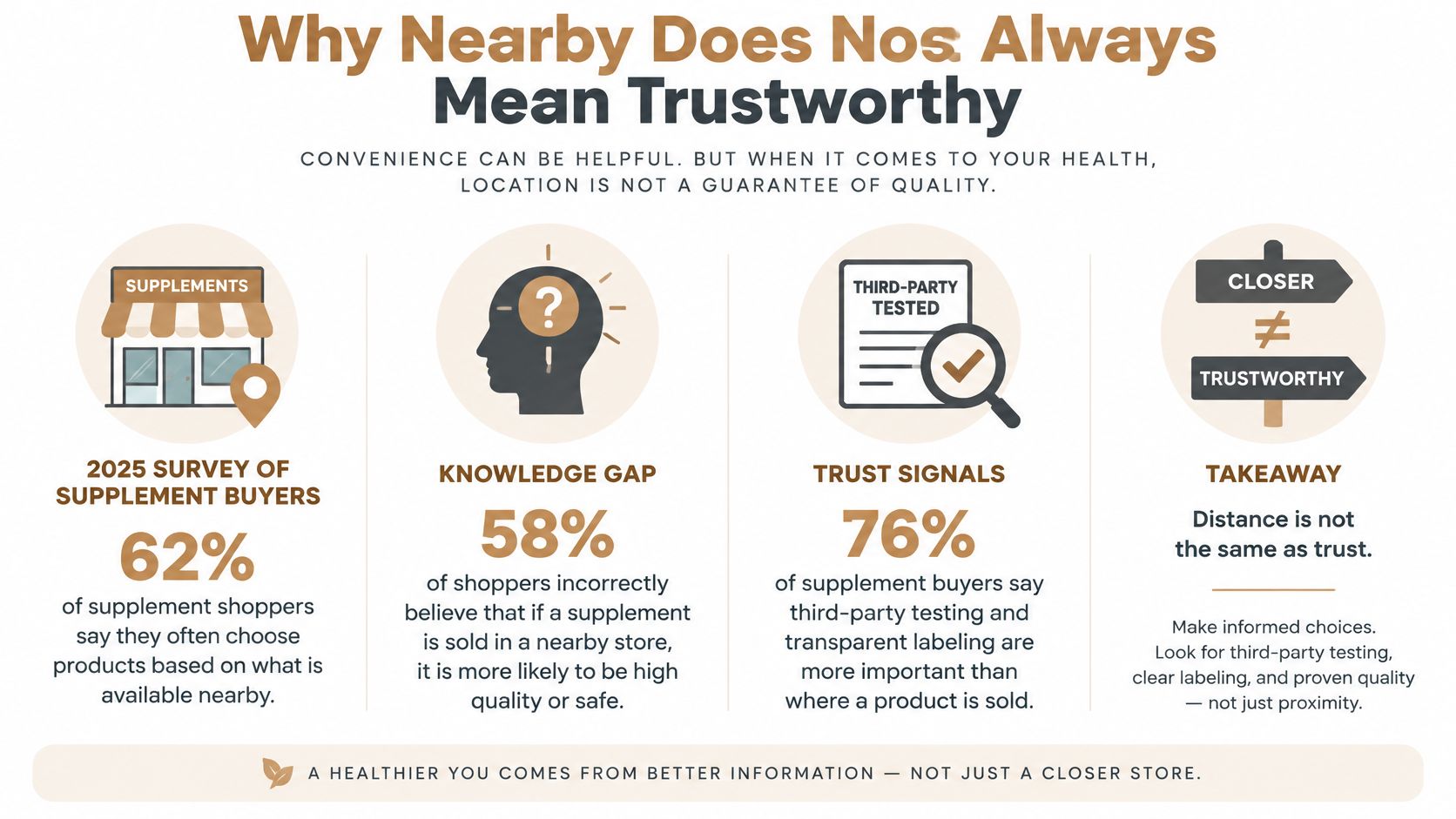
A 2025 survey of resident physicians published through Cureus found that 55% did not correctly know that dietary supplements generally do not require proof of efficacy and safety before marketing, 59% could not correctly identify how to report an adverse event, and only 7% knew about third party certification, while related consumer research found confidence rose from 38% to 68% when an independent certification mark was shown. Those figures don't mean every product is poor quality. They show why you shouldn't outsource all judgment to proximity, packaging, or a confident sales pitch.
Learn to Read Claims Carefully
Separate general well being language from disease treatment claims. A statement about supporting mood, vitality, confidence, or feminine well being is not the same as proof that a product treats a medical condition. The Federal Trade Commission's health products compliance guidance states that health related advertising for dietary supplements should be supported by competent and reliable scientific evidence from objective research conducted by qualified experts using professionally accepted methods.
That evidence needs to match what you're buying. Research on one ingredient doesn't automatically prove that a finished multi ingredient gummy works in the same way. The dose may differ, the combination may behave differently, and the people studied may not resemble you. Ask whether the research involved humans, whether it used the same ingredient and amount, and whether it measured the outcome mentioned on the package.
This is claim literacy, not cynicism. A transparent brand can describe intended support without presenting it as a guaranteed result. A trustworthy store can explain the limits of its knowledge and direct you to a pharmacist or clinician when your question becomes medical.
Be cautious when a label or salesperson avoids specifics but uses urgent language. If no one can identify ingredient amounts, testing, adverse event reporting, or who made the product, distance shouldn't rescue the purchase. Nearby is convenient. Trustworthy requires evidence you can inspect.
Getting Discreet Help With Sensitive Wellness Needs
Shopping for a multivitamin in a crowded aisle is straightforward. Asking a stranger about intimacy, confidence, vaginal comfort, or changes in desire is different. You may lower your voice, rush the question, or abandon the purchase because another customer is standing close enough to hear. That discomfort isn't a personal failure. It's a service design problem, and a good store plans for it.
The need for easier access is real. An Ipsos survey on women's preventive healthcare released in 2025 found that more than two in five women experienced at least one barrier to preventive care access during the previous year. Privacy also fails when there's no suitable physical space for a conversation, a related concern identified in the wider access research context. A local store can't replace preventive care, but it can remove avoidable barriers to a respectful product conversation.
What Supportive Service Looks Like
Look for a place where staff can step aside with you, speak at a normal but private volume, and answer without embarrassment or jokes. Product displays should let you read labels without announcing your interest to the whole aisle. Discreet bags, online ordering for pickup, self checkout, or plain packaging can help, depending on the retailer.
Language matters too. Staff should describe products as supporting general wellness where that's the intended role, not diagnose symptoms or promise treatment. If you mention pain, unusual discharge, bleeding, persistent low mood, medication concerns, pregnancy, or another symptom that needs assessment, the right response is a clear suggestion to contact a clinician. Staff who recognize that boundary protect you better than staff who try to answer everything.
Use three polite questions to test the environment before you share details:
- Privacy first: "Is there somewhere quieter where I can ask about a personal wellness product?"
- Discretion options: "Do you offer discreet packaging, self checkout, or pickup for this item?"
- Qualified referral: "If my question involves medication or symptoms, can a pharmacist help, or should I speak with my clinician?"
Pay attention to the response, not just the policy. If staff seem rushed, dismissive, or amused, you don't owe them the sale. Walk out and choose a store, pharmacy, or online channel where you can get clear information with dignity.
Choosing Where to Buy and Taking Your Next Step
A nearby store and an online checkout solve different problems. Buying locally lets you inspect the package, read the complete label, check the date, and leave with the product the same day. Ordering online gives you more privacy, account based reordering, and time to compare details without standing in an aisle. The better choice depends on what this particular purchase requires, so decide per order rather than by habit.
| Buying Option | Best For | What to Verify |
|---|---|---|
| Local store | Same day pickup, inspecting packaging, speaking with staff or a pharmacist | Exact branch stock, full Supplement Facts panel, expiration and lot details, intact seals, private help if needed |
| Online purchase | Discreet ordering, comparing information at home, avoiding a wasted trip | Full ingredient and direction details, manufacturer information, shipping terms, returns and contact routes, qualified advice for interactions |
Apply the same quality checks in both channels. Online convenience should not excuse missing ingredient amounts, vague claims, or absent contact information. Shelf availability should not excuse them either. If you order online, save the product page details and check the package that arrives against them. If you buy locally, keep the receipt and note the lot number in case you need to contact the manufacturer.
A Worked Example
Eve's Eden products are found in wellness stores, and our website offers a store locator so you can look for local availability before you travel. Femme Fresa Fatale, Women's Vitality and Wellness Gummies has a regular price of $24.99, which gives you a useful reference point. You can compare the shelf price at a nearby retailer with the direct online price, then weigh that against how soon you want the product and how private you want the purchase to be.
Start with whichever channel fits your immediate constraint. Choose local if you want the product today and the branch has confirmed stock. Choose online if privacy matters more, your nearest store does not carry it, or you want more time to read the details at home. Either way, confirm the exact product name and read the warnings before use. Femme Fresa Fatale gummies are for adult use only, and you should consult a healthcare professional first, especially if you are pregnant, nursing, have a medical condition, or take medication.
Your next step can be small and specific. Open the Eve's Eden store locator, identify one nearby retailer, and call that branch to ask whether Femme Fresa Fatale is on the shelf today. If it is not available, or you would rather shop privately, order the daily gummy directly through the online store instead.
We make sensual wellness supplements formulated for women's confidence, connection, and feminine vitality, with Femme Fresa Fatale designed as a daily gummy that fits into your routine. Use our store locator to check local availability or order privately online, and start by visiting Eve's Eden to review the product details and choose the option that feels right for you.
Produced via Outrank