Sexual Wellness Supplements: What the Evidence Shows
Sexual wellness supplements explained: what the evidence supports, hidden drug risks, medication interactions and a label checklist to run before you buy.
The global market for sexual health supplements was valued at USD 3.52 billion in 2023, according to a March 2024 ResearchAndMarkets report. That number covers an enormous range of products, from a jar of ground maca root to a capsule engineered to imitate a prescription drug without saying so on the label.
Buyers aren't naive for asking whether any of it works. The harder question is which of three different promises a given bottle is making, because the evidence, the risk and the right next step change depending on the answer.
Three questions settle most of the decision. Is the promise wellness positioning or a medical claim? Was the formula tested as sold, or is the label borrowing studies on individual ingredients? And does the label describe what's inside? Answer those sincerely and a bottle of sexual wellness supplements stops being a gamble and becomes an ordinary purchase decision.
What Sexual Wellness Supplements Claim to Do
In a November 2024 survey, 34% of women named pleasure enhancement as a concern and 32% named low libido, according to Nutrition Business Journal figures reported by New Hope Network. Demand is genuine and specific. What the category does with that demand is a different story.
Three claim families with three different standards
Nearly every product on the shelf borrows language from one of three families. Confidence and mood claims sit closest to ordinary wellness positioning, and they're the least tested at the level of a finished formula. Desire and libido claims edge toward a medical outcome. Arousal and performance claims borrow vocabulary from prescription medicine, which is exactly where the safety problems cluster.
The table below is the short version of what each family can promise and the signal that should end the conversation.
| Claim type | What the evidence supports | Realistic expectation | Red flag |
|---|---|---|---|
| Mood and confidence | Wellness positioning; few finished-product trials | Subtle daily support, not a clinical change | Promised fixed mood outcome |
| Libido and desire | Few well-designed placebo-controlled trials; one trial of 77 healthy women | Unproven for clinical use; judge over weeks, not days | Guaranteed increase in desire |
| Arousal or erection | Drug-class ingredients (PDE5 inhibitors) are prescription medicines | No equivalence to medicine | Claims matching prescription drug effects |
| Fast action | No credible support for rapid effects in finished products | No reliable same-day effect; judge over weeks | "Works in 30 minutes" promise |
| Natural or botanical label | Does not establish safety or efficacy | Ingredient quality still needs checking | Natural used as a substitute for testing |
Where to draw the line: a bottle that promises a calmer mood is selling a habit. A bottle that promises the effect of a prescription drug is making a claim it can only deliver through adulteration or through disappointment.
Regulators read fast-action marketing the same way. Consumer material from the FDA names "works in 30 minutes" claims as a warning sign for tainted sexual enhancement products (FDA material on tainted sexual enhancement products). A botanical extract doesn't act on that timeline. A drug does.
None of this makes the category worthless. A daily gummy can be optional support for someone who wants a small ritual around mood and self-care, and that's a legitimate reason to buy one. It's not a reason to expect it to repair desire, and it's certainly not a reason to accept a formula nobody has tested. The honest version of the promise is modest, and it holds up better than the inflated one.
Why Some Products Contain Hidden Drugs
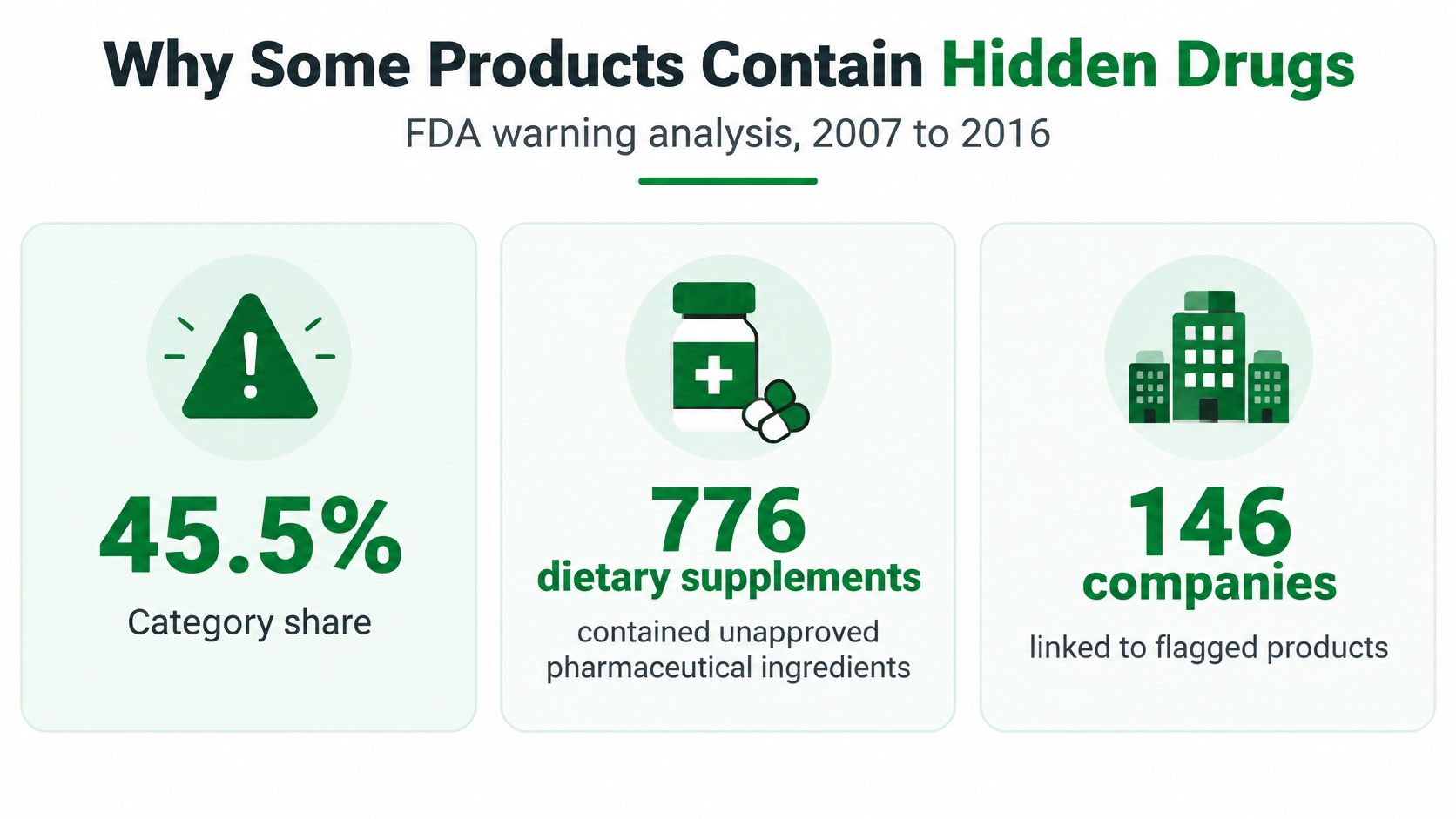
Sexual-enhancement products formed the largest category in a 2007 to 2016 analysis of FDA warnings, which identified 776 dietary supplements containing unapproved pharmaceutical ingredients tied to 146 companies. Sexual-enhancement products accounted for 353 of the 776, or 45.5%, ahead of weight-loss products at 317 (40.9%) and muscle-building products at 92 (11.9%).
That ranking is worth pausing on. The two categories promising the most visible physical change are also the two where a manufacturer has the strongest incentive to make something happen fast.
What the counts show about sildenafil
Undeclared drug findings in the FDA warning data, 2007 to 2016
| Finding | Count | Share |
|---|---|---|
| Sexual-enhancement products | 353 | 45.5% of 776 products |
| Weight-loss products | 317 | 40.9% of 776 products |
| Muscle-building products | 92 | 11.9% of 776 products |
| Other categories | 14 | 1.8% of 776 products |
| Sexual-enhancement products containing sildenafil | 166 | 47.0% of sexual-enhancement products |
| Sexual-enhancement products containing a sildenafil analogue | 134 | 38.0% of sexual-enhancement products |
| Sexual-enhancement products containing sildenafil or an analogue | 287 | 81.3% of sexual-enhancement products |
| All adulterated products with undeclared ingredients | 757 | 97.6% of 776 products |
| Products with more than one undeclared ingredient | 157 | 20.2% of 776 products |
The sildenafil rows explain the pattern. A product carrying the active ingredient of a prescription erectile drug isn't a botanical blend with an interesting side effect. It's an unapproved medicine in a supplement bottle, sold at a supplement price, with no dose control and no warning about what it will do to your blood pressure. The disclosure rows are just as important: almost nothing in this set listed everything it contained.
Think of the label as a menu. The kitchen can still send out dishes the menu never listed, and you won't find out until you taste something you didn't order.
The recall gap
Being named in a warning isn't the same as being pulled from sale. A JAMA analysis of the same FDA warning dataset counted 746 distinct adulterated products but documented voluntary recalls for only 360 of them, or 48%, leaving more than half without a documented voluntary recall at the time of the analysis.
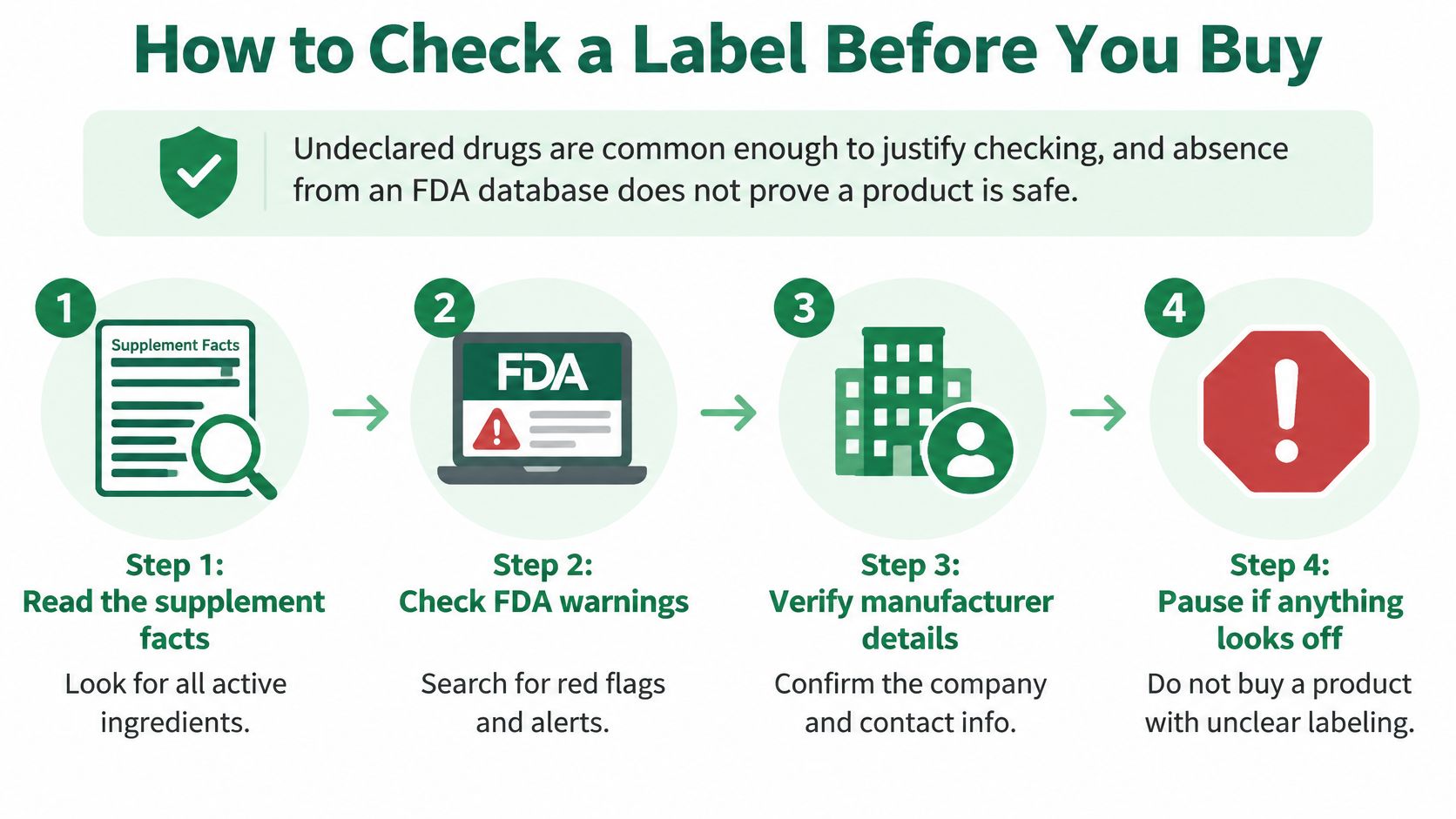
That gap matters for how you read a clean search result. A product with no warning against its name may be well made, or it may be untested and unnoticed. Absence of a flag is not evidence of purity, and no consumer should treat it as such.
What Ingredient Studies Can and Cannot Prove
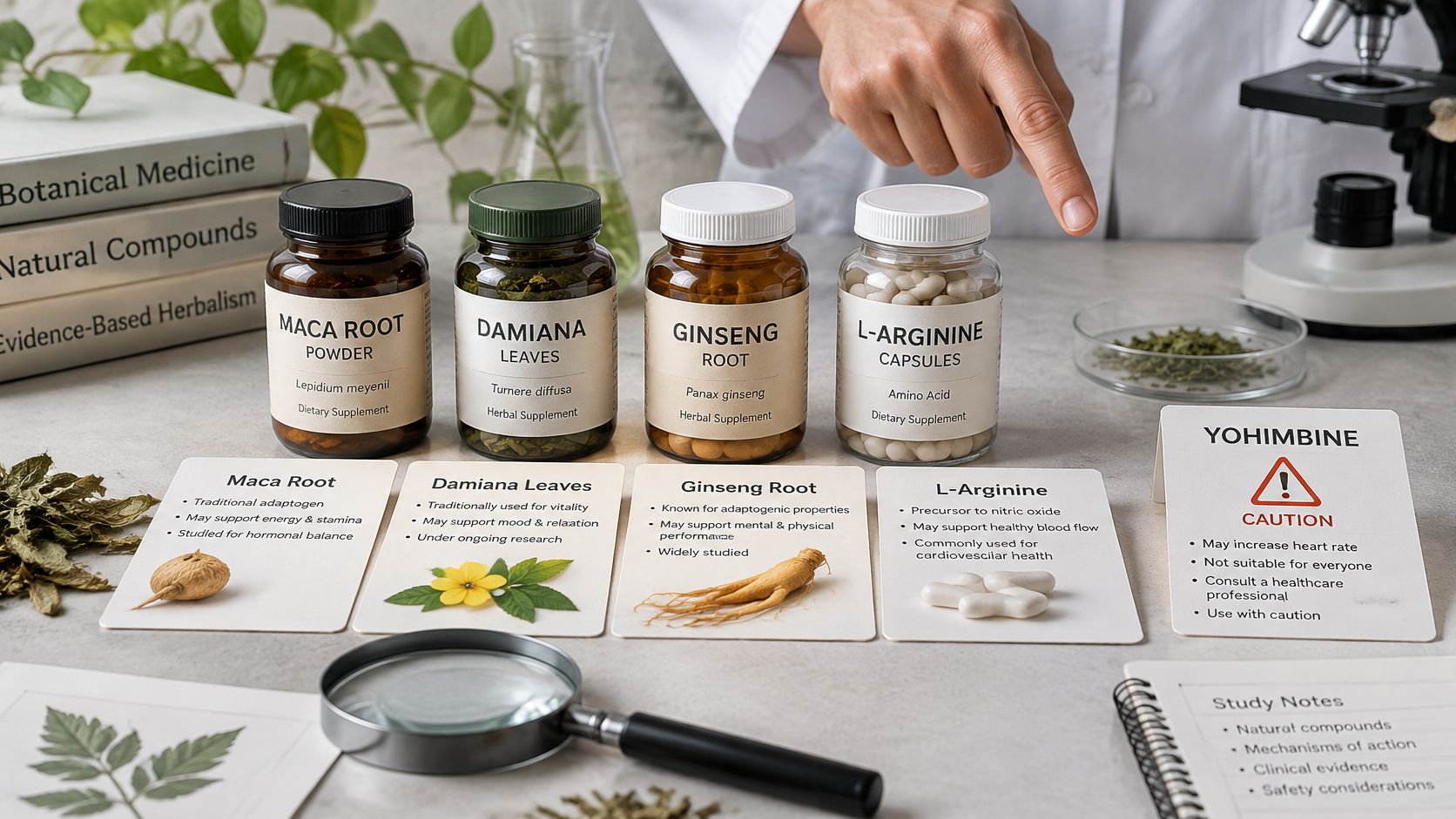
The ingredient names repeat across this category with almost no variation. Maca, damiana and ginseng anchor many botanical blends, L-arginine turns up in circulation-focused formulas, and yohimbine appears in stronger products despite being a potent compound that deserves more caution than a gummy label implies. Those are also the botanical ingredients that anchor most sensual wellness formulas, which makes them the right place to ask what the research measured.
Why a single-ingredient study doesn't travel
A systematic review of natural and complementary interventions for female sexual dysfunction found few well-designed, double-blind, placebo-controlled trials behind the claims. The strongest single result inside that review came from one randomized controlled trial of 77 healthy women, which reported greater improvement in sexual satisfaction than placebo.
That's a real finding, and it deserves to be reported as one. It's also one trial, in one population, and it can't be extended to every botanical blend, to a gummy format, or to women with a clinically diagnosed sexual function problem. Testing one spice on its own tells you very little about how the finished dish tastes.
A five-question evidence check
Run any product through these before you credit its claims.
- Was the finished formula tested? Not the ingredients in isolation, the product as sold, at the dose in the bottle.
- Was the population defined? Healthy women, postmenopausal women and women with a diagnosis are different groups with different baselines.
- Were the outcomes validated? Desire, arousal, lubrication, orgasm, satisfaction and distress are the standard set. A vague "improved well-being" score isn't.
- Was there a placebo group? Without one, expectation explains most of the change.
- Does the tested dose match the label dose? A trial on a concentrated extract says nothing about a gummy carrying a token amount of the same plant.
Reviews of this category repeatedly run into the same limits: small samples, short follow-up, formulations that differ from product to product, and outcome measures that don't line up between studies. Those limits make dose equivalence and efficacy extrapolation unreliable, which is why a claim about mood or confidence belongs in wellness positioning unless the exact ingredients, at the exact doses, in the finished product have been tested.
Medication Interactions and Who Should Avoid Them
The interaction that matters most is also the easiest to overlook. Undeclared ingredients can interact dangerously with prescription medicines, and nitrates are the classic example, because the drug class most often found in tainted sexual-enhancement products can drop blood pressure sharply when combined with them. The exposure isn't limited to obscure websites either; FDA records of tainted dietary supplements show the risk reaching retail settings.
Who should not start a supplement without review
| Situation | Main risk | What to do first |
|---|---|---|
| Nitrate medicines (nitroglycerin, isosorbide) | Dangerous drop in blood pressure with PDE5 inhibitors | Do not combine; ask a clinician before any use |
| Blood pressure medicines or alpha blockers | Additive low blood pressure | Clinician or pharmacist review first |
| Blood thinners | Possible interactions with botanicals or undeclared drugs | Review with the prescriber before starting |
| Pregnancy or breastfeeding | Limited safety data for most botanicals | Avoid unless a clinician approves |
| Diagnosed chronic condition (heart, liver, kidney, diabetes) | Unclear dose and ingredient effects | Clinician review before starting |
| Under 18 | Products are intended for adults | Do not use |
Signs to stop and get care
Some reactions don't wait for a review date. Stop the product and seek care for dizziness or fainting, chest pain, palpitations, a rash or swelling, or an erection lasting more than four hours, which is a medical emergency rather than a side effect to monitor.
The label is a clinical document. Photograph the supplement facts panel and bring it to every appointment, including the ones that have nothing to do with libido.
Two habits prevent most of these problems. Bring the full label, not the product name, to any clinician or pharmacist reviewing your medications, because they need the ingredients and amounts. And read every bottle on your shelf together rather than one at a time, since stacking is where accidental duplication happens; if you also take a mood support supplement that works on serotonin, the combined effect is a question for a pharmacist, not a label.
When Symptoms Need a Clinician, Not a Gummy
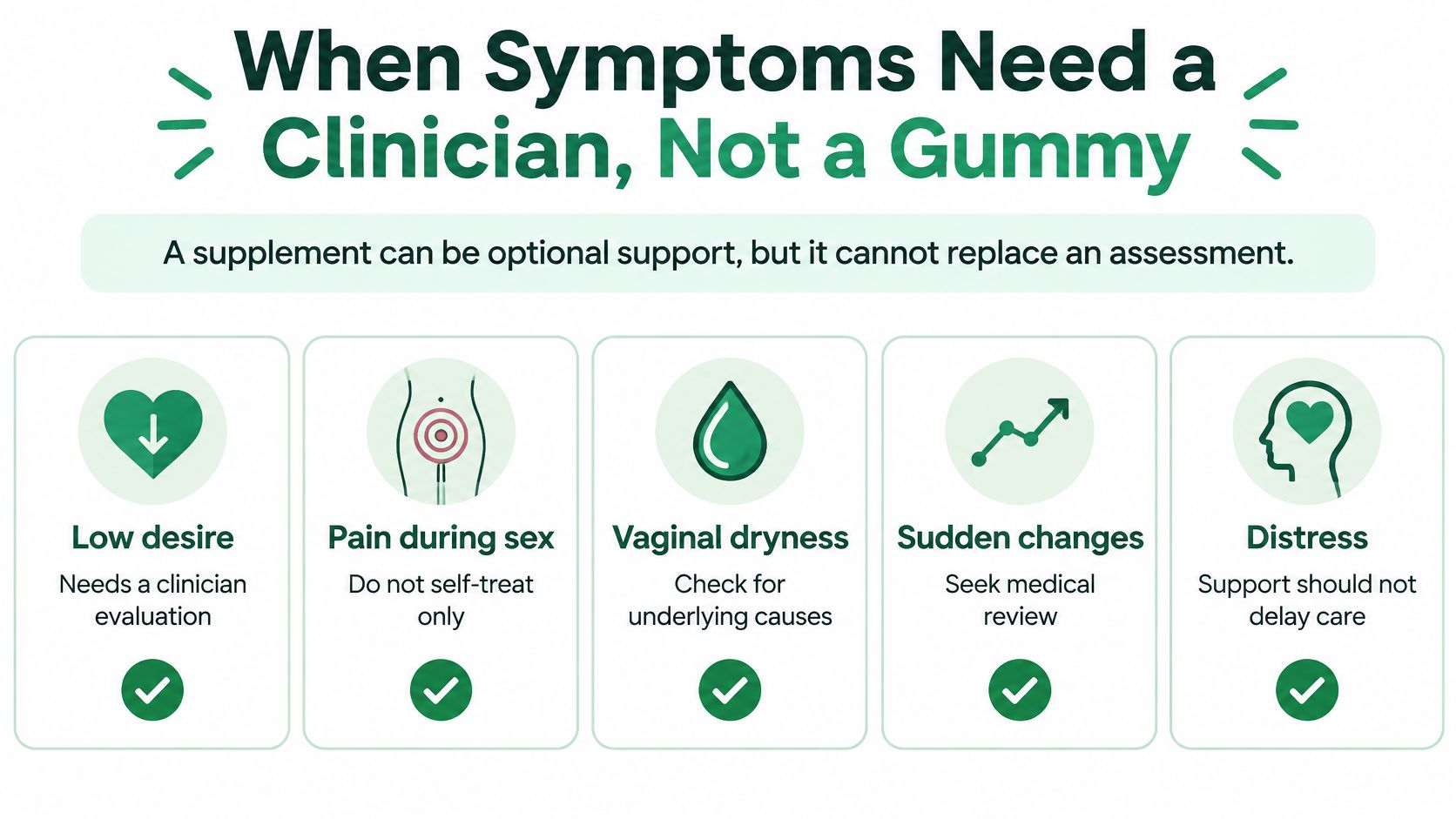
A supplement can be optional daily support. It can't stand in for an assessment, and the cost of confusing the two is measured in months spent adjusting the wrong variable.
Low desire, pain during sex, vaginal dryness, sudden changes, distress, and symptoms that begin after a medication change all point toward evaluation rather than a higher dose. A clinician will separate the contributors a label can't touch: psychological factors, hormonal shifts, medication effects, relationship context and underlying medical conditions. Each has a different response, and none of them is a botanical dose.
Set the review date before the first gummy
Pick a review date a few weeks out and decide in advance what would count as improvement. Track one symptom in a short daily note rather than five, because scattered tracking produces a vague impression instead of an answer. Stop at once if a side effect appears, and don't restart to test whether it was a coincidence.
Five questions before you continue
Walk through these, ideally in writing.
- Is the symptom persistent rather than a one-off bad week?
- Is it new, or has it been part of your life for years?
- Is it causing distress that affects your relationships or your mood?
- Did it begin around a medication change, including a new contraceptive?
- Does the product duplicate an ingredient you already take in something else?
A yes on any of the first four is a reason to book an appointment. A yes on the fifth is a reason to simplify the shelf.
If nothing has changed by your review date, treat that as the result. It's a reason to get assessed, not a reason to increase the dose and start the clock again.
How to Check a Label Before You Buy
Undeclared drug content is documented often enough in this category that a pre-purchase check is warranted, and the checks are unglamorous. They're also exactly what a competent manufacturer should already be doing: supplier qualification, identity testing by more than one method, a quantitative assay of every active ingredient, contaminant and heavy metal screening, microbial testing, stability studies through shelf life, and finished-batch verification by an independent laboratory (analysis of adulteration in sexual-enhancement supplements).
Seven checks, in order
Amounts, not blends. Look for exact milligrams per serving for every active ingredient. "Proprietary blend" hides the doses, and without doses neither you nor your clinician can assess cumulative exposure. The common mistake is reading a blend total as if it were a per-ingredient figure.
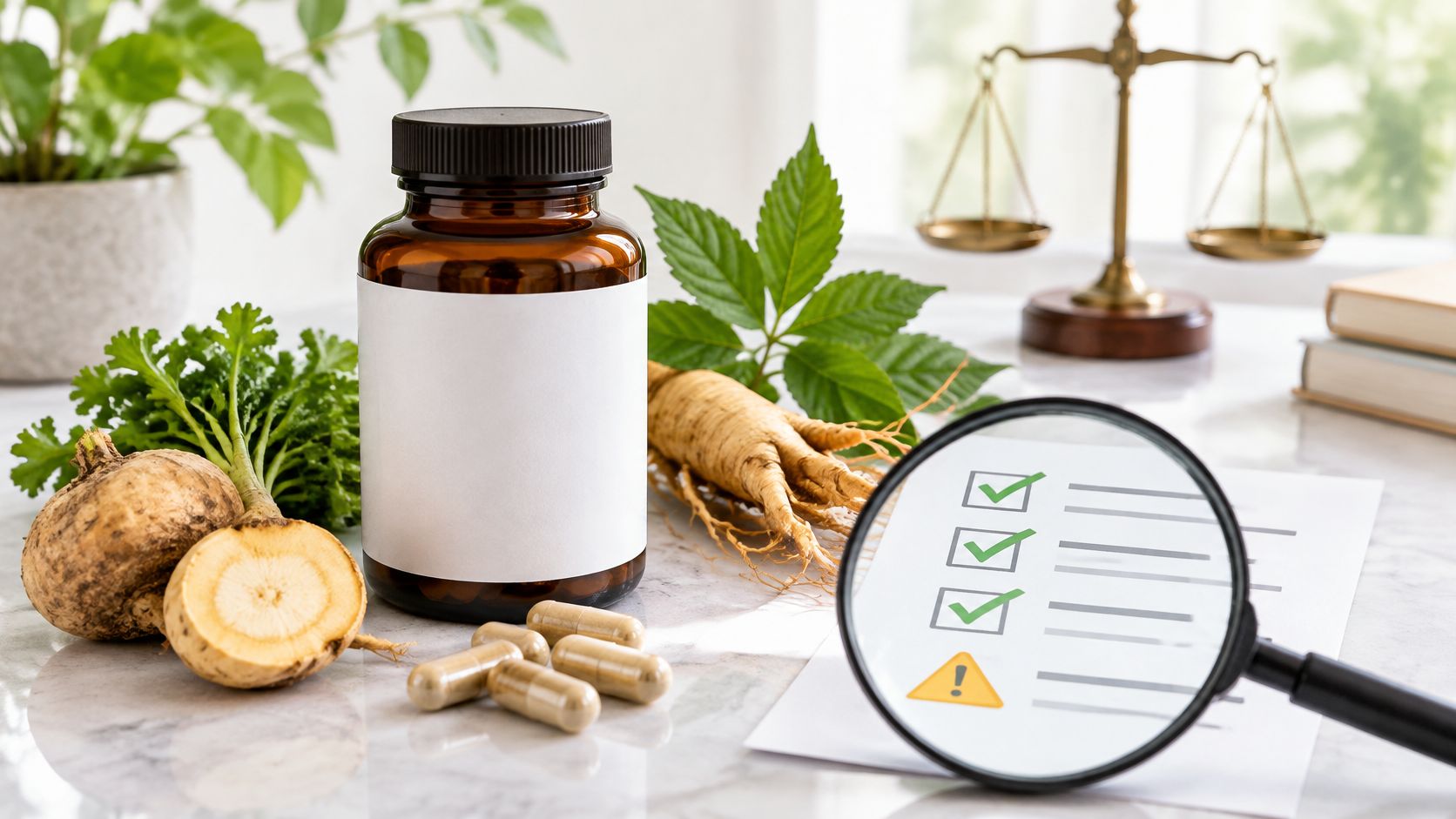
Botanical identity down to species and plant part. "Ginseng" on a label could mean Panax ginseng root or a leaf powder with a completely different profile. Standardized extracts with a named marker compound are easier to verify. Don't assume a familiar plant name proves a verified plant.
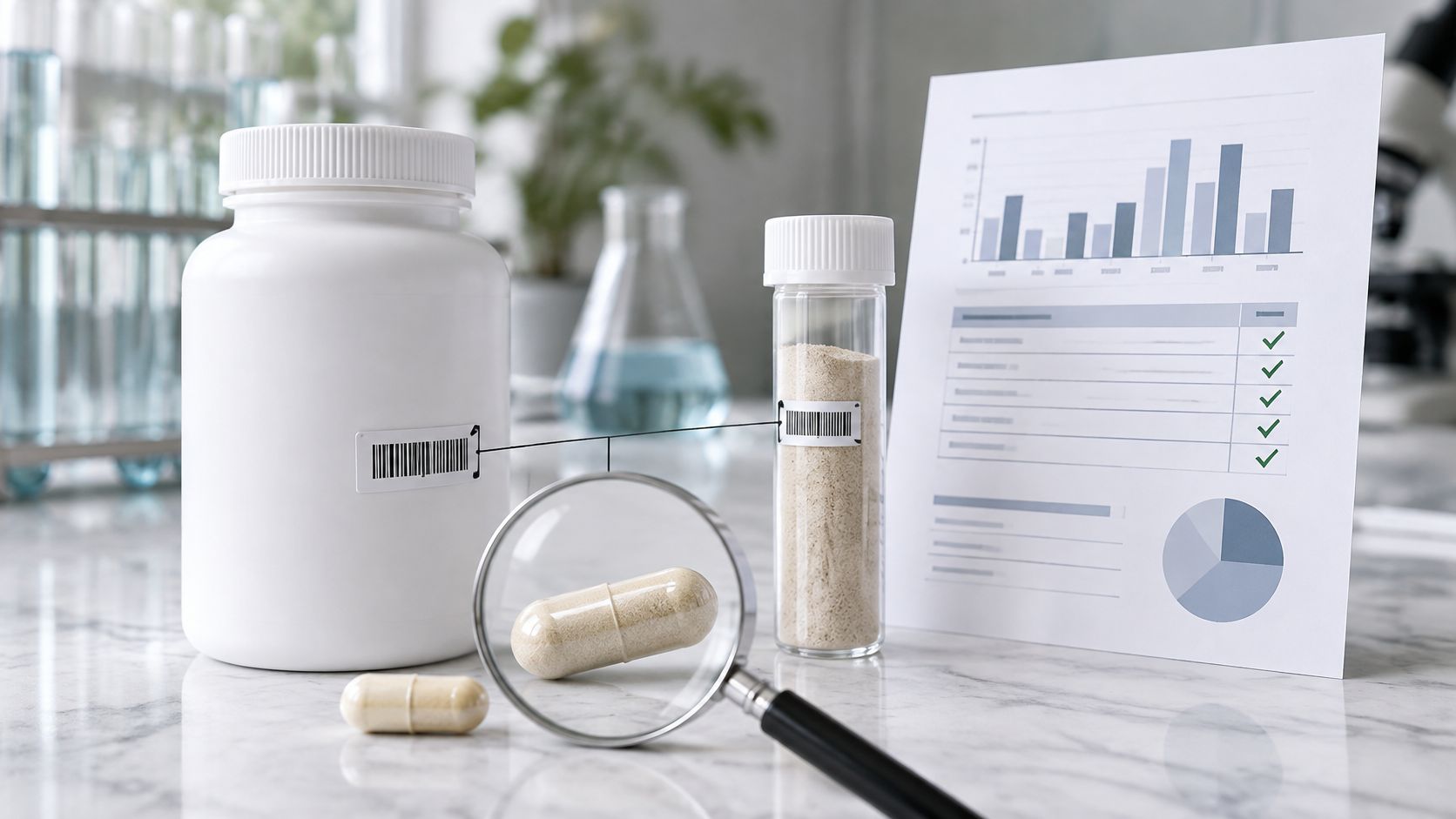
Independent testing of the finished batch, matched to your lot. Ask for the certificate of analysis and compare the lot number on the package with the one on the document. Third-party testing only counts when it's lot-specific, which is the distinction behind what third-party tested supplements actually certify.
Scope of the testing. Identity, assay, heavy metals, contaminants, microbes and stability through shelf life should all appear. A certificate reporting only "identity confirmed" tells you nothing about quantity or purity.
Manufacturer and history. Find out who makes it, to what facility standard, and whether the brand or product carries a recall or warning history. A polished website is not evidence of a well-run plant.
An adverse-event route. Look for a phone number or email where a reaction gets reported and tracked. If nobody collects that information, nobody learns from it, including the company.
A straight answer to a direct question. Email the brand and ask for the lot-matched certificate and the ingredient quantities. A company that can't produce them within a few days has answered a different question.
A complete, checkable label has four features: every active ingredient named with an amount, botanicals identified by species, a lot-matched certificate you can request, and a manufacturer willing to answer questions. When one of those is missing, you're being asked to trust the packaging rather than the product.
Decide Whether a Supplement Earns a Place in Your Routine
The rule is short. If the label passes every check above and nothing in your medication list or health history raises the risk, a daily botanical product is a low-stakes optional trial with a review date attached. If any check fails, skip it. Both outcomes are useful.
Eve's Eden's Femme Fresa Fatale is a reasonable case to run through the checklist because the brand puts specifics on the table. Each gummy contains 200mg of botanical ingredients formulated to support energy, mood and confidence, built around maca root, damiana and ginseng, and manufactured in the United States in GMP-certified facilities. The gummies are described as 100% natural, vegan and gluten-free.
Those are brand claims, and the checklist applies to them exactly as it applies to any other label. Ask for the lot-matched certificate of analysis, confirm the amount of each botanical rather than the blend total, and treat a 200mg blend figure as the total it is. It tells you how much botanical material is in each gummy, not how much maca, damiana or ginseng, and the split is the number a clinician would want.
Eve's Eden labels the product for adults 18 and over and advises consulting a healthcare professional before use, particularly during pregnancy or nursing, or when managing a medical condition or taking medication. That's the same instruction a pharmacist would give, and it's worth following carefully.
Your next steps are the same for any product. Write down every medication you take, including over-the-counter ones. Name the single symptom you want to track. Set a review date. Bring the label to your clinician. Stop if side effects appear.
Eve's Eden makes Femme Fresa Fatale, a daily strawberry-flavored gummy built around maca root, damiana and ginseng for women who want a deliberate ritual around mood and confidence rather than a prescription-strength promise. If the checklist above cleared for you, visit Eve's Eden to read the full label and make the call on your own terms. If it didn't clear, that's a useful answer too, and it belongs in a conversation with your clinician.