Third Party Tested Supplements: What Lab Testing Proves
Learn what third party tested supplements actually verify, how to read a certificate of analysis, and what lab testing cannot guarantee.
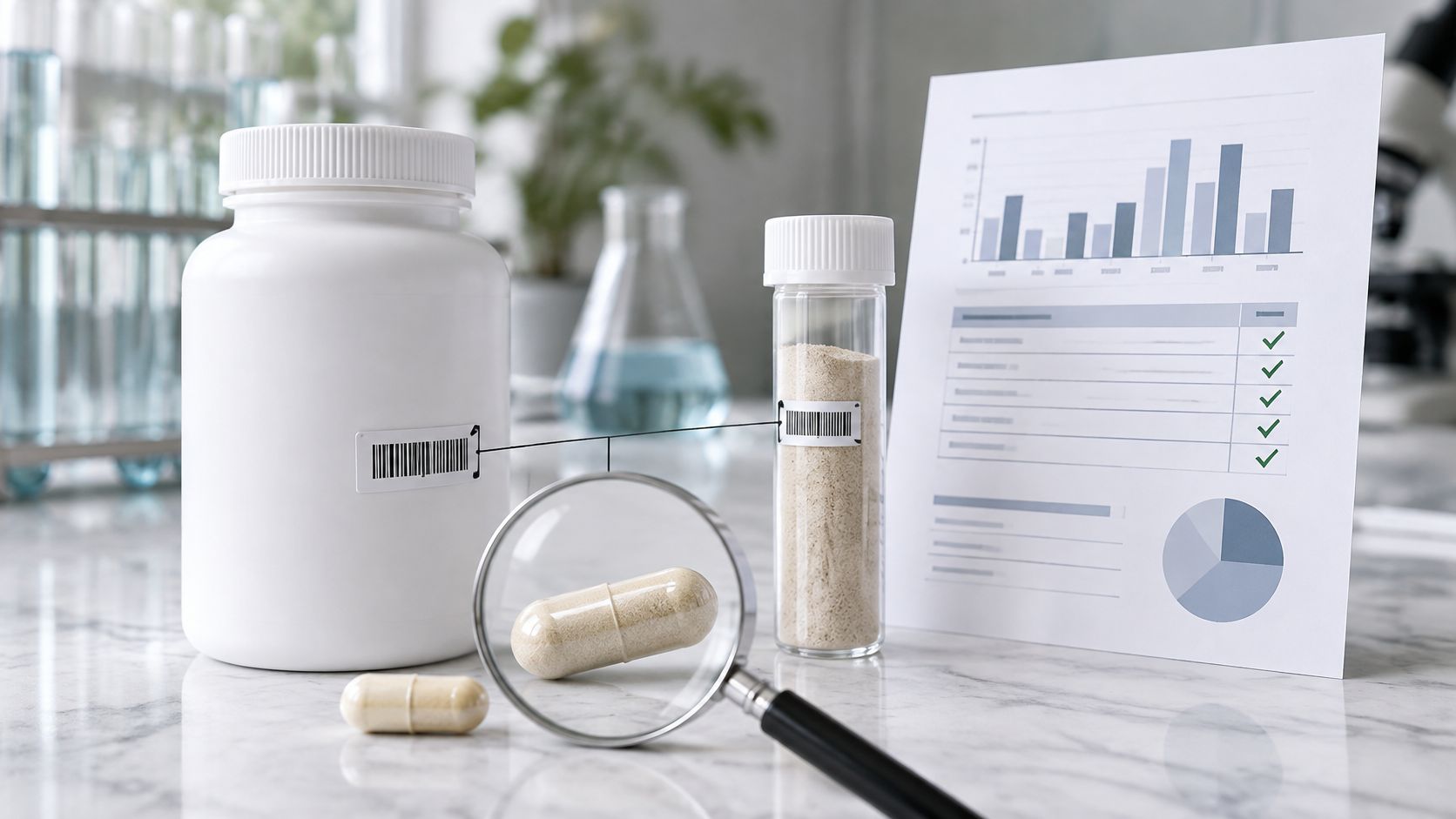
Search for advice on supplements and you'll meet the same instruction everywhere: buy only products that are third party tested. It sounds like a safety switch, either on or off. It isn't. The phrase describes a relationship, not a result. It means someone outside the brand ran a test at some point, and it tells you nothing about what was tested, which batch, what limit the result was compared against, or whether the report you're shown belongs to the bottle in your hand.
That's the advice worth replacing. Instead of hunting for a phrase or a seal, follow a chain of evidence: a named laboratory, a written specification, a specific lot number, and a document you can match to the product you're holding. When the chain is complete, you know something real. When any link is missing, you know the claim is unfinished.
What Independent Testing Checks in a Supplement
Think of a lab report the way you'd think of an inspection sticker on a single car, on a single day. The sticker says the brakes and lights passed when the inspector looked. It says nothing about the car that came off the line last Tuesday, and nothing about how either car will drive in five years. A report covers one sample, one batch, one set of limits.
What that sample gets compared against is a specification: a written list of what the product must be. USP guidance for its dietary supplement verification program describes a workable specification as covering identity, purity, strength, composition, performance and contaminant limits. USP also expects the analytical method itself to be validated, meaning it has shown accuracy, precision, specificity and reproducibility before anyone uses it for release testing. A number produced by an unvalidated method is a number, not a result.
Here's how the five areas stack up in a finished-product program.
| Test area | What the lab measures | What a pass confirms |
|---|---|---|
| Identity | Marker compounds or DNA-based identification of the declared ingredients | The named ingredient is present |
| Potency | Measured amount of the active or marker compound | The dose falls within the label's acceptance range |
| Contaminants | Heavy metals, pesticides, residual solvents, aflatoxins | Results sit below written limits |
| Microbial quality | Total counts and specified organisms | Counts meet the stated limit at the time of testing |
| Label accuracy | Full label panel compared with lab findings | Declared ingredients and amounts match the results |
Reading each line for what it actually says
Identity is a presence test. For a botanical, the lab usually looks for a marker compound the plant is known to contain, or uses DNA-based identification to confirm the species. A pass confirms the named ingredient is in the sample. It doesn't confirm the plant was grown, harvested or extracted the way a sourcing story describes.
Potency compares a measured amount with an acceptance range built around the label claim. A gummy labeled with 100 mg of an extract passes when the measured value falls inside that range. Gummies deserve extra attention here because ingredient distribution, moisture and potency can shift across shelf life.
Contaminants and microbial quality are limit tests. Heavy metals, pesticides, residual solvents and aflatoxins get compared with written thresholds, and microbial testing counts total organisms plus specified ones. Moisture and sugar in a gummy make that microbial line more relevant than it is for a dry capsule.
Label accuracy pulls the other four together: the full panel, ingredient by ingredient and amount by amount, against what the lab found.
The limit to hold onto: a pass confirms only the tests that were run, against the limits written for that batch, on that batch. Nothing beyond that.
Why Label Claims Alone Are Not Enough
The scale of the problem is the reason certificates exist. In 2025, about 800 of 3,000 tested samples of popular herbal supplements were reported as adulterated or mislabeled, according to Natural Medicines' summary of a recent report. That's a finding about finished products people could buy, not about obscure corners of the supply chain.
Botanicals make this harder than it looks. A plant varies by harvest, by supplier, by drying method and by extraction. A label written when the formula was designed can end up describing a powder that arrived from a different farm a year later.
Sort the statements on a product page and the confusion clears up. There are three kinds.
- Sourcing descriptions. "Carefully sourced," "premium botanicals" and similar phrases describe intent at the point of purchase. They're not measurements.
- Negative claims. "No harsh chemicals" and "all natural" say what a brand believes it left out. Without published criteria, there's nothing to check.
- Verification claims. "Third party tested" is the only one of the three that implies an outside check happened. Even this one is incomplete until it names what was measured, against what limit, on which batch.
Ask those three questions of any claim on any page: what was measured, against what limit, and on which batch. A line like "lab tested" answers none of them.
The failures aren't only about potency drifting. A 2018 analysis of FDA warnings covering 2007 to 2016 identified 776 dietary supplements containing unapproved pharmaceutical ingredients, per JAMA Network Open, most of them marketed for sexual enhancement, weight loss or muscle building. Brand statements can be sincere and still unverified, which is why they work better as starting points than as proof. How a company documents its sourcing, its testing and its results is the wider question that transparency in supplement branding tries to answer, and it's a question you can only settle with paper.
Evidence has to name the product, the batch and the specification. Anything less is marketing with a lab coat on.
Read the Certificate and Confirm the Lot Before You Buy
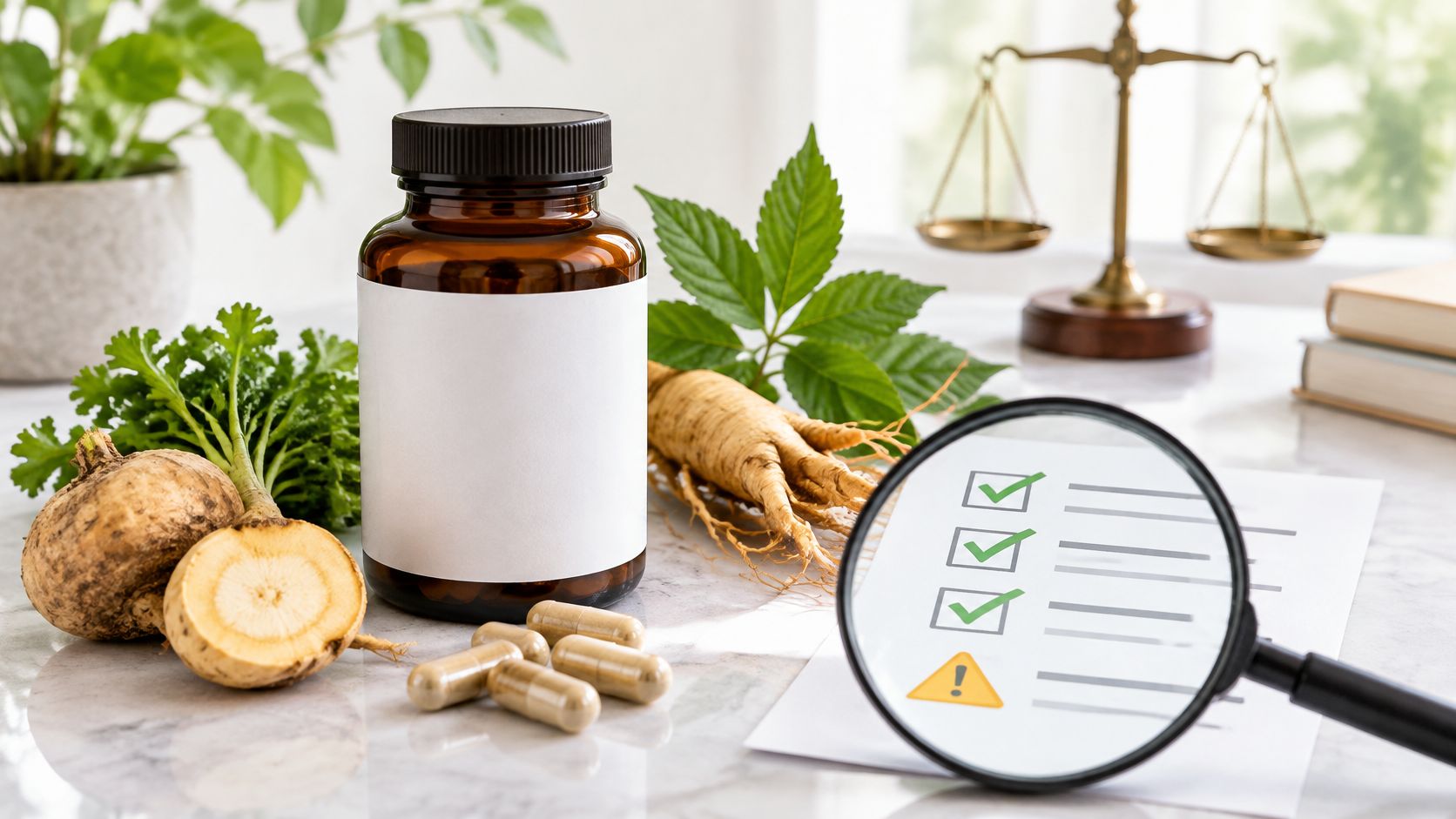
The document that carries the evidence is a certificate of analysis, usually shortened to COA. It should be available for a specific lot and specific tests, and you should be able to read it without a chemistry degree. Here's the short version of the checks before the detail.
The three moves that matter most are matching the lot, confirming the lab and reading the details. Everything else supports those.
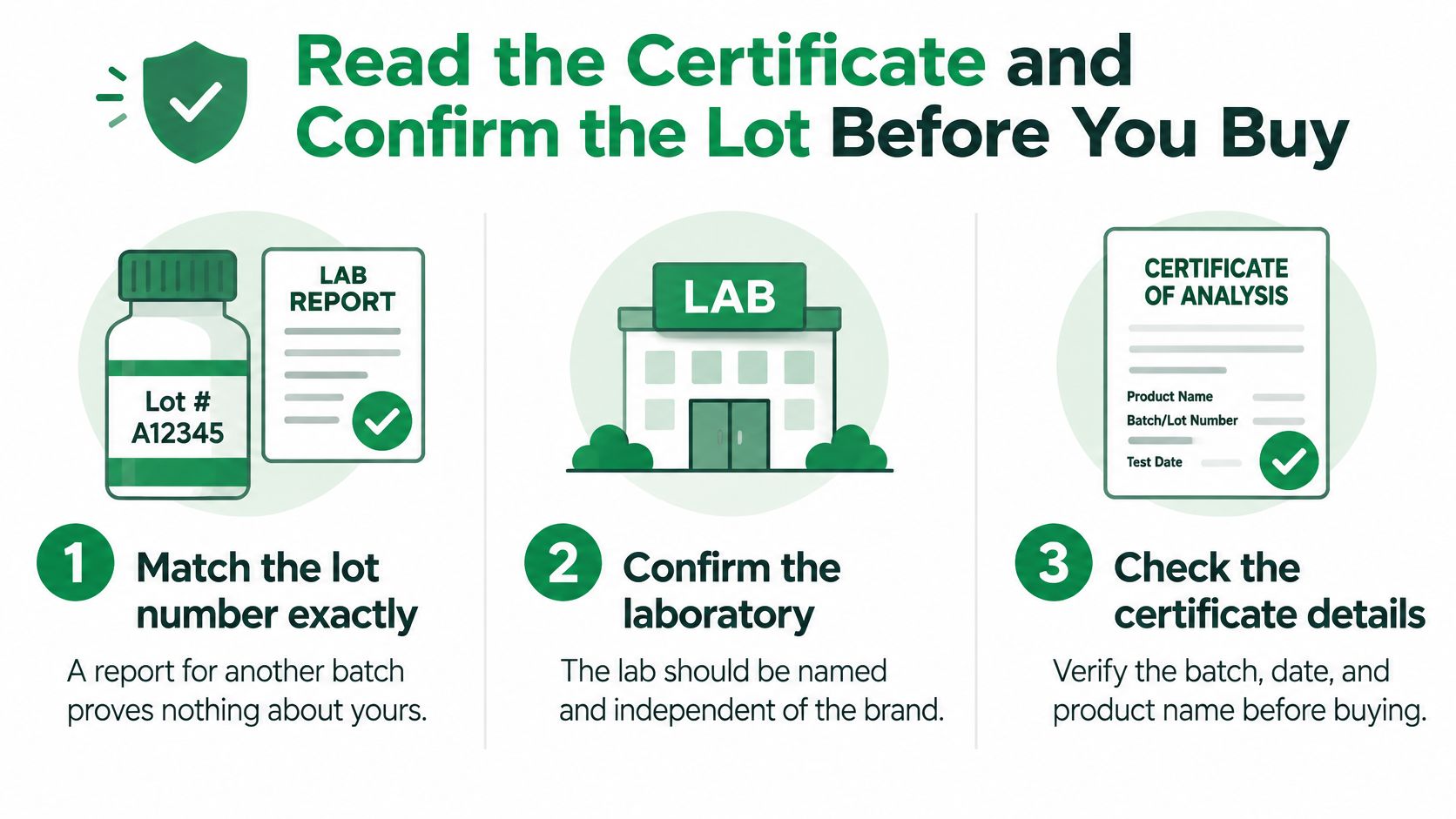
- Match the lot number exactly. The bottle or carton prints a batch or lot code. The report should carry the same characters. A report for a different batch tells you nothing about yours, even when the product name and label match perfectly.
- Confirm the laboratory is named and independent. The lab should be identified, unaffiliated with the manufacturer, and accredited for the tests listed, for example to ISO/IEC 17025. An unnamed "third-party lab" can't be checked by anyone, including the brand's own quality team.
- Check the date and the sample type. Look for when the testing happened, and confirm it covered the finished product rather than only the incoming raw materials. A raw-material certificate proves a powder was clean, not that the gummy came out right.
- Compare each analyte with its specification. Every line should show the analyte, the limit, the measured value and a pass or fail. A summary that says "passed" without numbers is a conclusion with the working removed.
- Check that methods are named. The analytical method behind each number should be identified and suitable for that analyte. Without it, a reviewer can't tell whether the result is meaningful or merely repeatable.
- Check the label panel and the retesting schedule. Ingredient list, amounts and ingredient form should match the label you're holding. Ask whether the product is retested after a formulation or supplier change, and whether that schedule is written down anywhere.
The buying rule: buy only when the lot-specific report matches the bottle, names an independent laboratory, shows measured values against limits and covers the finished product. If the lot number is missing, ask for the batch document. If none arrives, choose another product.
We have our gummies manufactured in the United States in GMP-certified facilities, which means batch records and specifications exist before any outside lab sees a sample. Testing sits on top of that paper trail. It doesn't replace it. Femme Fresa Fatale gummies are not intended to diagnose, treat, cure, or prevent any medical condition, and the product has not been evaluated or approved by the FDA.
If you're pregnant, nursing, managing a medical condition or taking medication, talk to a healthcare professional before adding any supplement, whatever its certificate says.
Certification Marks and What They Cover
Shoppers lean on marks because reading certificates is work. In 2025, 63% of surveyed supplement consumers said third-party certifications were very or moderately influential when buying, according to Nutrition Business Journal consumer research reported by New Hope Network. In 2024, 95% of surveyed consumers said they trusted claims made by independently certified supplements, per an NSF consumer report summarized by Food & Beverage Business Review.
Trust that high deserves a look at scope. A mark means a defined program checked specific things at a specific time. It never means the product works, and it never means the product is safe for every person who might take it.
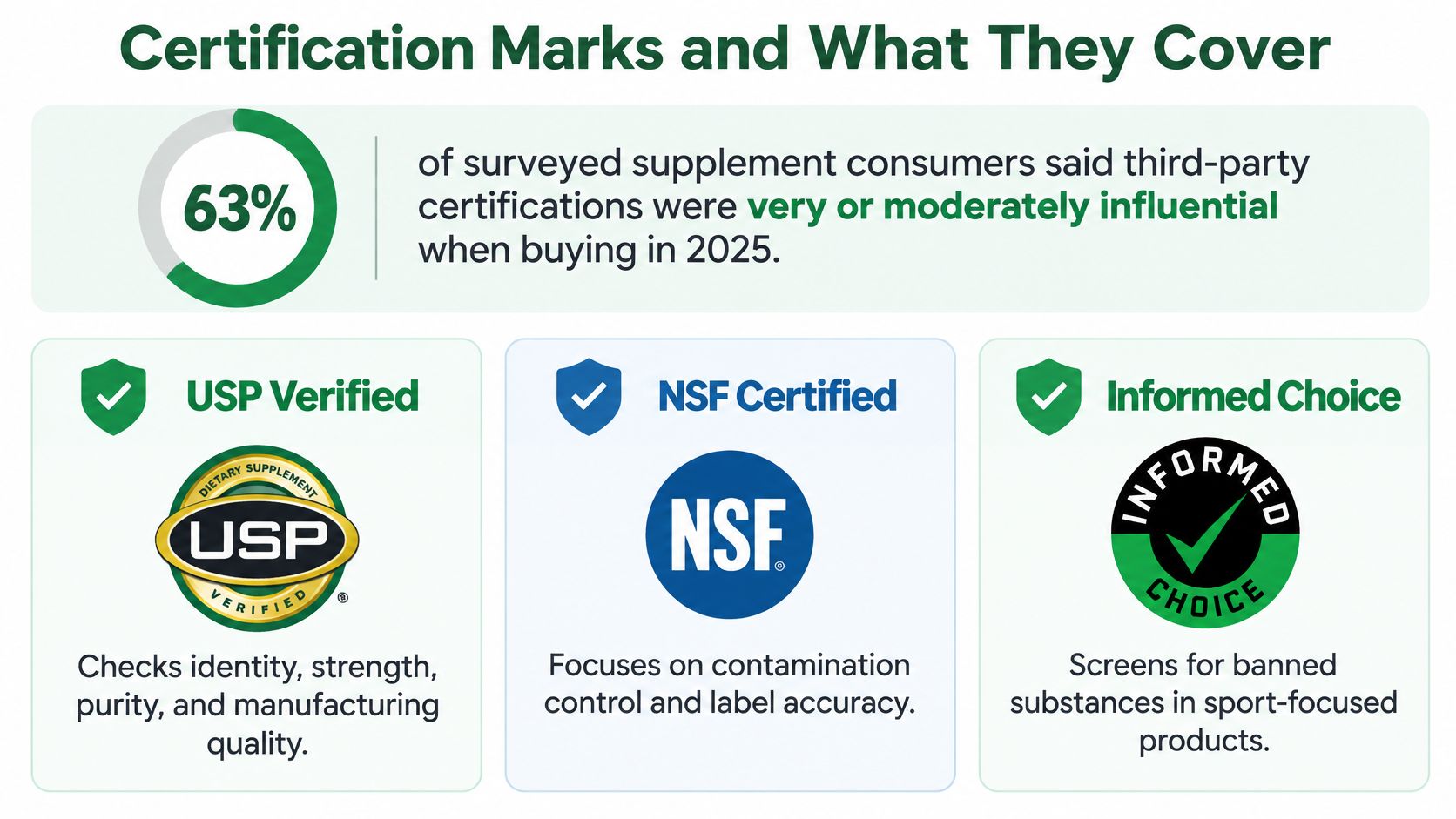
| Program type | What it audits or tests | What it does not prove |
|---|---|---|
| Finished-product label and contaminant program | Label accuracy, potency and specified contaminants in product samples | Clinical effectiveness or safety for every user |
| Sport banned-substance program | Screening for substances prohibited in competitive sport | Absence of ingredients outside its screening panel |
| GMP facility certification | Manufacturing site, procedures and records | That each batch was tested for potency or contaminants |
| Generic quality seal | Scope often unpublished | Any specific test result unless its scope is stated |
A mark sits on top of the manufacturing rules rather than in place of them. The FDA's consumer guidance on dietary supplements describes current good manufacturing practice rules that require manufacturers to set finished-batch specifications for identity, purity, strength, composition and contamination limits, and to verify conformance batch by batch or through a statistically sound sampling plan. Independent certification adds an external layer on top: facility audits, document review, sample testing and off-the-shelf checks. Useful, and still bounded. The same guidance notes, citing NIH, that quality seals do not guarantee safety or efficacy.
So find the program's published scope before you trust the mark. Most programs list the tests they run, the substances they screen for and a searchable list of certified products, which is how you confirm that the specific bottle in your hand is covered rather than the brand in general. Then match the mark to the claim it's being used to support. A purity mark doesn't back a mood claim, and a facility certificate doesn't back a potency number printed on one bottle.
Lot Numbers, Retesting and Online Purchases
A lab result is a snapshot of one batch. It's like tasting one pot of soup: the seasoning is right in that pot, and that tells you very little about the next one if someone changed the stock, the salt or the cook.
The chain runs from the bottle to the report, and from the report to the batch it describes.
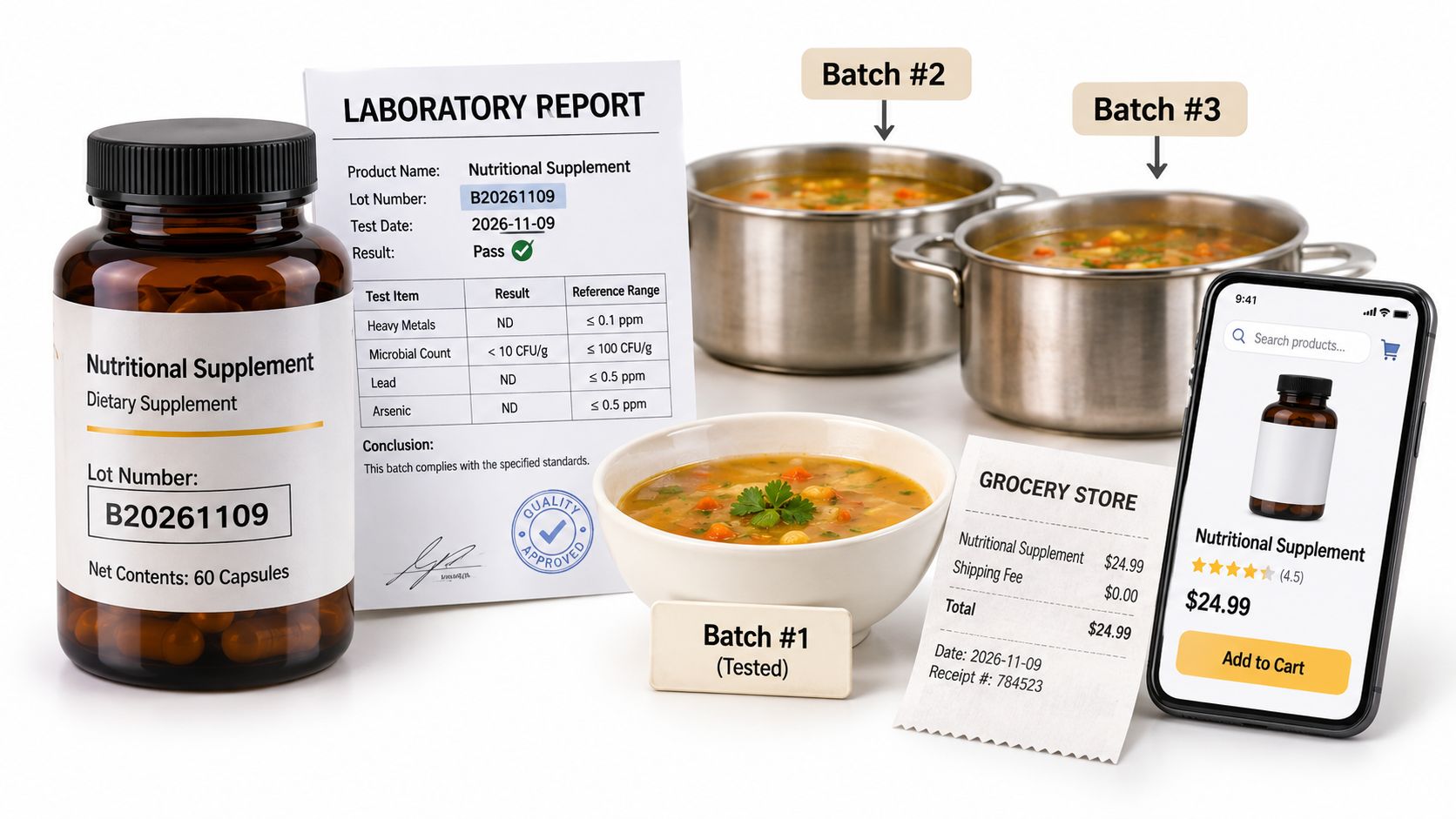
What changes between lots is unglamorous and constant. A new ingredient supplier. A tweak to the formula. A different warehouse temperature. A slow shipment through summer heat. Contamination introduced at the filling line rather than at the mixing tank. Multi-ingredient gummies carry more of this exposure than a single-ingredient capsule, because several botanicals with different stability curves share one piece of candy.
So ask about cadence, not just existence.
- How often is the product retested? One test at launch and nothing since is a fact about the launch, not about the box in your hand.
- Does retesting follow change? A new supplier or a reformulation should trigger fresh testing rather than a new label on old data.
- Is the lab independent and technically competent? Independent means no financial tie to the brand. Competent usually shows up as accreditation for the specific tests listed.
A certificate can be authentic and still narrow. Testing one ingredient instead of the finished product is narrow. Checking contaminants without verifying the labeled dose is narrow. A 2024 analysis of nearly 70 supplements sold through major online retailers reported that FDA testing found most contained active ingredients not listed on the label, according to VitaEvidence's review of what third-party testing can and cannot prove. Authentic paperwork and an accurate product aren't the same thing.
Online buying adds one more layer, because the listing you saved may ship from a different batch than the certificate it displays. The channel itself carries risk: in a 2025 check of 200 sports supplements purchased online, 35% contained substances prohibited under World Anti-Doping Agency rules, according to Sport Integrity Australia data cited by BSCG. Sports products aren't women's wellness gummies, but the mechanism is the same one worth watching. What arrives isn't always what the listing described. If you buy through online supplement stores, check the lot code when the parcel lands, not when you order.
Match the lot number on the box to the report. If the box carries no lot number, treat the test as unconfirmed, however polished the certificate looks.
That's the honest version of the phrase. Third party tested supplements aren't a category with a fixed safety level. The phrase is a link between a document and a specific product, and it holds only as long as you can trace it.
What Testing Cannot Guarantee
A lab test shows what's in a gummy and how much of it is there. It doesn't show what the gummy does in a person. Those are two different kinds of question, answered by two different kinds of study, and most confusion about supplement quality comes from blending them.
| Claim on the label | Can a lab test confirm it | Evidence to look for |
|---|---|---|
| Ingredient is present | Yes | Identity result for the named lot |
| Amount is within the labeled range | Yes | Potency result with acceptance limits |
| Contaminants are below limits | Yes | Contaminant results against written limits |
| Supports mood or confidence | No | Human outcome studies on the finished product |
| Clinically studied ingredient | Partly | A study using the same ingredient, form and dose |
| Natural or no harsh chemicals | Partly | Published criteria and supplier documentation |
A botanical can be pure, correctly identified and present at exactly the labeled amount, and still have no demonstrated effect at that dose. Purity and efficacy don't travel together by default. The phrase "clinically studied ingredient" deserves its own scrutiny, because a trial on one extract at one dose says little about a blend that includes that extract at a different dose, alongside other ingredients, in a gummy matrix.
"Natural" is definitional rather than measurable. A product can contain nothing but plant material and still be a poor choice for a particular person. Testing also doesn't establish suitability during pregnancy or nursing, interactions with medication, or how an ingredient behaves in someone with a specific medical condition. Those are clinical questions, and no certificate answers them. A pharmacist or physician does.
If you want to go one level deeper on format, whether gummy supplements are effective is a separate evidence question from whether a gummy is clean, and it's worth reading on its own terms.
A verified label tells you what's in the bottle. Evidence for what it does has to come from somewhere else, and no mark on a lid substitutes for it.
Reading labels closely is a habit worth applying to the products you take every day. Eve's Eden makes Femme Fresa Fatale, a strawberry-flavored daily gummy with 200 mg of botanical ingredients including maca root, damiana and ginseng, manufactured in the United States in GMP-certified facilities, with the formulation details set out on each product page. If you're building a wellness ritual around botanicals and want to know exactly what's in the bottle before it becomes part of your morning, start at Eve's Eden.