Online Supplement Stores: How to Assess Them
Learn how to assess online supplement stores from the product page, purchasing policies, and support path before you check out.
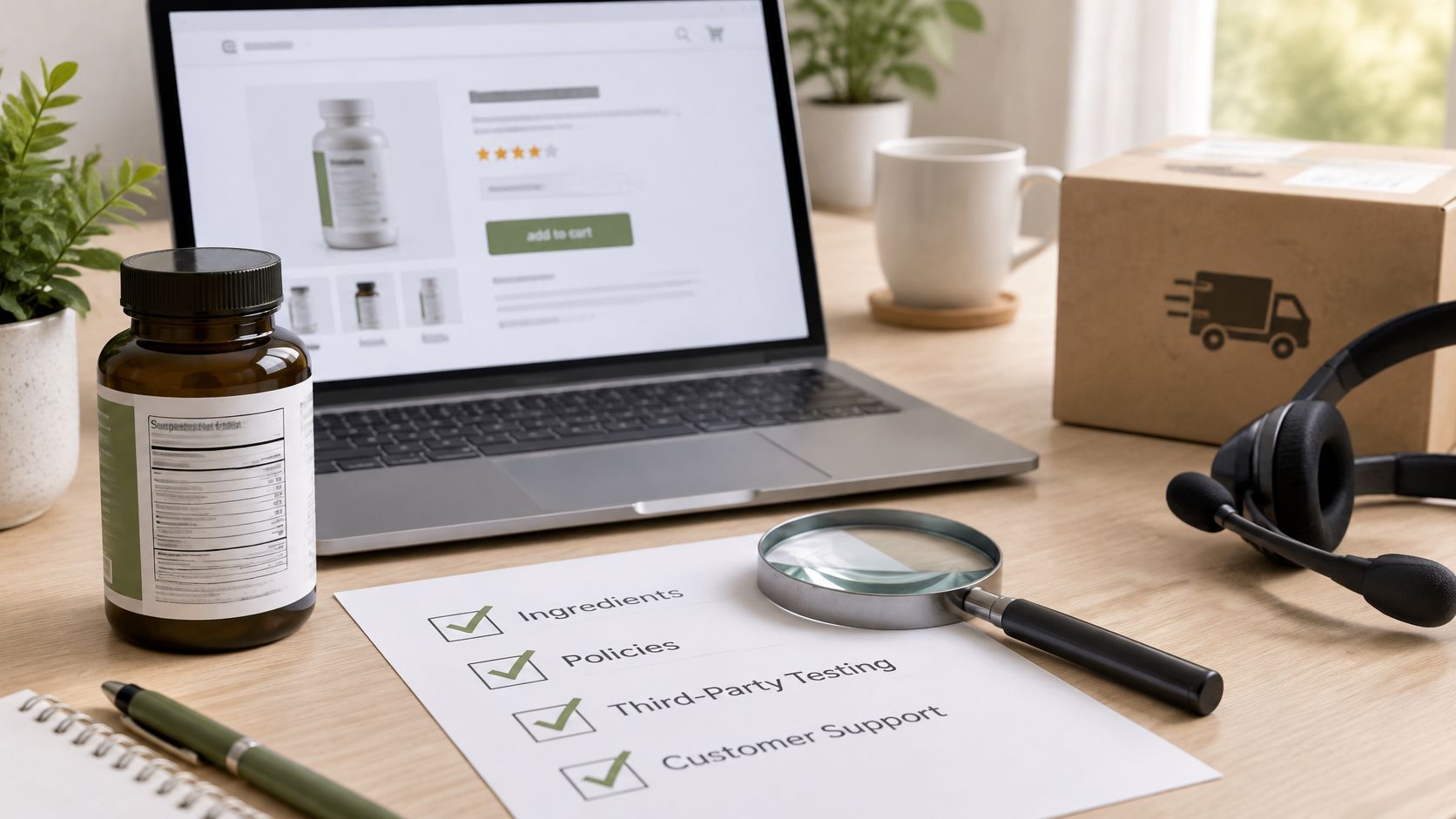
“Check the reviews” is incomplete advice for choosing online supplement stores. Reviews can describe taste, delivery, or a shopper's impressions, but they don't establish what's in a gummy, whether its claims are justified, or who will investigate a damaged pouch.
A better approach is to follow one product from its on-screen label through its purchasing policies, batch evidence, and customer-support reply. Treat those pieces as one traceable test, not separate signs of credibility. The regulatory checks below focus on products sold in the United States, where supplements generally aren't preapproved like medicines.
The Pre-Checkout Scorecard
Pre-checkout scorecard for an online supplement store
| Check | Where to look | Pass | Fail |
|---|---|---|---|
| Supplement Facts panel | Product page | Serving size, amount per serving, and other ingredients | Marketing ingredient list only |
| Claim wording | Headlines, FAQs, and ads | Qualified wellness language such as supports mood or vitality | Disease treatment, cure, or overnight sexual-enhancement promise |
| Responsible firm | Label or product page | Firm name plus business address or phone | No company identified |
| Lot and expiration | Label photo or package details | Lot or batch and expiration date visible | No lot and no date |
| Independent testing | Quality or product page | Named lab and a stated scope such as identity or heavy metals | Lab-tested badge with no lab or scope |
| Shipping and returns | Policy pages before checkout | Cost, return window, and who pays postage | Rules missing or shown only in checkout fine print |
| Adverse-event contact | Product label | Domestic address or phone for serious reports | Email or chat presented as the only channel |
| Support path | Contact, FAQ, or account | Route tied to an order plus a response expectation | Form with no order link and no reply window |
Use this as a shopping screen, not a certificate of safety or a statement that every row is a legal requirement. Open a note beside the product page, save the relevant evidence, and stop at the first hard fail. A missing answer means pause, not assume the best.
Run the rows in order
Start with the Supplement Facts panel. Enlarge the image until you can read the serving size and amounts; a colorful list of featured botanicals doesn't pass this line. Other ingredients may appear beside or below the panel rather than inside it.
For claims, inspect the headline, FAQ, and ad that brought you to the store. Don't clear a page because its footer uses cautious wording if the main sales message promises a medical result.
For the responsible firm, record the company name and its business contact information. A brand logo and social-media handle aren't enough to identify who stands behind the product.
Then check whether the lot and expiration information is legible. A photograph may show a sample package rather than current inventory, so mark the actual shipment's lot as unconfirmed until the seller supplies it.
For testing, write down the laboratory and what it tested. If the page only displays a badge, leave this row unresolved rather than interpreting the badge as independent verification.
Check the transaction, not just the product
Open shipping and return policies before entering payment details. Record the delivery charge, return deadline, and postage responsibility in plain language, including any restrictions on opened packages.
Keep the adverse-event contact separate from routine customer service. Finally, send a focused question through the advertised support route and see whether the reply addresses your product rather than pasting a general sales answer.
Practical rule: A polished page can pass the presentation test and still fail the purchasing test.
These checks are deliberately conservative. A smaller store may need to answer a question manually, while a larger retailer may publish the information immediately. What matters is whether you receive a clear, checkable answer before paying.
Reading the Product Page as a Label
The FDA's consumer guidance on dietary supplements explains that the agency generally doesn't approve supplements for safety, effectiveness, or labeling before sale. Manufacturers and distributors must ensure their products aren't adulterated or misbranded, while FDA can act against unsafe or misleading products after they reach the market.
That division makes the product page more than a brochure. It's where you should be able to inspect the information you'd otherwise read while holding the package.
Use this visual as a guide to the comparison.
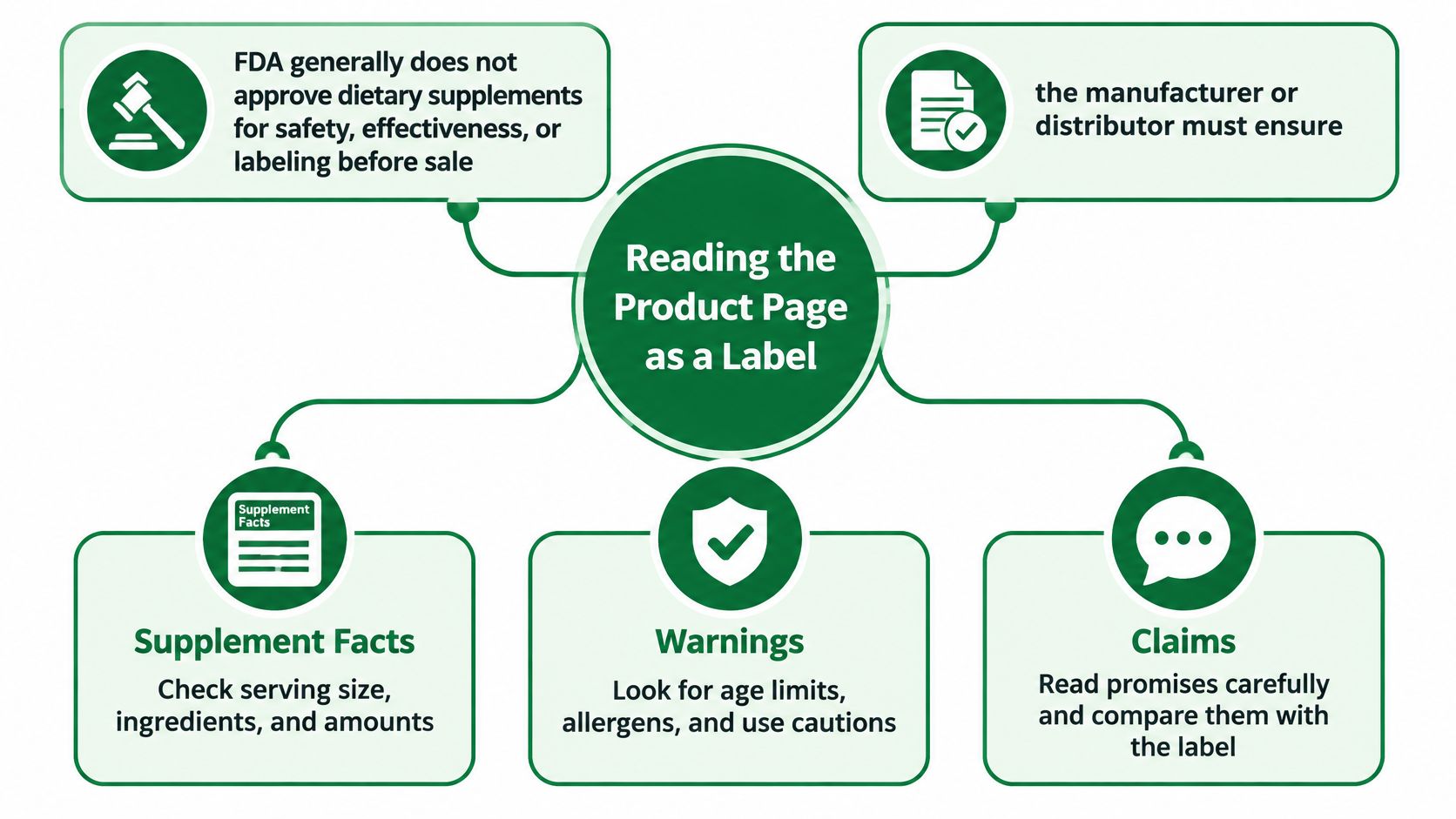
Compare the screen with the package
The FDA's dietary supplement questions and answers describes labeling information and explains why disease claims can cause a product to be regulated as a drug. Use that distinction to examine both the factual panel and the sales language.
Compare the page with a readable photograph of the physical label:
- Product identity: The item should be identified as a dietary supplement.
- Serving information: Find serving size and servings per container.
- Composition: Check dietary ingredients and amounts per serving where required, plus the other-ingredients list.
- Package details: Find net quantity and the responsible firm's business information.
- Use cautions: Read directions, warnings, and allergen information rather than relying on a headline.
With gummies, the serving isn't necessarily a single piece. Sweeteners, flavors, colors, and the gummy base also belong in your assessment because you swallow them along with the featured ingredients.
If the website and package disagree, pause the purchase. Ask which label applies to the inventory being shipped and request the current version. Don't choose whichever version looks more favorable.
Test the meaning of each promise
Copy the headline, an FAQ answer, and a testimonial into a note. Ask whether each statement still makes sense if the product is only a supplement, not a treatment.
Qualified language about supporting confidence, vitality, mood, or feminine well-being isn't permission to imply treatment of depression, sexual dysfunction, or a hormonal condition. A testimonial displayed by the seller deserves the same scrutiny as its own headline.
Ask what evidence supports the wording and whether it concerns the finished formula or individual ingredients. A useful answer connects the claim to relevant evidence instead of merely repeating that the ingredients are studied.
When comparing broader women's health products, keep product category and intended use clear. Attractive packaging and familiar wellness language shouldn't blur the distinction between a daily supplement and medical care.
Purchasing Policies That Should Be Public
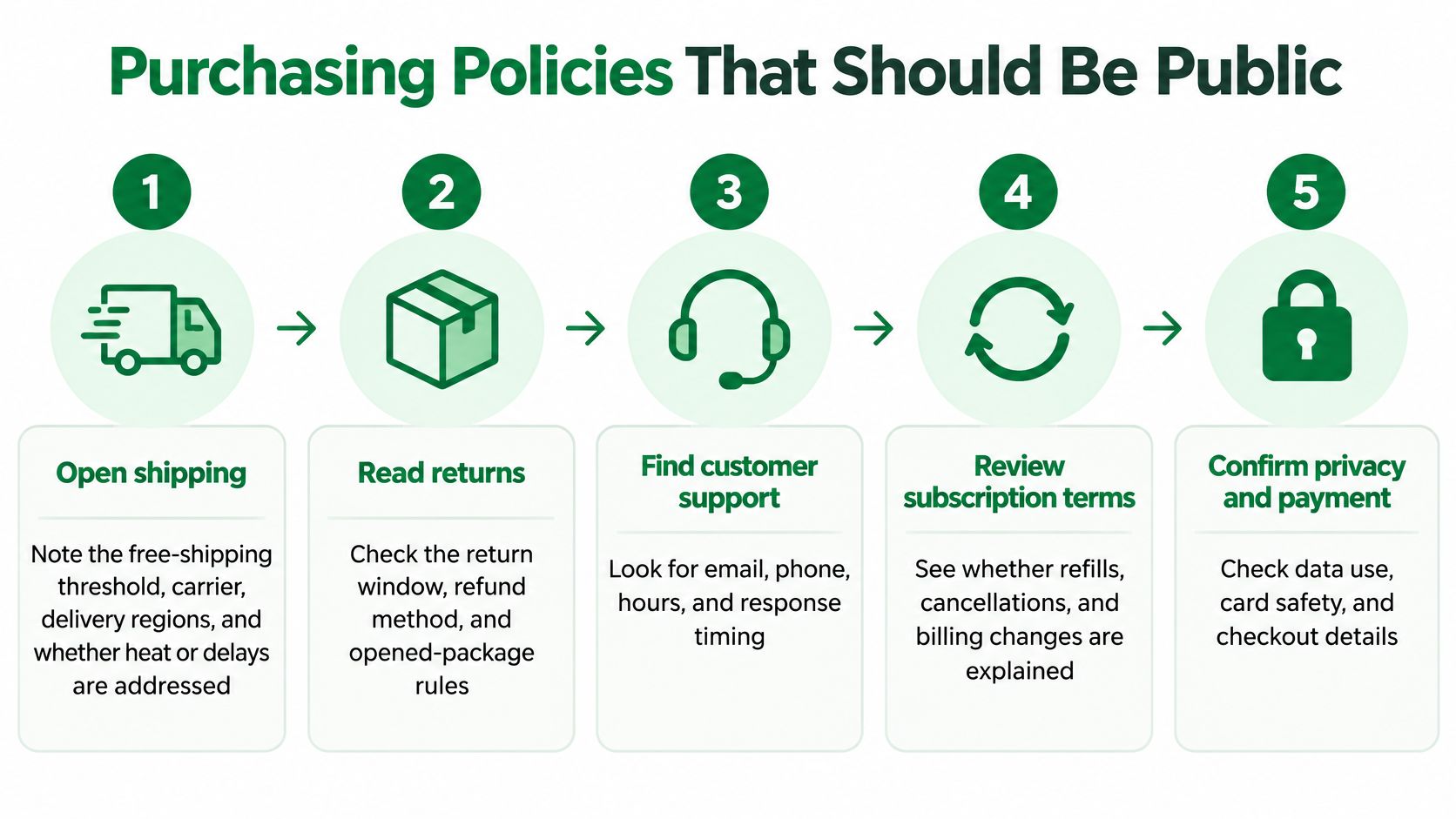
Read the policies with a practical question in mind: If this shipment arrives wrong, can I tell what happens next? Save the policy text or screenshots with your order records, since a bookmark alone doesn't preserve what you read before buying.
Open the policies before checkout
Open shipping. Note any free-shipping threshold, carrier information, delivery regions, and handling of delays or heat exposure. For gummies, look specifically for instructions about a warm package or changed texture rather than assuming the ordinary delivery policy covers them.
Read returns as separate situations. Distinguish a change-of-mind return from a quality complaint involving a stressed seal, melted or stuck pieces, or conflicting serving directions. Find the return window, refund method, opened-package rules, and who pays postage.
Find the serious-report contact. The FDA's guidance on required dietary supplement labeling explains that a domestic address or domestic phone number is required for serious adverse-event reports; email or a website can supplement that channel but can't replace it.
Check the final transaction. Confirm the selected currency, taxes, and shipping total before authorizing payment. If a subscription is offered, inspect refill frequency, cancellation instructions, and billing terms rather than treating the first-order price as the whole commitment.
Inspect the order record. Look for an order ID, product identifier or SKU, and shipment date. Ask how the seller can connect that shipment to a lot if the lot isn't displayed in your account.
This visual provides a companion view of the policy pages to inspect.
Keep a usable complaint file
What a supplement complaint record should capture
| Field | What to record | Why it matters |
|---|---|---|
| Product identity | Name, SKU, and lot or batch | Ties the report to the affected product and batch |
| Use | Dose, timing, and how long it was taken | Helps assess use-related and batch-related possibilities |
| Symptoms | What happened and the onset date | Helps assess urgency and patterns |
| Other products | Medicines and other supplements taken too | Flags possible stacking and interactions |
| Medical care | Whether a clinician was seen and what care was needed | Helps assess seriousness |
| Fulfillment | Order ID and ship date | Links the unit to a distribution path |
Keep your contact details and the seller's case reference with this file. Medical care is relevant to seriousness, but seeing a clinician alone does not establish that a report meets a regulatory definition of serious.
Record heat exposure, moisture, seal damage, texture changes, and incorrect instructions even when nobody feels ill. A seller should distinguish these reports from ordinary returns and be able to review repeated complaints involving the same lot, rather than treating every message as an isolated refund request.
A Support Path That Can Trace a Complaint
Say a shopper orders a strawberry daily vitality gummy. The pouch arrives warm, its seal looks stressed, and several pieces are stuck together. Nobody has taken any yet, but the shopper already has a quality complaint, not merely a change of mind.
The package condition is the starting point for the record.
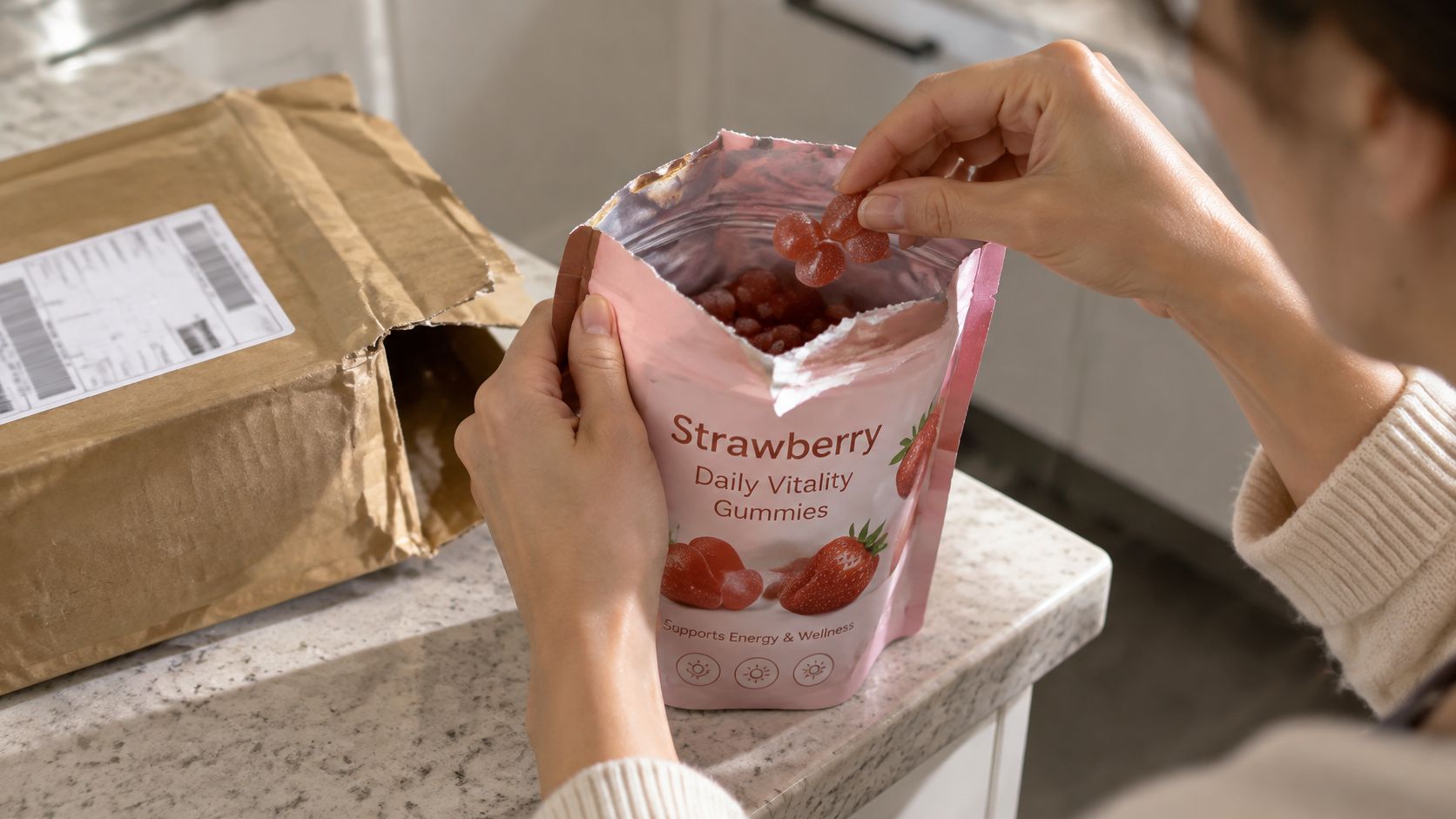
The shopper photographs the unopened pouch, seal, shipping carton, and visible lot information. They set the product aside rather than tasting it to decide whether it seems acceptable.
Send the evidence together
A useful opening message can be brief:
My order arrived warm, with a stressed seal and gummies stuck together. I've attached the order confirmation, lot and expiration photos, seal and texture photos, shipment date, and delivery details. Please confirm how you'll assess this quality complaint and whether I should retain the package.
Add where the parcel sat after delivery, if known. Describe observations rather than assigning a cause: “left on a sunny porch” is more useful than “your warehouse damaged it.”
A competent reply acknowledges the quality concern, connects the photographs to the order, and requests any missing lot information. It explains the next action and gives a response expectation without pushing a replacement purchase before capturing the facts.
A weak reply offers only a discount, refuses to discuss an opened pouch, or cannot connect the package to a batch. A chatbot can collect initial details, but it shouldn't be the end of a complaint that needs human review.
The accompanying video is available below.
Handle the exceptions without losing the trail
If the pouch was a gift, provide the recipient's delivery details and ask the purchaser for the order confirmation where possible. Don't assume the recipient must create an account before the seller can investigate.
For a multipack, photograph each pouch's lot and identify which one changed texture. If the box was delayed in transit, retain tracking information and describe its condition on arrival without assuming every pouch was affected equally.
If the shopper also reports nausea, a rash, or another symptom, the exchange needs a safety-report route as well as a quality assessment. Record dose, timing, symptom onset, other products taken, and medical care, and use the domestic contact on the label. Don't wait for a refund decision to seek appropriate medical help.
What Support Claims Do Not Mean
A product that supports mood isn't thereby a treatment for depression. Confidence, vitality, and feminine well-being describe broad lifestyle aims; they don't establish a guaranteed response or prove that the finished gummy performs like each ingredient studied separately.
The Federal Trade Commission's supplement consumer guidance encourages shoppers to ask about scientific proof, appropriate doses, side effects, and medication interactions. It also cautions against replacing prescribed medicines, combining products carelessly, and interpreting dramatic promises as reliable evidence.
Monitor a routine without creating a treatment trial
If a clinician considers the supplement appropriate, agree on a review point and keep a short note on sleep, energy, mood, and unwanted effects. Don't set a universal deadline for results or continue through symptoms merely to finish a planned trial.
Make the note useful rather than elaborate. Record whether you followed the labeled serving and whether other parts of your routine changed, such as sleep, medicines, or alcohol use. An improvement after starting a gummy doesn't by itself establish that the gummy caused it.
For a closer look at the wording used around mood-boosting supplements, keep the same distinction between personal impressions and evidence of an effect.
A hopeful outcome isn't a reason to increase the dose or replace prescribed treatment.
Bring the whole routine to a pharmacist
A medication review should include more than prescription names. Bring label photographs and list everything you take, including products you use only occasionally.
- Existing products: Include a prenatal, hormonal contraception, antidepressants, blood-pressure medicines, and other botanicals if you use them.
- Dose questions: Ask whether the proposed serving fits your medicines and other supplements.
- Watch points: Ask which symptoms require stopping and what follow-up is appropriate.
- Pregnancy plans: Discuss pregnancy, trying to conceive, or breastfeeding before starting.
- Allergies: Flag any listed ingredient you've reacted to rather than testing your tolerance yourself.
These examples aren't a claim that every combination interacts. They identify information a clinician or pharmacist needs to assess your particular situation.
Stop using the product and seek advice if you develop a rash or another suspected reaction. Chest pain, breathing difficulty, or severe mood changes call for prompt medical assessment, not a customer-service experiment. Don't let natural, herbal, or botanical wording override those decisions, and don't use a wellness promise to excuse missing product or contact information.
Verify Lots and Recalls Before You Buy
A readable label tells you what the seller says the product contains. Lot evidence helps connect that statement to the inventory you'll receive.
The New York Department of State's consumer alert on supplements warns about deceptive advertising, labeling violations, counterfeit products, and potentially harmful or undeclared ingredients in supplements sold online. Those concerns justify checking the product itself rather than relying on a retailer's overall reputation.
Match the lot and inspect the test
Begin with the lot or batch and expiration shown on the package. Ask whether that image represents current stock; a sample photograph doesn't identify your future shipment. Search the product and firm names on FDA recall and safety-alert pages and the firm's own notices, then compare any affected lot information carefully.
If the seller can't identify the lot before dispatch, treat the purchase as unresolved under this conservative shopping method. A clear explanation of warehouse limitations is useful, but it isn't a lot match.
Next, examine the testing claim:
- Who performed it: Request the laboratory's name and clarify whether it is independent of the manufacturer.
- What was tested: Distinguish identity, potency, heavy metals, and other stated checks.
- Which material was tested: Ask whether the report covers a raw ingredient or the finished product.
- Which lot it covers: Request a certificate of analysis tied to the relevant batch.
A certificate with a different product or lot doesn't clear the item in your cart. Even a matching report supports only its stated scope; it doesn't establish clinical effectiveness or suitability for your medicines.
Compare the dose with the cited evidence
Open the study the seller relies on and compare the ingredient, form, amount, and population with the product label. An extract isn't automatically interchangeable with an unstandardized plant powder, and ingredient evidence isn't automatically finished-formula evidence.
Don't adjust your serving to imitate a study. Ask the seller to explain the relevance and take dosing questions to a clinician.
Save the lot information, alert-search date, and certificate status in your shopping note. No alert found isn't proof of safety; a listed recall is a reason not to buy the affected lot. If a unit has already arrived, retain its details and use the complaint route.
Confirm the Store Before You Order
Order only when the evidence agrees; pause when a material gap remains. That means the label and page match, the claims stay within qualified wellness language, the transaction rules are visible, the batch evidence is checkable, and support can trace the shipment.
This standard applies to a brand-owned store and a marketplace seller alike. Neither channel deserves an automatic pass, and passing a store assessment doesn't establish that a supplement is appropriate for you.
Apply the same standard to our store
At Eve's Eden, our products are manufactured in the United States in GMP-certified facilities. That manufacturing fact belongs in your assessment, but it doesn't replace a product-specific label review, lot evidence, or a medication discussion.
We offer free shipping on orders over $60, with taxes and shipping calculated at checkout. Check the live terms and final total rather than adding items solely to reach a shipping threshold.
Our website includes customer accounts, an FAQ, and a contact page. You can email us at info@edenseve.com with questions; use the label's domestic phone or address for a serious report rather than relying only on email.
For shoppers weighing local and online purchasing, our guide to finding a health and wellness store near you can help frame the channel choice. Buying in person may let you inspect a package, but it doesn't remove the need to evaluate its claims and suitability.
Keep the decision in writing
Save a short decision note with your order confirmation:
- Cleared evidence: Identify the label version, relevant policies, batch information, and testing documents you checked.
- Support outcome: Keep the answer and any case reference, not just the date you sent a question.
- Personal suitability: Record any clinician or pharmacist advice relevant to starting the product.
If you're pregnant, trying to conceive, or taking prescription medicines, get appropriate advice before use. If an important answer remains missing, leave the cart unpaid. When the checks are complete and any necessary clinician review raises no objection, purchasing can be a reasonable next step, not a guarantee of benefit.
Eve's Eden offers sensual wellness supplements intended to support confidence, connection, and feminine vitality. Visit Eve's Eden to review the product information and purchasing policies, then bring any unresolved label, lot, or support question to us before placing your order.