Are Gummy Supplements Effective? What the Evidence Shows
Are gummy supplements effective? See which nutrients work, how dose and format matter, and how to check a label before you buy.
Gummy supplements can be effective when they deliver a nutrient you need at a verified dose, but the format alone doesn't decide whether they work. Calcium with vitamin D and folic acid are established examples of useful supplementation for specific needs, not proof that every gummy delivers a benefit.
If a gummy contains a useful ingredient, does that mean you'll notice the result promised on the bottle? That's the gap between nutrition and marketing. A nutrient can have an established role without every product containing it being effective for every person.
To answer “Are gummy supplements effective?”, judge each product on separate grounds: whether you need its ingredients, whether it reliably delivers its labeled dose, and whether the finished formula has been tested for the outcome you want.
Which Gummy Nutrients Have Solid Evidence
A gummy can be a useful way to address a nutritional shortfall. What matters first is the nutrient and its purpose, not whether you chew it or swallow it.
The National Institutes of Health Office of Dietary Supplements explains that supplements can help people obtain essential nutrients when food alone isn't sufficient. It identifies calcium and vitamin D as supporting bone strength and reducing bone loss, and folic acid as reducing the risk of certain birth defects. Those are specific benefits tied to specific nutrients, not a general endorsement of gummy supplements.
Evidence for gummy supplements by nutrient or ingredient
| Nutrient or ingredient | Established role | Evidence strength |
|---|---|---|
| Calcium with vitamin D | Supports bone strength and can reduce bone loss | Established for documented need; a gummy still needs an appropriate, reliable dose |
| Folic acid | Reduces the risk of certain birth defects | Established nutrient benefit; not proof of every gummy formulation |
| Multivitamin without a documented deficiency | Benefit unclear for most adults without an identified nutritional gap | Weak basis for expecting a noticeable benefit without a defined need |
| Botanical extracts such as ginseng | Effects must be assessed by species, extraction method, and dose | Ingredient-level findings need matching formulations; product trials are needed for finished-formula claims |
| Mood, confidence, or intimacy claims | Outcomes aren't established by unrelated nutrient evidence | Product-level human evidence required |
The table separates an established nutrient role from a promise about how you'll feel. Supporting bone health isn't the same claim as improving energy, and neither establishes that a gummy improves confidence or intimate well-being.
A multivitamin also deserves a different question from a targeted supplement. Instead of asking whether a long ingredient list looks complete, ask which nutritional gap it addresses. More ingredients don't automatically make the product more relevant to you.
Match the evidence to the reason you're taking it
Say your clinician identifies a nutritional shortfall. A supplement supplying that nutrient in an appropriate amount has a clear job. By contrast, taking a broad blend because you feel vaguely below your best leaves both the cause and the expected benefit uncertain.
Botanicals need particularly careful matching. A familiar herb name isn't enough to identify the preparation used in a human study. The extract and dose matter, so a finding about one preparation shouldn't become a promise about every product bearing the same plant name.
Supplements also can't replace a varied diet. Before choosing a gummy, write down the nutrients you suspect you lack and the reason for that suspicion. Check each against its established role, then discuss uncertain gaps with a clinician or registered dietitian.
Key takeaway: Effectiveness starts with the nutrient and the need, not the gummy.
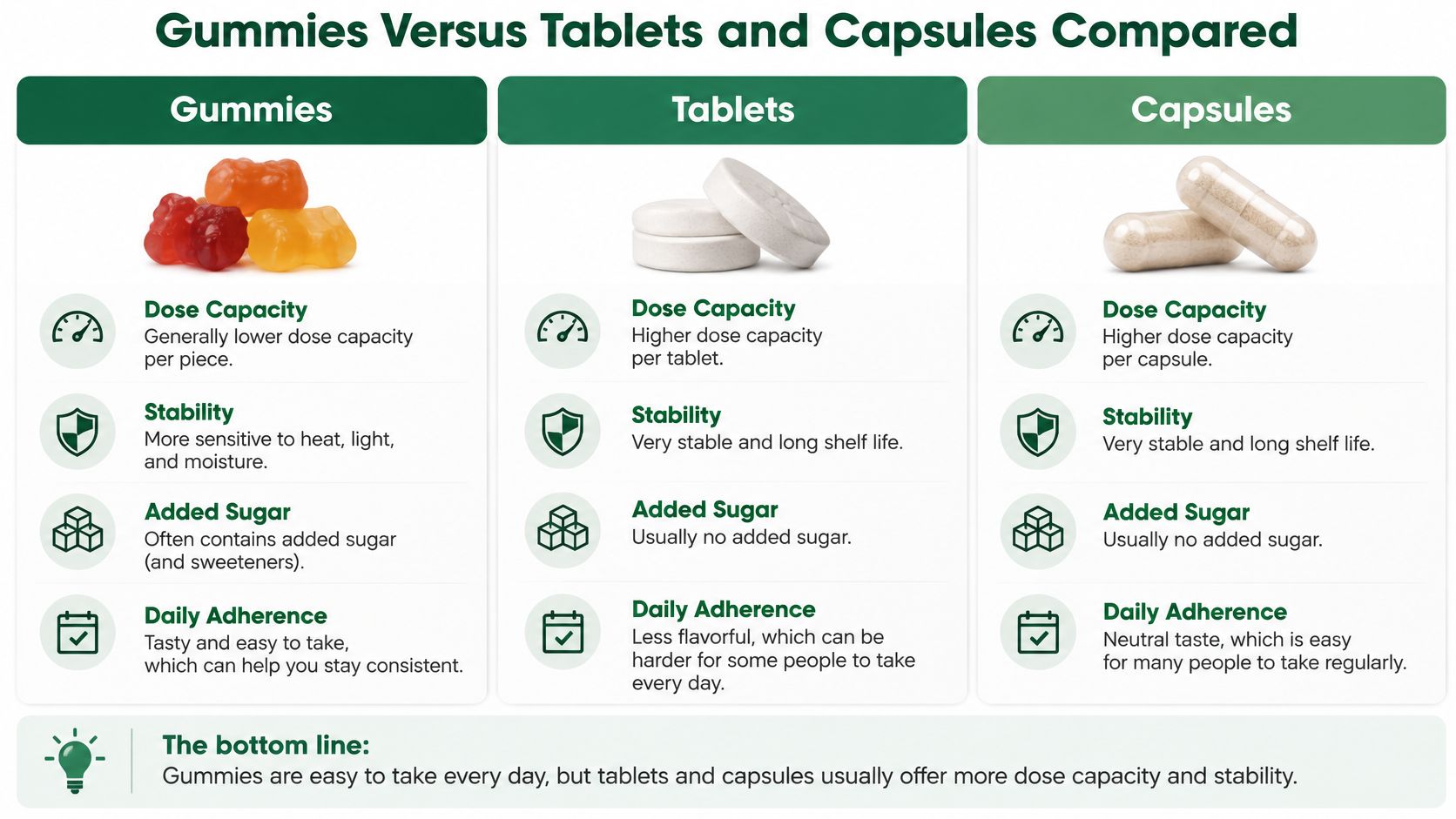
Gummies Versus Tablets and Capsules Compared
| Format | Dose capacity | Stability | Added sugar and adherence |
|---|---|---|---|
| Gummy | Limited room for active ingredients alongside the gummy base | Moisture and acidity make formulation and packaging important | Often contains added sugar; a pleasant taste may help consistency |
| Tablet | Can accommodate higher-dose or more complex formulas | A dry formulation and protective coating can support stability | Typically doesn't need added sugar; swallowing can be a barrier |
| Capsule | Can hold powders or oils; capacity is limited by capsule size | Protection relies on the shell, formulation, and packaging | Typically doesn't need added sugar; ease of use is personal |
These are practical trade-offs, not a ranking of effectiveness. A tablet you can't comfortably swallow may be an unsuitable choice, but an enjoyable gummy still needs to supply a useful formula.
The comparison below highlights what to check before choosing a format.
Better absorption isn't a format-wide promise
A small crossover study summarized by Good Housekeeping found higher blood vitamin D levels from one gummy product than one tablet product, while a 2023 systematic review emphasized evaluating chemical composition, dissolution, and bioequivalence rather than assuming the dosage form determines effectiveness.
That comparison doesn't establish that all gummies outperform all tablets. Different nutrient forms, doses, and formulations prevent that leap. Bioequivalence concerns whether products deliver comparable exposure to an active ingredient, not whether they look or taste alike.
A video can provide another way to consider the format comparison.
Convenience has a limited but useful role
Potential gummy advantages include:
- No intact pill to swallow. Chewing can make supplementation more manageable.
- An appealing routine. Taste may help you remember a needed supplement.
- Simple delivery. A straightforward formula may fit the format well.
The limits deserve equal attention:
- Dose capacity. Larger amounts of active ingredients can be difficult to fit.
- Extra ingredients. Sweeteners and the gummy base take up space.
- No efficacy shortcut. Enjoying the product doesn't establish a biological benefit.
Consistency matters only when the underlying supplement is appropriate. Taking an unsuitable formula reliably doesn't turn it into an effective one.
If you need a high dose of a particular nutrient, a tablet or capsule may fit better. If swallowing pills prevents you from following an appropriate plan, assess a gummy's actual dose and quality rather than dismissing the format.
What Changes How Well a Gummy Works
The amount printed on the label, the amount remaining when you take the product, and the amount your body can use aren't necessarily identical. Stability concerns whether the product retains its intended composition during storage.
Gummies contain moisture and often have an acidic base. Those conditions can make sensitive vitamins and botanical constituents harder to preserve. The NIH dietary supplement consumer guide also emphasizes that supplements require careful evaluation rather than an assumption of safety or effectiveness based on their availability.
What manufacturers need to control
Manufacturers can use protective packaging, stability testing, and carefully calculated overages, meaning extra ingredient added to account for expected losses. Laboratory measurements help determine whether a batch meets its release specifications.
The important question isn't whether an ingredient went into the mixing vessel. It's whether the declared amount remains within specification through the expiration date under the stated storage conditions.
Several practical factors affect that judgment:
- Storage conditions. A bottle left in a hot car or humid bathroom may experience conditions outside those used to establish its shelf life. An unexpired date isn't permission to ignore storage instructions.
- Serving size. Check whether the listed amount applies to a single piece or the full suggested serving. Don't assume a gummy supplies the entire labeled serving.
- Formula capacity. A gummy base needs room for texture and flavor. A crowded ingredient list can leave little space for meaningful amounts of each active ingredient.
Added sugar is another label consideration, particularly when you use several supplements. Assess the full serving rather than treating each piece as nutritionally insignificant.
Your starting point changes the likely benefit
A person with an established shortfall has a different reason to supplement from someone whose intake is already adequate. The same product may address a clear need for the former without providing an additional benefit for the latter.
More isn't automatically better. Too little may fail to address the intended need, while excessive intake can create risks. Don't compensate for doubts about potency by taking extra gummies.
Practical rule: Check both the expiration date and the printed storage instructions. If the product has been stored outside those conditions, ask a pharmacist or the manufacturer before continuing to use it.
Check a Gummy Label and Buy With Confidence
Treat label review as a purchasing skill, not a search for reassuring words. A clear label lets you identify what you're taking; quality testing helps establish whether the contents match it.
Use this visual guide to locate the details that deserve closer inspection.
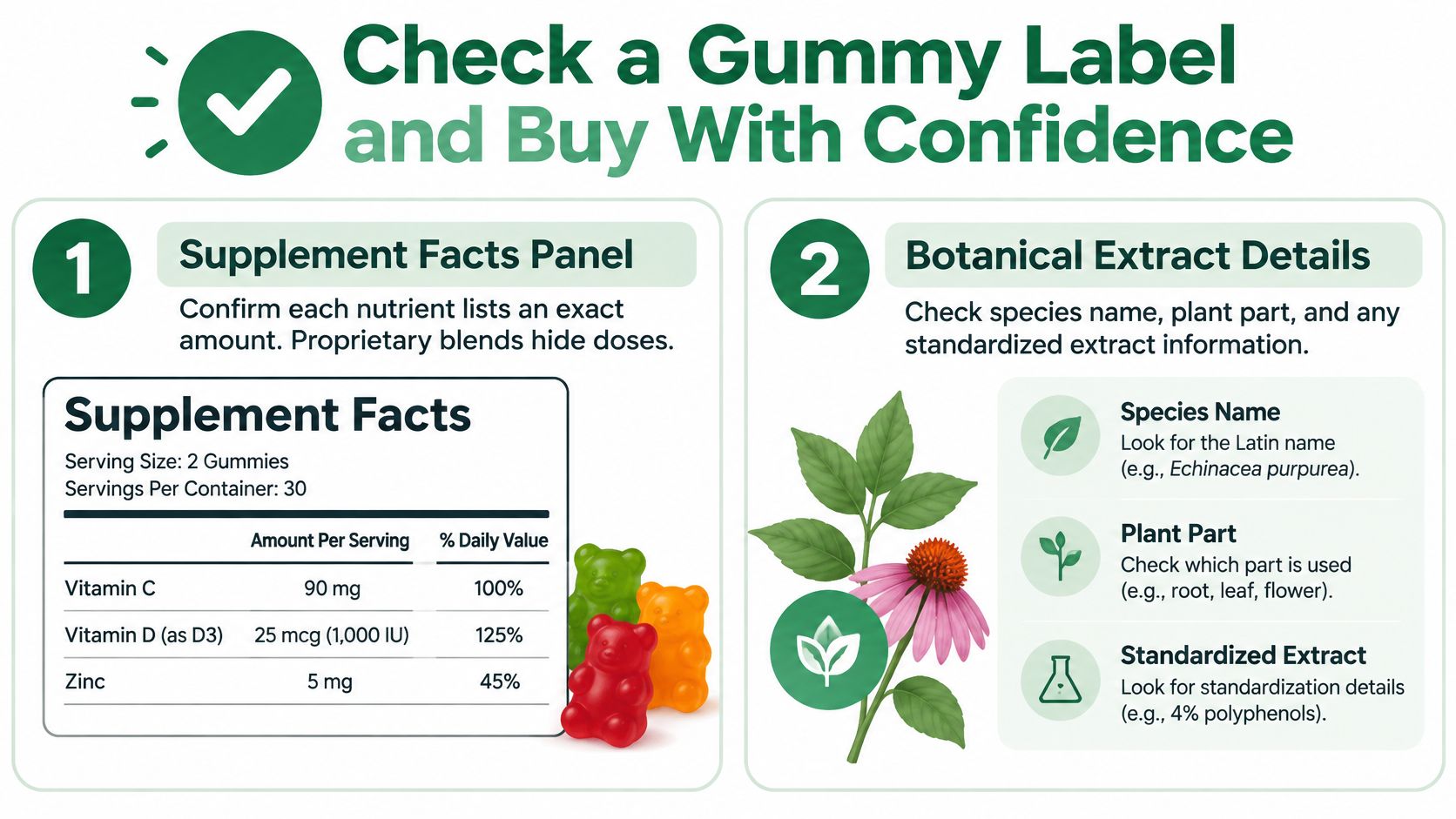
A copyable label checklist
Find the Supplement Facts panel. Confirm the serving size and the amount of each active ingredient. A proprietary blend total doesn't disclose how much of each component you receive.
Identify botanical preparations. Look for the species, plant part, extraction details, and standardized markers where relevant. A marker is a measured constituent used to help characterize an extract, not automatic proof of benefit.
Match the dose to human evidence. Look for a study using a comparable ingredient preparation and intended outcome. Don't assume a smaller amount will reproduce a result because the ingredient name matches.
Check independent testing. Identify who performed the testing and what it covered. Ingredient identity, amounts, contaminants, and appropriate breakdown are different checks from clinical effectiveness.
Review shelf-life support. Read the expiration and storage information, then look for confirmation that potency was assessed through expiry. A test at manufacture alone doesn't answer that question.
Verify manufacturing credentials. Good Manufacturing Practice, or GMP, certification concerns manufacturing controls. Check what the certification covers rather than treating a logo as evidence of a health outcome.
Search official recall notices. Check the product and manufacturer names, and compare any affected lot information with the package you own.
Challenge medical promises. Claims to diagnose, treat, or cure a condition are warning signs for a supplement. Don't use them as a reason to replace prescribed care.
Label reliability deserves attention because it can fail independently of ingredient science. An analysis summarized by Good Housekeeping examined 25 melatonin gummy products and found 22 outside 10% of their labeled claim. That finding concerns the tested melatonin products, not every vitamin or botanical gummy.
Recall checking serves a separate safety purpose. As of July 22, 2024, the FDA reported 74 illnesses across 28 U.S. states, including 38 hospitalizations, linked to recalled Diamond Shruumz gummies and related products. This was a specific recall, not an estimate of ordinary supplement risk.
Apply separate tests to a real product
Our Femme Fresa Fatale gummies contain 200 mg of botanical ingredients per gummy, formulated to support energy, mood, and confidence. They're 100% natural, vegan, gluten-free, and made in a GMP-certified facility, with a regular price of $24.99.
Those facts describe composition, positioning, manufacturing, and price. The blend total doesn't establish each botanical's individual dose, and manufacturing credentials don't demonstrate the finished formula's effect on mood or confidence. Our discussion of how transparency works offers context for evaluating product information.
Keep the decision separated:
- Need. Is this an ingredient or nutrient I have a clear reason to take?
- Delivery. Is there evidence that the product consistently supplies its declared amounts?
- Outcome. Has the finished formula been tested for the result I want?
For unresolved questions, request the relevant stability documentation and any human trial of the finished formula. If a clinician agrees supplementation makes sense, record a baseline and agree on a review period before starting. Change one supplement at a time so you can discuss benefits and adverse effects without confusing several simultaneous changes.
Judging Claims About Mood, Confidence and Intimacy
A recipe can contain excellent ingredients and still produce a disappointing cake. You need to assess what happens when those ingredients are combined, prepared, and served, not merely admire the shopping list.
Supplement formulas deserve the same distinction. Ingredient evidence describes findings for a particular compound or extract. Product evidence describes what the finished preparation did in people under specified conditions.
The image illustrates the recipe analogy, not evidence of a supplement's effectiveness.

Ask what the study actually measured
A statement that a formula contains clinically studied ingredients leaves important questions unanswered. Did the study use the same preparation? Was the amount comparable? Did researchers assess the outcome advertised, or something only loosely related?
A useful finished-product trial would specify:
- The outcome. Mood, confidence, desire, and intimate comfort aren't interchangeable.
- The dose and schedule. The tested use should match the product's recommended use.
- The timeframe. A sustained change and an immediate effect require different evidence.
- The comparison. A placebo comparison helps distinguish the product's effect from expectation and other changes.
Mood and intimate well-being involve subjective experience, but that doesn't make them impossible to assess. Ask whether researchers used a validated questionnaire, meaning a measure evaluated for its intended purpose, rather than relying only on testimonials or an undefined statement that participants felt better.
Statistical results also need practical interpretation. Ask what changed, how researchers defined improvement, and whether that improvement resembles the benefit you're seeking.
Read disclaimers as limits, not fine print
Our supplement disclaimer states that it isn't intended to diagnose, treat, cure, or prevent any medical condition and hasn't been evaluated or approved by the FDA. That means you shouldn't interpret the label as regulatory confirmation of a proven outcome.
When browsing a guide to the best gummies for sex, apply the same scrutiny to every recommendation. A product described as supporting confidence hasn't thereby demonstrated an effect on sexual function, relationship satisfaction, or a medical concern.
If finished-formula evidence isn't available, the accurate conclusion is uncertainty. That's different from proving a product ineffective, but it's also different from establishing that it works.
Ingredient evidence is not product evidence. A plausible formula is a reason to investigate, not a guarantee of results.
Who Should Check With a Clinician First
Adult wellness gummies aren't automatically suitable for everyone. Our gummies are for adults aged 18 and over, and we advise consulting a healthcare professional before use, especially during pregnancy or nursing, with a medical condition, or when taking medication.
A clinician or pharmacist can assess the complete combination, including prescriptions, nonprescription medicines, and other supplements. Botanical extracts and nutrients can interact with medicines, so bring the actual label rather than just the product name.
Situations that call for a check first
- Pregnancy or nursing. Review the entire formula before starting.
- Prescription medication use. Ask a pharmacist to check ingredients against your medication list.
- A medical condition or persistent symptoms. Don't use a wellness claim to explain away a problem that needs assessment.
- Suspected deficiency. Ask whether dietary review or a blood test is appropriate. Symptoms alone don't confirm a nutritional shortfall.
Our guidance describes side effects as rare, but an individual reaction still matters. If you experience an adverse reaction, stop taking the gummies and consult a healthcare professional.
Don't exceed the recommended dose, and keep gummies out of children's reach because they can resemble candy. Our guide to how many gummy vitamins you can take a day explains why the serving instructions deserve attention.
A supplement should complement an appropriate care plan, not replace it. The best next step may be a targeted supplement, a dietary change, or an assessment of symptoms rather than another bottle.
Eve's Eden offers strawberry-flavored, plant-based sensual wellness gummies positioned to support confidence, connection, and feminine vitality. Visit Eve's Eden to review the product information and usage guidance, then assess the formula against your needs, its quality documentation, and the evidence for the outcome you want.