Serotonin Mood Support Supplements: Evidence and Safety
Serotonin mood support supplements explained: what the claims mean, which ingredients have evidence, and when interactions with antidepressants matter.
“Low serotonin” is often presented as the simple reason for low mood, and a supplement that raises serotonin is then offered as the simple fix. That skips three different questions: whether someone has a serotonin deficiency, whether an ingredient changes serotonin-related activity, and whether a finished product improves mood in practice.
Those questions don't have the same answers. A precursor on a label isn't proof of a mood benefit, and evidence about one botanical doesn't automatically apply to a gummy blend. If you're considering a mood product, the useful starting points are what its ingredients have been studied for, what medicines you take, and whether your symptoms need professional care.
Serotonin Supplement Ingredients Compared by Evidence and Risk
Most serotonin-oriented supplements have limited human evidence for mood. St. John's wort has the largest body of trials among the ingredients below, but it also has significant interaction risks. The other ingredients have different evidence gaps and safety flags, so they shouldn't be treated as interchangeable.
| Ingredient | What it is | Human evidence for mood | Main safety flag |
|---|---|---|---|
| St. John's wort | Botanical extract from Hypericum perforatum | Strongest evidence base here. Reviews found it performed better than placebo for mild-to-moderate depression and wasn't significantly different from antidepressants on measured outcomes. Severe depression was under-studied. | Major drug interactions. It can lower the effect of many medicines. |
| 5-HTP | Compound made from tryptophan, a direct serotonin precursor | A small evidence base. Two randomized trials favored it over placebo, but the evidence is limited. | Serotonin syndrome risk with serotonergic medicines. |
| L-tryptophan | Essential amino acid the body uses to make serotonin | Limited and inconsistent trial results. | Serotonergic interaction risk and historical safety concerns. |
| SAMe | Compound the body makes, also sold as a supplement | Some depression trials, with mixed results. | Can increase serotonin and contribute to serotonin syndrome with serotonergic medicines. |
| Maca root | Andean root used in traditional tonics | Few controlled human trials on mood, mostly small. | Limited safety data overall. |
| Damiana | Shrub leaf used in traditional herbal products | Little controlled human evidence for mood. | Limited safety data; pregnancy use isn't well studied. |
| Ginseng | Panax root that can have stimulant-like effects in some people | Small trials have mixed mood and energy results. | May affect blood thinners and blood sugar medicines. |
The evidence column asks whether people have been tested for a mood effect. It doesn't give an ingredient credit just because the body can use it in serotonin-related chemistry. The safety column names a first issue to check, not every possible interaction or side effect.
Each row describes a single ingredient. A gummy or blend may combine several ingredients, and the label may not disclose how much of each one it contains. So an ingredient's trial results can't be transferred to a finished product unless the formulation, dose and use are comparable.
Quick label routine: Find each ingredient in the table, note what human mood evidence exists, then check whether its safety flag applies to a medicine or health situation you already have.
For a broader comparison of options, see our guide to best mood support supplements. Treat any ranking as a starting point for questions, not as a substitute for checking the exact product label with a pharmacist.
What Serotonin Does and Why Low Levels Are Not Proven
Serotonin is a chemical messenger, not a mood dial. The body makes it from tryptophan, an amino acid found in food. Nerve cells release serotonin between cells, where it signals receptors; much of the messenger is then taken back up through a transporter.
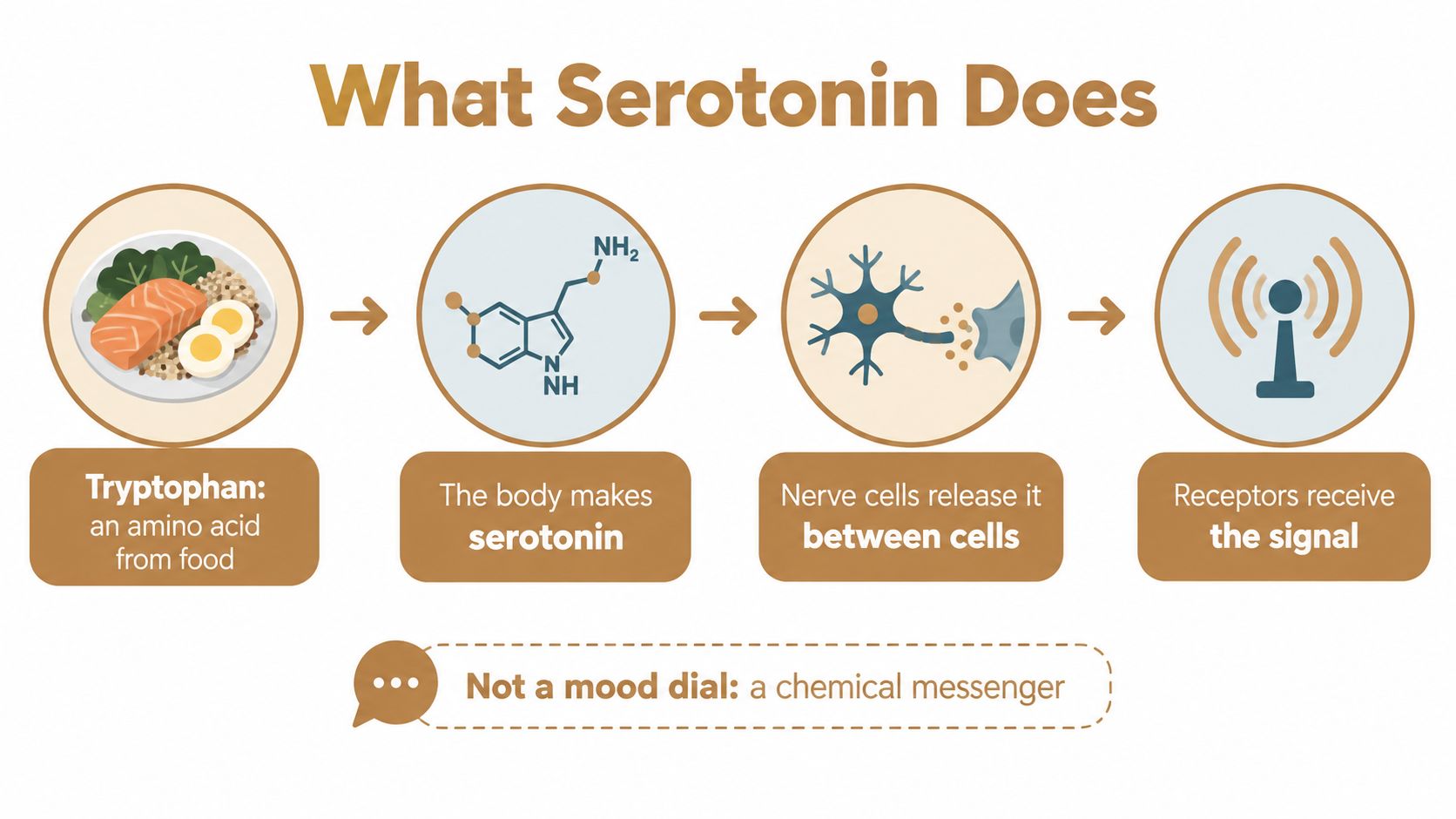
There are more than a dozen receptor types, and their effects depend on where they are and what circuit they're part of. Think of serotonin as a messaging network across a city, not a light switch. Sending more messages doesn't guarantee that each recipient interprets them in the way you'd want.
Why “low serotonin” is not a simple diagnosis
A common assumption says that depression means serotonin is low and that more serotonin should therefore improve mood. But direct evidence for a serotonergic deficiency in depression remains inconsistent. An umbrella review of serotonin and depression found no consistent relationship between depression and serotonin concentrations, serotonin-metabolite levels, receptor or transporter binding, tryptophan depletion, or related genetic markers.
That doesn't mean serotonin is irrelevant to brain function. It means the evidence doesn't support using a single low-serotonin explanation to diagnose depression or predict who will benefit from a supplement. Symptoms such as persistent sadness, anxiety, irritability or poor sleep can have different causes and deserve to be considered in context.
A blood serotonin test also doesn't reliably measure serotonin in the brain, so it can't confirm that someone has a brain serotonin deficiency. If a product claims to support serotonin, that language alone can't tell you whether you're deficient or whether you'll feel a predictable mood effect.
The practical point is that changing serotonin-related chemistry isn't the same as improving mood. Sleep, stress, health conditions, medicines and a person's broader mental-health needs all matter. For persistent or severe symptoms, seek professional care rather than trying to diagnose a chemical imbalance from how you feel.
What Supplement Mood Claims Really Promise
Three questions hide inside every mood claim on a supplement label. Is your serotonin actually low? Does the ingredient raise serotonin in humans? Has this finished product produced a measurable mood effect in a trial? Label language usually gestures at the middle question at best, so read each phrase as a clue to what is being claimed, then ask what evidence would be needed to support it.
| Label phrase | What it usually means | Evidence it would need |
|---|---|---|
| Supports mood | Wellness intent, not a treatment claim | Ingredient-level data relevant to the finished product |
| Supports confidence | Wellness intent, not a treatment claim | Ingredient-level data relevant to the finished product |
| Treats depression | Medical claim | Clinical evidence on the finished product under clinical oversight |
| Relieves anxiety | Medical claim | Clinical evidence on the finished product under clinical oversight |
| Clinically studied nutrients | Ingredients studied in other products, not necessarily this gummy | Studies of the actual formulation |
| Natural or no harsh chemicals | Sourcing language, not proof of pharmacological inactivity | No pharmacology evidence is implied by the phrase |
"Clinically studied" deserves particular care. The phrase can refer to research on an ingredient in a different product, at a different dose or in a different group of people, and it works like a borrowed credential: the ingredient carries the study history even though the gummy in your hand may never have been tested. "Natural" describes where an ingredient comes from, and says nothing about whether it can affect the body or interact with a medicine.
What the safety system can and can't tell you
Dietary supplements are sold under a different evidentiary and monitoring framework from prescription medicines. The FDA does collect adverse-event reports about supplements, but reporting is voluntary for consumers and incomplete in practice, so the reports capture only part of the possible problems tied to any product.
That cuts in both directions. A pattern of reports doesn't prove a specific gummy is unsafe, and a clean report history doesn't prove it's safe when reporting is incomplete. The practical check stays the same: does the label name each ingredient and amount, explain intended use, and give clear interaction warnings?
Femme Fresa Fatale gummies show what that framing looks like in practice. The product is described as supporting energy, mood and confidence, which is wellness-support language, while the label states it is not intended to diagnose, treat, cure or prevent any medical condition and has not been evaluated or approved by the FDA. Read the supportive phrases within that boundary, and follow the label's guidance to consult a healthcare professional before use, especially if you take medication.
Reading the Evidence Behind St. John's Wort
St. John's wort is a useful case study because it has a substantially larger clinical evidence base for mood than most botanical supplements. All that research answers one question well, whether the ingredient itself can outperform placebo, while leaving two others open: whether a given person's low mood involves serotonin at all, and whether a specific product on the shelf resembles what was tested.
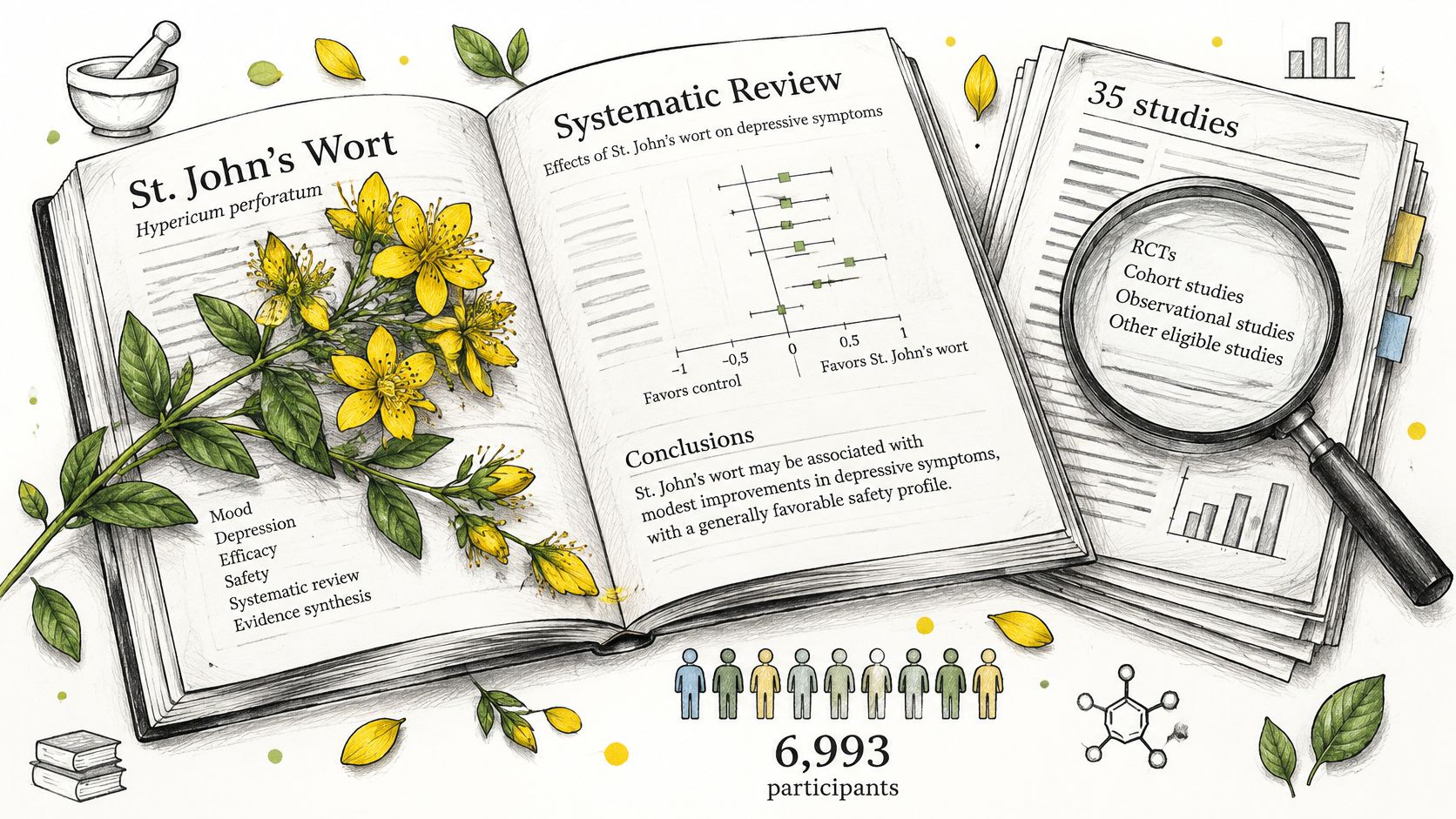
In a 2016 systematic review summarized by the U.S. National Center for Complementary and Integrative Health, St. John's wort used alone performed better than placebo for reducing depressive symptoms in adults with mild-to-moderate depression and wasn't significantly different from conventional antidepressants on the outcomes measured. That conclusion belongs to the review's studied populations and preparations, so it can't be assumed for every commercial product.
The Merck Manual's overview of St. John's wort evidence summarizes a separate review of 29 double-blind randomized trials that reported response-rate ratios for St. John's wort against placebo and against antidepressants. A response-rate ratio compares how often each group improved: a value above 1 favors the herb, while a confidence interval that includes 1 shows no clear difference.
| Comparison | Participants | Response-rate ratio | 95% CI | How to read it |
|---|---|---|---|---|
| St. John's wort vs placebo | 3,064 | 1.48 | 1.23 to 1.77 | Above 1, and the interval excludes 1, so the result favors the botanical. |
| St. John's wort vs antidepressants | 2,810 | 1.01 | 0.93 to 1.09 | The interval includes 1, so there's no clear difference. |
Read together, the two rows answer the ingredient question cleanly. The herb beat placebo, and it performed comparably to prescription antidepressants on the measured outcomes in these trials. That still says nothing about whether St. John's wort works for every person, or whether it can stand in for prescription treatment.
Why the findings don't transfer to every product
The studies differed in design, extract preparation, dosage and participant characteristics, and severe depression wasn't adequately studied. A result from one standardized extract applies cleanly only to a matching extract, at a similar dose, in a similar population. A multi-ingredient gummy sits several steps away from that: different plant material, different amounts, and other ingredients sharing the same formula.
The benefit findings also say nothing about interaction safety. St. John's wort has clinically important medication-interaction risks, so a favorable trial result can't establish that it's a suitable addition alongside other medicines.
A short video offers another overview of how this evidence is commonly discussed:
Before applying a study to a product, ask: Which extract was studied? At what dose? In which population? If the label doesn't give enough information for that comparison, the trial result can't establish what the finished product will do.
Medication Combinations That Raise Serotonin Risk
Interaction risk depends on the whole combination, not just the supplement. Some ingredients may add to serotonin activity, while others, such as St. John's wort, can change how quickly the body breaks down medicines.
The MSD Manual's supplement overview notes that SAMe may increase serotonin and contribute to serotonin syndrome when combined with serotonergic medicines. Tryptophan and 5-HTP products also warrant caution with medicines that affect serotonin. “Natural” doesn't mean pharmacologically inactive.
| Medicine or supplement | Why it matters | What to do |
|---|---|---|
| SSRIs and SNRIs, such as sertraline or venlafaxine | They affect serotonin; adding 5-HTP, tryptophan, SAMe or St. John's wort may add to that activity. | Don't combine without prescriber review. |
| MAOIs, such as phenelzine or selegiline | They affect serotonin breakdown, so adding a serotonergic supplement can carry serious interaction risk. | Treat a new supplement as a medication decision. |
| Triptans for migraine, such as sumatriptan | They act on serotonin receptors, so an additive effect is possible. | Ask a prescriber or pharmacist first. |
| Tramadol and other serotonergic pain medicines | They can add to serotonergic activity. | Get a pharmacist's review before combining. |
| Oral contraceptives, warfarin and transplant medicines | St. John's wort can speed the liver breakdown of these drugs and lower their effect. | Tell the prescriber before starting St. John's wort. |
| Stimulant ADHD medicines, including amphetamine-based medicines | Combining them with mood-active products may add effects on heart rate and the nervous system. | Review the combination with a prescriber. |
| Pregnancy or breastfeeding | Safety data for many mood botanicals is limited. | Consult a clinician before use. |
Keep a current list of every prescription, over-the-counter medicine and supplement, including doses. Bring it to a pharmacist before starting a mood product; don't rely on a product's headline claim to tell you whether the full combination is safe.
Femme Fresa Fatale gummies are for adults only, ages 18 and over. Customers should consult a healthcare professional before use, especially if pregnant, nursing, living with a medical condition or taking medication.
Warning Signs That Need Urgent Care
Serotonin toxicity can become an emergency, particularly when serotonergic medicines and supplements are combined. Seek urgent help for a concerning combination of symptoms such as:
- Agitation or restlessness, especially alongside other warning signs.
- Heavy sweating, rapid heartbeat or fever.
- Tremor, muscle twitching or stiff muscles.
- Diarrhea or other stomach upset, confusion or seizure.
If these signs occur after starting or raising a serotonergic supplement alongside a medicine, stop the supplement and call emergency services or go to an emergency department immediately. Don't wait to see whether a serious combination of symptoms passes on its own.
These warnings don't mean every mood gummy causes serotonin toxicity. They're a reason to take new symptoms seriously when a medicine-and-supplement combination could be involved.
Persistent low mood, loss of interest, or changes in sleep or appetite that last for weeks call for a clinician's assessment, not a supplement trial. Thoughts of self-harm need immediate support; in the United States, call or text the 988 Suicide and Crisis Lifeline. A supplement may fit into a self-care routine for everyday mood fluctuations, but it doesn't replace assessment for depression, anxiety or bipolar-spectrum symptoms.
Screen a Label Before You Buy or Combine
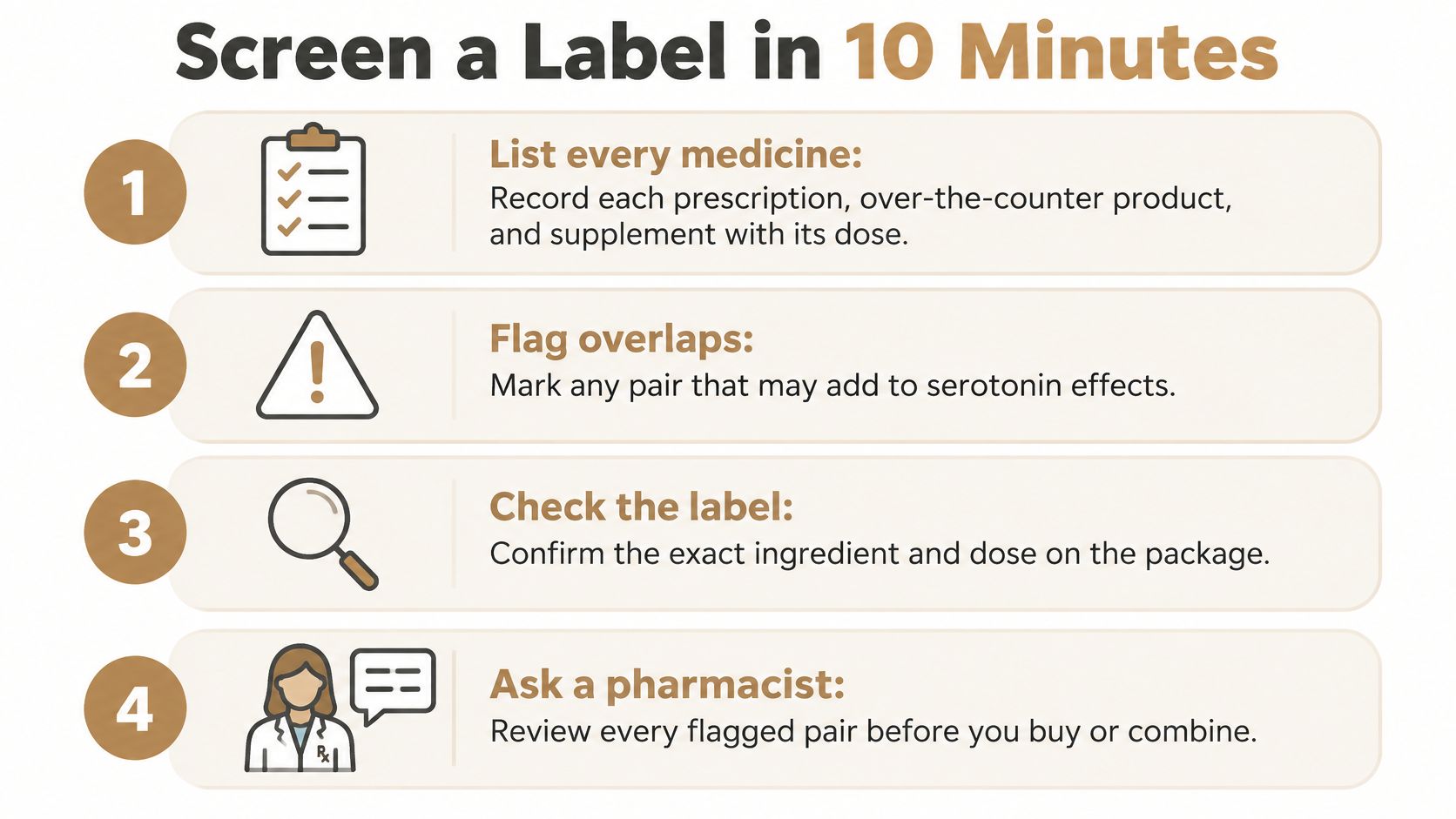
Use this six-step check before adding a mood product. It should take only a few minutes if you have your medicine and supplement labels handy.
- List everything you take. Write down each prescription, over-the-counter medicine and supplement, with its dose.
- Flag serotonin-related ingredients. Mark 5-HTP, tryptophan, SAMe and St. John's wort anywhere on that list.
- Check amounts and extract details. Look for a stated amount for each ingredient and, for botanicals, the extract type. A blend total isn't the same as an amount for each ingredient.
- Look for quality information. Check whether the manufacturer provides third-party testing or GMP certification; these details don't prove a mood benefit, but can help you assess product quality.
- Follow the serving instructions. Don't exceed the recommended dose, and keep supplements out of children's reach.
- Pause on any flag. Ask a pharmacist or prescriber to review the full combination before you start.
A label example
Femme Fresa Fatale is formulated with Maca Root, Damiana and Ginseng. Each gummy contains 200 mg of botanical ingredients, but that blended total doesn't show how much of each ingredient is in the gummy. That means step three can't be completed from the total alone.
This distinction matters when you're comparing a finished product with ingredient-level studies: the study's dose can't be matched to the gummy unless the individual amounts are known. If a label leaves you unsure what you'd be taking, pause and get a pharmacist's help. You can also review our guide to high-potency gummies for questions to consider when comparing products.
A gummy positioned for everyday wellness may fit a routine when the screen is clear, you aren't taking serotonergic medicines, and your mood changes are mild and temporary. If any medicine interaction is possible or symptoms are persistent, severe or worsening, speak with a clinician before trying a supplement.
Eve's Eden offers women's sensual wellness supplements, including Femme Fresa Fatale gummies formulated with Maca Root, Damiana and Ginseng for everyday wellness support. If you're comparing mood products, review the label and safety guidance first, then visit Eve's Eden to learn more about its offerings.
Powered by Outrank app