Best Mood Support Supplements by Evidence and Goal
Judge the best mood support supplements by goal, formula, evidence, and safety instead of chasing a single winner.
What if the search for the best mood support supplements starts with the wrong question? Most shoppers want a clear winner, but mood isn't one outcome, people aren't interchangeable, and ingredients don't carry the same level of proof. A better starting point is to name what you're hoping to support, everyday balance, confidence before a social moment, or relief from persistent low mood, and then ask what evidence matches that goal.
What Best Mood Support Supplements Really Means
Asking for the best supplement without naming the job is like asking for the best tool without saying whether you need a screwdriver or a ladder. Both are useful. Neither does the other's work. Mood products create the same confusion when a ranking treats a nutrient studied alongside depression treatment, a probiotic studied for anxiety symptoms, and a botanical gummy sold for daily confidence as if they're competing for one trophy.
Four Questions That Replace a Ranking
Start with questions a simple list usually skips.
- Best for which outcome: Are you looking at depressive symptoms, anxiety symptoms, general mood maintenance, or a self-care goal such as feeling more at ease and connected?
- Best for whom: Were the people in trials adults with a diagnosis, people with low nutrient levels, or generally well adults reporting everyday stress?
- Best in what formulation: Does the label disclose the ingredient form, amount per serving, and, where relevant, a ratio or standardized extract?
- Best with what evidence: Is the support based on finished-product trials, ingredient trials, observational links, or traditional positioning?
Those questions matter because the research base is uneven. A 2025 scoping review covering 209 clinical trials found evidence concentrated in a small group that included omega-3s, St. John's wort, saffron, probiotics, and vitamin D, while magnesium, melatonin, curcumin, and several other popular options remained mixed or insufficient. Trial populations and products also varied substantially, so a generic ranking can hide more than it reveals.
That concentration doesn't mean the five named categories are proven for every mood goal. It means researchers have studied them more, often for specific symptom scales in specific groups. A trial measuring depression scores doesn't directly answer whether a product supports sensual well-being, relationship ease, or how confident you feel getting ready for an evening out. Those are legitimate consumer goals, but they're different endpoints.
A useful definition of best is personal and specific. It names the outcome, the person, the formulation, and the level of proof before it names a bottle.
Ingredient findings also don't transfer automatically to a finished product. If a gummy, capsule, or powder doesn't disclose its exact ingredients and doses, or hasn't been tested as a finished product, you can't assume it will reproduce a trial result. Write your goal in plain language first. Then judge every product against that sentence, not against a headline promising a universal winner.
How Mood Support Differs from Depression Treatment
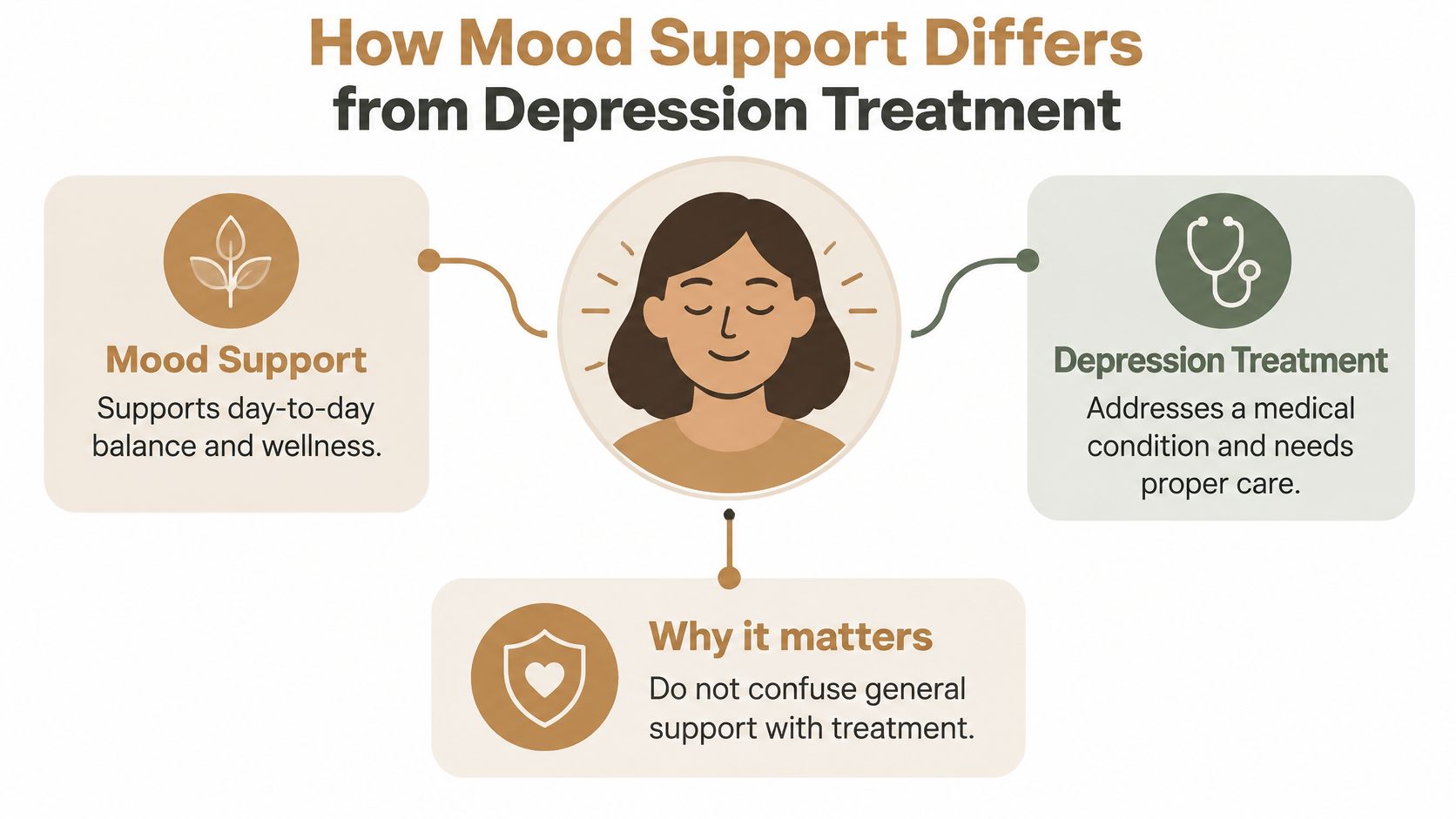
Mood support and depression treatment sound similar in everyday conversation, but they point to different responsibilities. Mood support language belongs to general wellness, such as supporting day-to-day balance as part of a routine. Depression is a medical condition, and treatment claims require a much stronger standard of evidence and professional care.
The visual below separates those two paths so the distinction stays clear as you compare products.
Nutrient research shows why that line matters. A meta-review of 33 meta-analyses covering 10,951 participants found the strongest evidence among nutrient supplements for polyunsaturated fatty acids, particularly EPA, when used as an adjunct to depression treatment. Adjunct means alongside standard care, not instead of it. That same evidence summary doesn't establish EPA as a stand-alone supplement for depression, and controlled trials of omega-3s used alone instead of standard antidepressant medication remain inconclusive.
What Modest and Uncertain Looks Like in Numbers
Vitamin B research offers a second, easy-to-misread example. In a 2019 systematic review of 18 articles representing 16 trials and 2,015 participants, eleven studies reported a positive effect on overall mood or a mood component, a detail that sounds encouraging in a headline. The pooled result told a more cautious story.
- Depressive symptoms: Across 568 participants, the effect was not statistically significant, with a standardized mean difference of 0.15 and p = 0.07.
- Anxiety: Across 562 participants, there was no effect, with a standardized mean difference of 0.03 and p = 0.71.
A standardized mean difference is a common ruler for comparing studies that used different scales. Values near zero mean the average shift was small. Statistical significance asks whether a result is distinguishable from chance under the study's threshold. Here, the combined vitamin B findings didn't clear that bar for depressive symptoms or anxiety, even though some individual studies sounded positive.
Reviewers of adjunctive omega-3 research have reached a similarly restrained conclusion, judging the average benefit unlikely to be clinically meaningful and finding high-certainty evidence insufficient for treating major depressive disorder. That's not a reason to dismiss nutrition. It's a reason to keep claims in their proper lane.
Responsible positioning: general wellness, mood maintenance, or nutritional support, not prevention or treatment of depression.
If a product marketed for everyday confidence borrows clinical language, pause. You're entitled to ask whether it was studied for that clinical outcome, in people like you, at the dose on the label. If the answer is no, treat it as a wellness ritual, not medical care.
Reading a Formula Instead of a Category Name
A category name tells you almost nothing on its own. Fish oil, omega-3, and saffron are starting points for questions, not specifications. Two products can share the same front-label phrase while delivering different ingredients, ratios, and amounts, which is why careful shoppers read the supplement facts before they read the marketing.
Omega-3 research gives you a worked example. A 2019 meta-analysis of 26 double-blind, randomized placebo-controlled trials involving 2,160 participants found a small overall improvement in depressive symptoms versus placebo, with a standardized mean difference of -0.28. Composition changed the picture. Formulations that were pure EPA or EPA-major, defined as at least 60% EPA, showed stronger effects at 1 g/day or less, while DHA-pure and DHA-major products did not show significant benefit.
The Shopping Rule Hidden in That Result
Don't stop at total omega-3 milligrams. Look for the actual EPA milligrams per serving and calculate whether EPA makes up at least 60% of the EPA plus DHA total the label discloses. A large softgel number can still be mostly DHA or other fats. Conversely, a lower total can be EPA-major if the formula is built that way.
Keep the boundary in view, too. Those trials measured depressive symptoms. They don't prove that every EPA product improves everyday confidence, intimacy, or a passing low mood. People taking anticoagulants or managing a mood disorder should get clinician guidance before use.
Saffron teaches the same label lesson from the botanical side. Positive findings don't remove the need for a named, standardized extract, a disclosed dose, and validated testing. The word saffron alone doesn't tell you which extract was used or whether the amount matches anything studied.
What to Verify on a Mood Supplement Label
| Label language | What to verify | Why it matters |
|---|---|---|
| Fish oil or omega-3 | EPA milligrams, DHA milligrams, and EPA percentage | Composition, not total oil, drove the differences described above |
| Botanical name | Named extract, plant part where disclosed, and amount per serving | A category word can't show whether a formula resembles a studied preparation |
| Proprietary blend | Whether individual amounts are disclosed or only a combined total | A combined total limits your ability to compare dose with research |
| Mood support | Whether positioning is adjunct, nutrient support, or general wellness ritual | Positioning tells you which expectations are reasonable |
| Quality language | Testing and manufacturing details the brand actually provides | Specific information is more useful than broad purity claims |
Use the table as a quick filter. If you can't identify the ingredient form and amount, you can't meaningfully compare the product with evidence, however strong the category research may be. That's true for nutrients, probiotics defined by strain, and botanical blends alike.
What Vitamin D Research Shows About Expectations
Vitamin D is familiar, widely discussed, and often linked with mood, which makes it an ideal case for learning how expectations can outrun evidence. The research doesn't move in a straight line from low levels to supplement benefit. It splits into two different kinds of findings, and confusing them leads shoppers to expect more than trials have shown.
The comparison below frames that split between a widespread association and mixed intervention results.
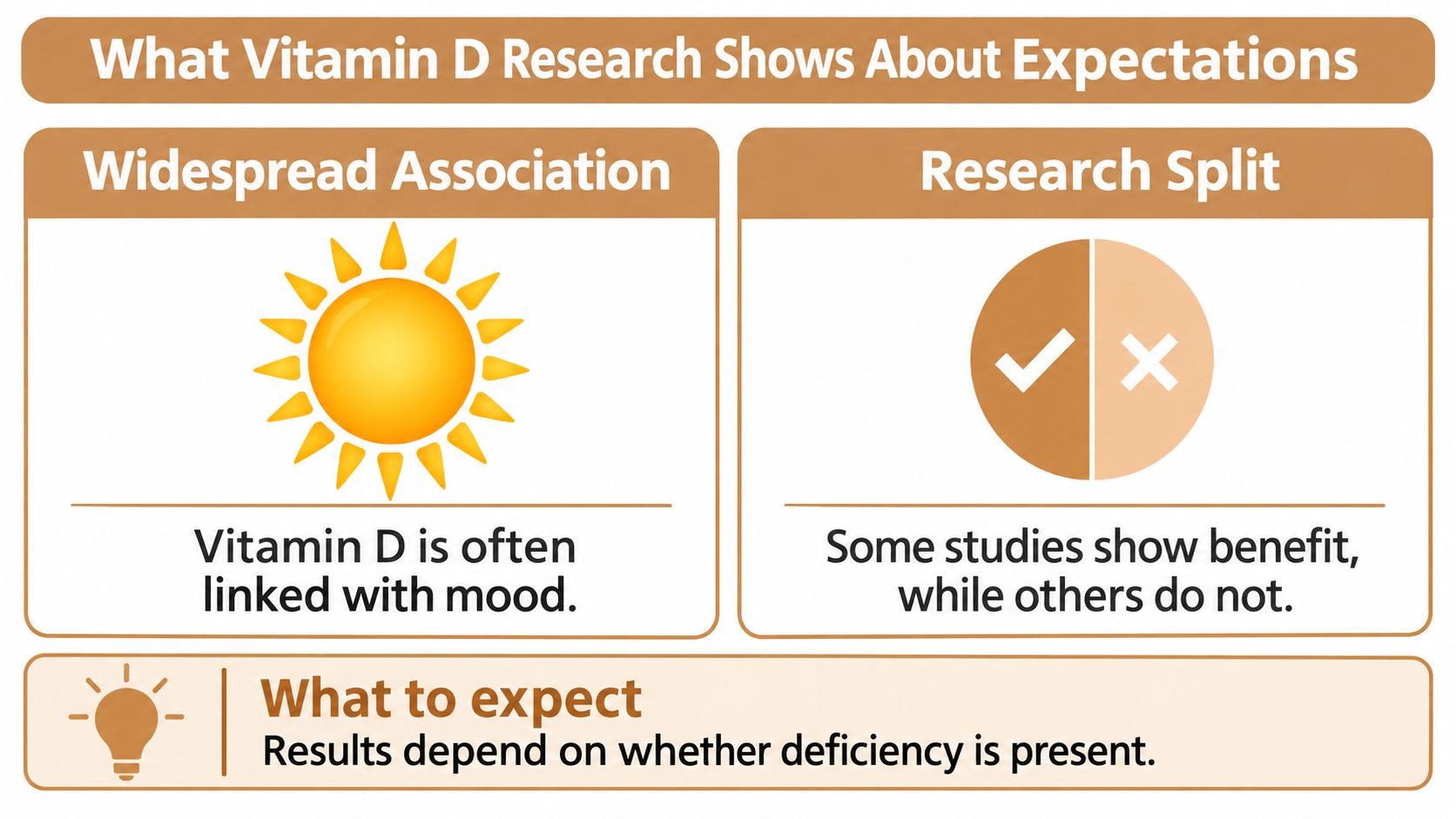
On one side, observational research found a link. A systematic review of 14 observational studies involving 31,424 adults found an association between low or deficient 25-hydroxyvitamin D levels and depression, with participant mean ages ranging from 27.5 to 77 years. Observational studies watch patterns. They can show that two things travel together, but they can't by themselves prove that changing one will change the other.
Think of it as a weather report versus a raincoat test. Noticing that people carry umbrellas on wet days doesn't prove umbrellas cause rain, and it doesn't prove handing out umbrellas will change the weather. You need an intervention test. For vitamin D, a separate meta-analysis of nine randomized trials involving 4,923 adults diagnosed with depression or depressive symptoms found no significant reduction in symptoms after supplementation. Clinical trials also found no meaningful differences in depression incidence, recurrence, or mood scores.
A Wider Lesson From Diet Trials
Diet research reinforces the need for modest expectations. A 2020 meta-analysis of 16 randomized dietary-intervention trials involving 45,826 participants found a statistically significant but small reduction in depressive symptoms, with an effect size of g = 0.162. Anxiety outcomes across 11 trials and 2,270 participants were not significant. Small average shifts across thousands of people can be real without feeling dramatic for any one person.
The short video below adds everyday context for thinking about vitamin D and mood before you translate research into a purchase.
None of this makes nutrient adequacy unimportant. If you're concerned about vitamin D status, testing and clinician guidance are more informative than guessing from mood alone. It does mean a supplement shouldn't be presented as a proven depression treatment without product-specific clinical evidence. Apply that same standard to products marketed around confidence and well-being. A plausible wellness role isn't the same as a demonstrated clinical outcome.
Safety Checks Before You Add a Supplement
A product can have studies behind its ingredients and still be the wrong choice for you. Safety depends on your medications, health history, life stage, and the severity of what you're experiencing. Labels that say natural or generally safe in trials don't answer those personal questions.
Use the checklist below as a prompt for a slower, more specific review before you buy.
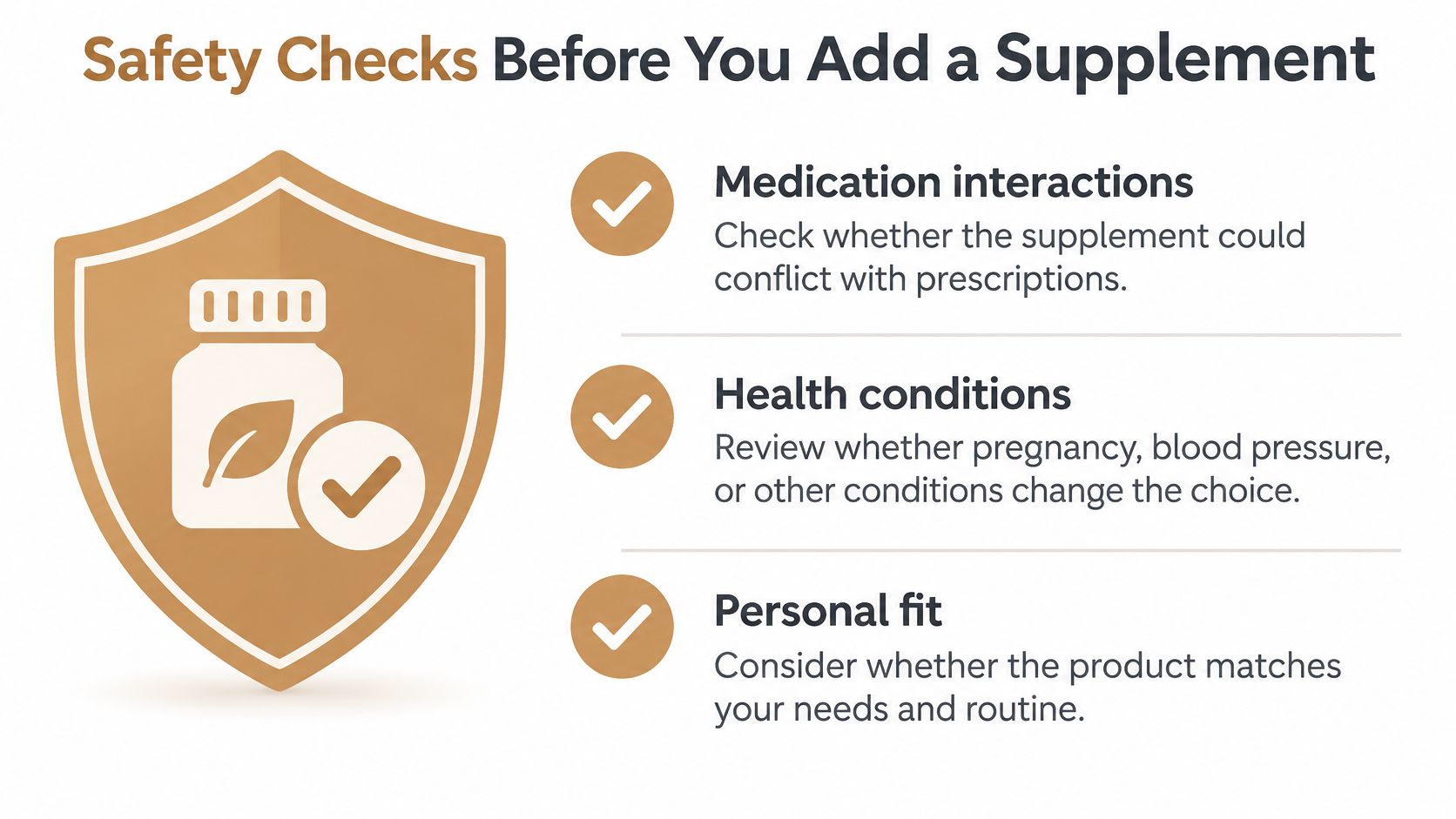
St. John's wort shows why medication review comes first. It's frequently listed among evidence-supported mood supplements, yet you still need explicit guidance on interactions with prescription medicines, hormonal contraception, antidepressants, and other drugs. Calling it a natural mood booster doesn't make that check optional.
Your Stop and Check List
Work through these questions before adding anything new.
- Medication review: List prescriptions, over-the-counter medicines, hormonal contraception, and other supplements, then check interactions with a pharmacist or clinician.
- Life stage: Pause for professional guidance if you're pregnant, trying to conceive, or breastfeeding.
- Mood history: Discuss bipolar-spectrum symptoms, current depression or anxiety care, and any recent medication changes before using mood-positioned products.
- Severity and duration: Treat severe, persistent, worsening, or function-limiting distress as a reason to seek professional care rather than self-experiment.
- Tolerance: Consider gastrointestinal sensitivity and stop rules, especially with probiotics, oils, and botanical blends you haven't used before.
Probiotics illustrate why positive averages still need personal context. A 2025 meta-analysis of 23 randomized trials involving 1,401 participants found reductions in depression and anxiety symptoms, but heterogeneity was high, and study duration and formulation contributed to varying effects. Another review found probiotic monotherapy produced only a small improvement in unmedicated mild-to-moderate depression and noted possible industry bias and study heterogeneity. Strain, dose, duration, and baseline nutrient status can matter more than the category name.
That nuance is practical, not academic. If results vary by formulation, a different strain at a different dose for a shorter period isn't the same intervention. If you're also deciding where to shop in person, bring the same medication list to that conversation, whether you start online or look for a health and wellness store near me. Studied doesn't mean universally safe, and tolerated by trial participants doesn't guarantee it'll suit you.
How to Choose a Daily Mood Support Ritual
Once you've separated goals and checked safety, three paths cover most decisions. They aren't better or worse in the abstract. Each fits a different situation, and mixing them up is where disappointment starts.
The image below reflects that choice between trial-led nutrient decisions, a botanical daily ritual, and professional care.
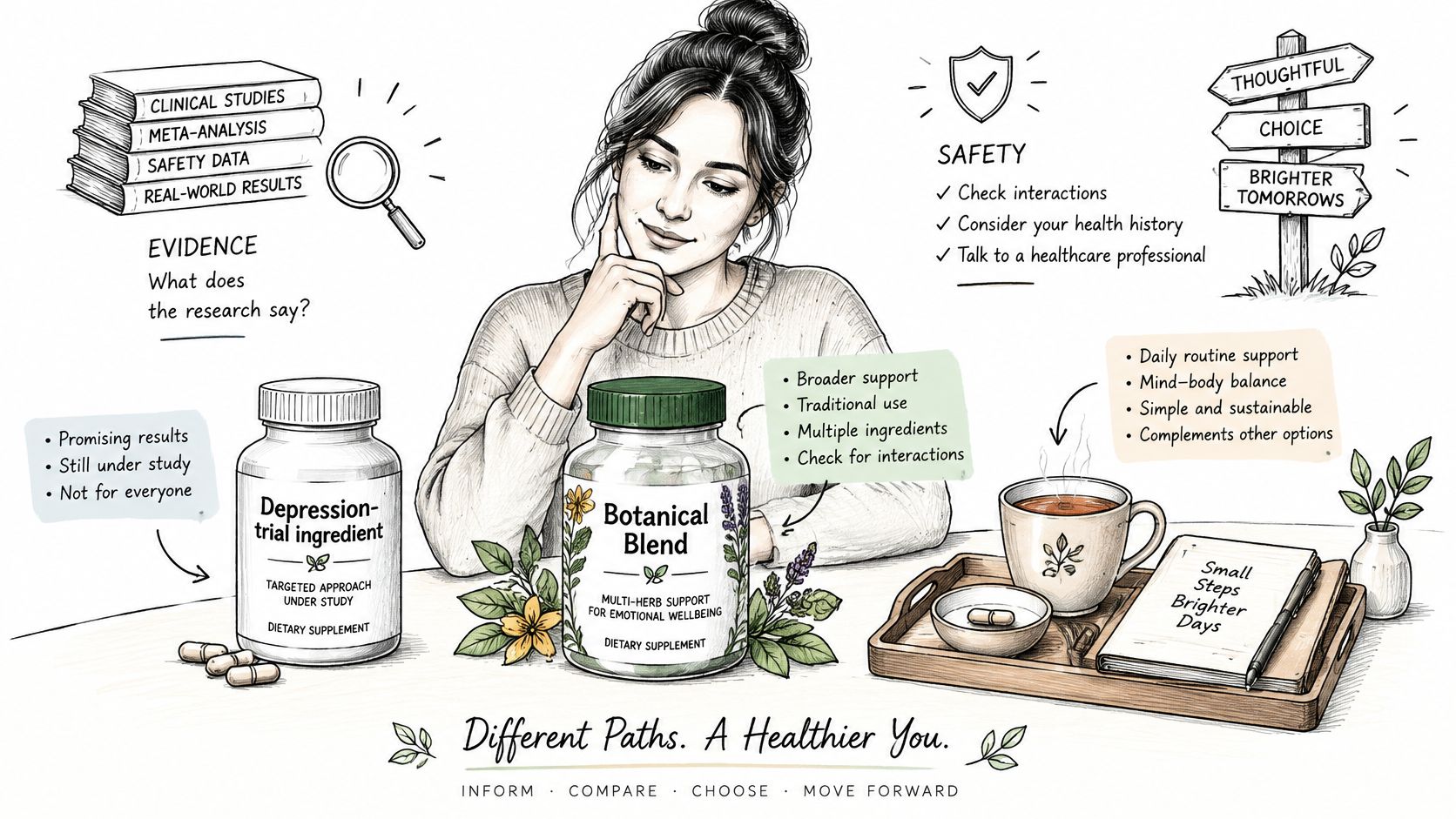
Path one is a tightly specified nutrient. This fits when your question is tied to depressive-symptom evidence and you're working with a clinician, especially if a supplement would sit alongside existing care. For omega-3s, the decision turns on EPA milligrams and percentage, as covered in the label section above. It isn't an intimacy guarantee, and it shouldn't be sold as one.
Path two is a broad botanical ritual. This fits when your goal is everyday self-care and you value format, flavor, and a routine you'll enjoy. Judge it by named ingredients, disclosed amounts, honest wellness positioning, price, and whether the schedule fits your life. Don't judge it as if it won a clinical ranking it never entered.
Path three is professional care without a supplement detour. This fits when distress is severe, persistent, worsening, or interfering with work, sleep, relationships, or safety. In that situation, skipping a purchase and seeking assessment is the responsible choice, not a failure to find the right bottle.
Applying the Same Checklist to a Women's Gummy
Our Femme Fresa Fatale belongs in the ritual category. It's a strawberry-flavored daily gummy positioned around confidence, connection, feminine vitality, energy, mood, and balance. Each gummy contains 200 mg of botanical ingredients formulated to support energy, mood, and confidence, and the blend includes Maca Root, Damiana, and Ginseng as part of a modern sensual wellness ritual. The regular price is $24.99.
We frame Femme Fresa Fatale as sensual wellness rather than treatment of a named medical condition. Our material emphasizes botanicals and clinically studied nutrients, but it doesn't provide finished-product trials, so you shouldn't infer specific clinical outcomes from ingredient categories. That transparency lets you make a fair comparison. Choose it, if you choose it, because the disclosed blend, gummy format, price, and everyday positioning match a modest wellness goal, not because it replaces care for depression or anxiety.
Match the product type to the promise. A ritual should be judged as a ritual, a specified nutrient by its specification, and clinical symptoms by a clinical standard.
If you can't say which path you're on in one sentence, you're not ready to compare products yet. Write the sentence, then shop.
A Practical Next Step for Everyday Wellness
Bring the decision down to one sequence you can repeat with any product. First, name your goal in everyday language, such as supporting calm confidence as part of an evening ritual. Second, confirm that goal isn't a substitute for depression or anxiety treatment. Third, check medications, medical conditions, and life stage. Fourth, read the actual serving instructions instead of relying on a headline or flavor description.
If your goal is a simple women's wellness ritual, review Femme Fresa Fatale against those four steps and decide whether its format fits your routine. Take the suggested serving about 45 minutes before you want to feel your best, and the gummies can be enjoyed as needed with no daily commitment required. Keep expectations modest, because our material doesn't establish specific clinical outcomes for the finished product.
Boundaries to Confirm Before Use
- Adults only: The gummies are for adult use only, 18 and older.
- Consult first: Consult a healthcare professional before use, especially if you're pregnant, nursing, managing a medical condition, or taking medication.
- Watch your response: Side effects are rare, and if any adverse reaction occurs, discontinue use and consult a healthcare professional.
- Follow the serving: Don't exceed the recommended dosage, and keep the product out of reach of children.
Before buying, verify the practical details on the product page you open, including current currency and shipping information. Use the store locator if you prefer wellness-store availability, and use the FAQ or contact pages for practical questions about ordering or policies. That final check turns a vague search for the best mood support supplements into a specific decision you can explain. You know the goal, the product type, the serving, and the boundaries. That's a stronger next step than chasing a ranking that never asked what you needed.
If your goal is an everyday confidence and sensual wellness ritual rather than treatment for a medical condition, explore our strawberry-flavored Femme Fresa Fatale gummies with Maca Root, Damiana, and Ginseng and review the serving and safety details before you decide. Visit Eve's Eden to shop online, check store availability, and find answers to practical product questions.
Drafted with Outrank app