How to Cu: Choose a Wellness Gummy Safely
How to cu is an unfinished search. Match the phrase to a real goal, then use steps and a label checklist to judge a sensual wellness gummy.
If a wellness gummy is botanical and easy to take, what tells you whether it's suitable for you? Neither feature answers the questions that matter most: what you want it to do, what's in the finished formula, and whether taking it makes sense alongside your health needs.
The search phrase “how to cu” is unfinished, so there's no single method that answers it. If you meant choosing or using a wellness gummy, start with a decision rather than a purchase.
What How to Cu Can Mean
What how to cu might mean
| Reading | What the searcher wants | Covered here |
|---|---|---|
| CU as see you | A casual sign-off in texts or email | No, it is not a procedure |
| Cu the element copper | Identity of the metal, not a use method | Identity only, not a how-to |
| CU as credit union | Banking or membership information | No |
| Unfinished wellness query | How to choose or check a daily gummy for mood, confidence, or intimacy | Yes, the rest of this guide |
The Free Dictionary's C.U. entry identifies CU as an informal abbreviation for “see you.” That's a message closing, not a process with steps, a dose, or an outcome.
Copper and banking belong to different searches. Cu is copper's chemical symbol; Britannica's copper entry identifies it as having atomic number 29 and standard atomic weight 63.546, with its name derived from the Latin cuprum, associated with Cyprus. Those facts identify a metal, not instructions for using it, while a credit-union query needs banking or membership information rather than supplement guidance.
Finish the question before choosing a product
For wellness, the missing words matter. Choosing a supplement, checking its safety, and deciding whether a health concern needs care are different tasks.
Say you want to feel more comfortable making time for intimacy. That might involve privacy, less pressure, a conversation with a partner, or help with discomfort. A product marketed around confidence doesn't tell you which of those needs applies.
Likewise, wanting a calmer evening isn't the same as seeking treatment for persistent anxiety. A broad word such as mood can hide a specific concern that deserves a more useful answer than a shopping recommendation.
A useful goal describes a change in your life, not a promise copied from a bottle.
Try completing this sentence: I want support with ______ so that I can ______. Use ordinary words, such as feeling more at ease during an evening routine or making space for connection without feeling rushed.
Leave out product names for now. If you can only describe the result using advertising language, make it more concrete. Before shopping, write a sentence naming the result you want.
How to Check the Label Before You Buy
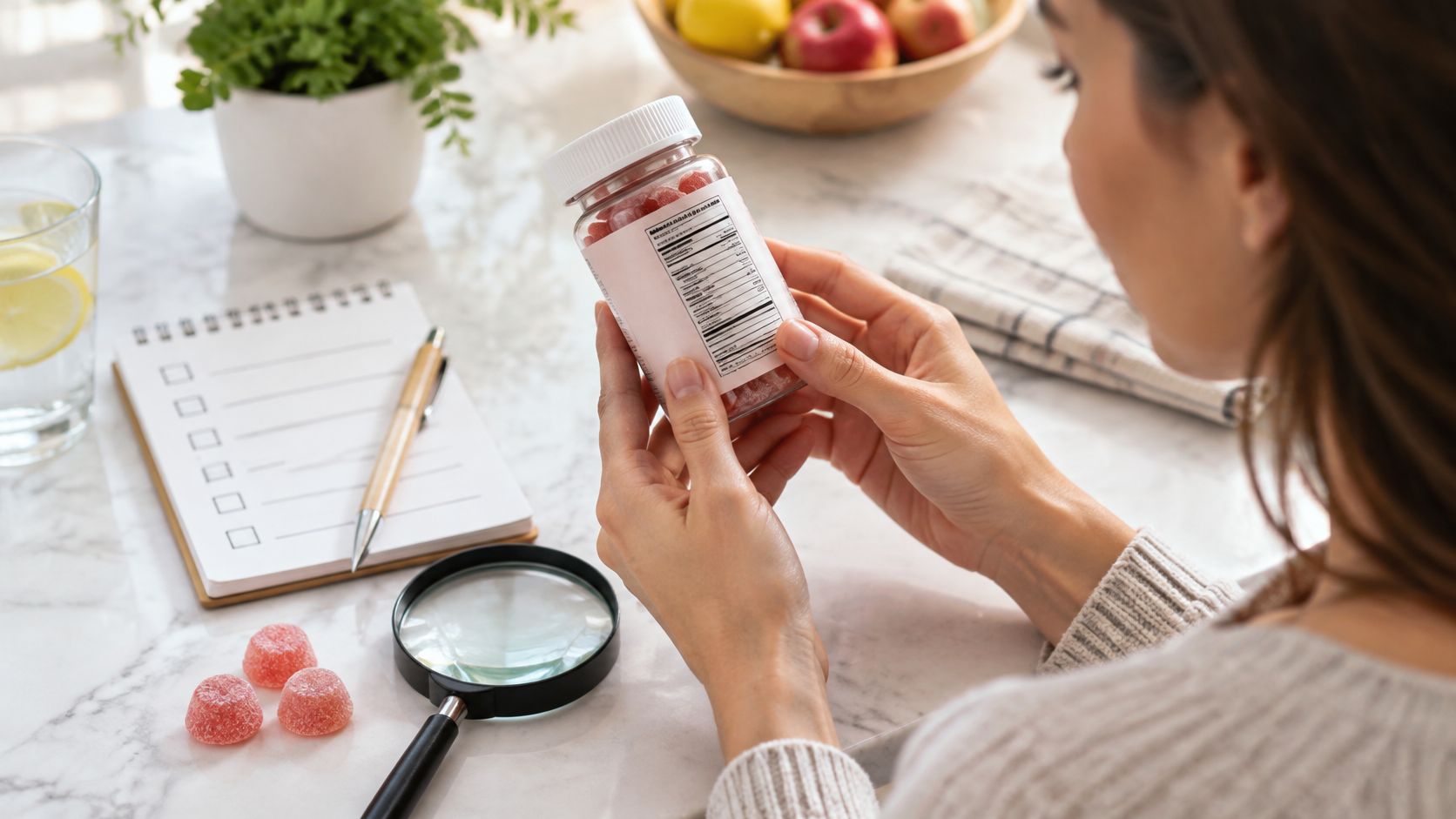
Treat the finished-product label as your starting document. Photograph the ingredient panel, directions, and warnings so you can compare products without relying on the front of the package.
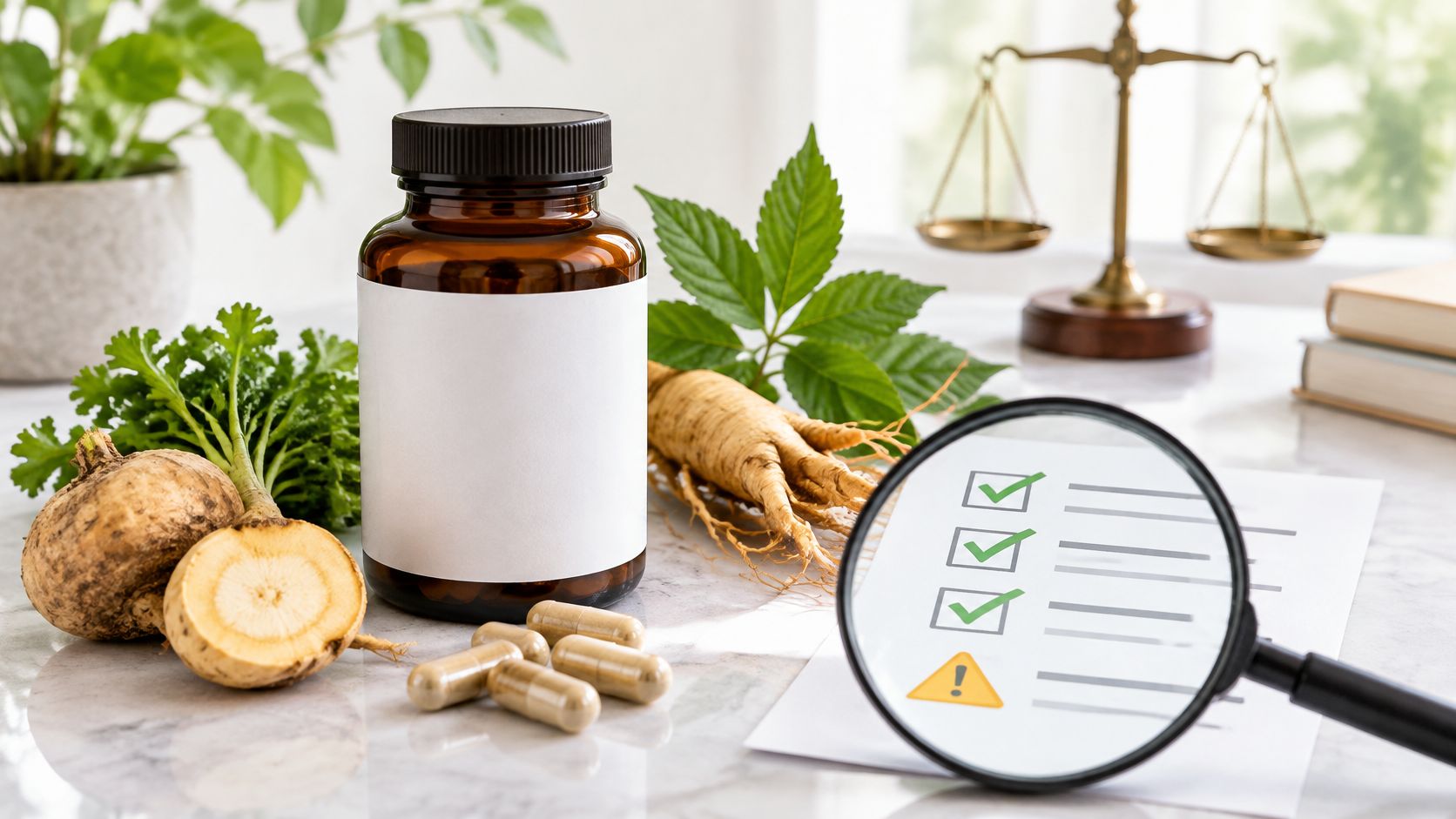
The visual checklist offers a quick starting point. Sourcing information is useful context, but it can't substitute for ingredient amounts.
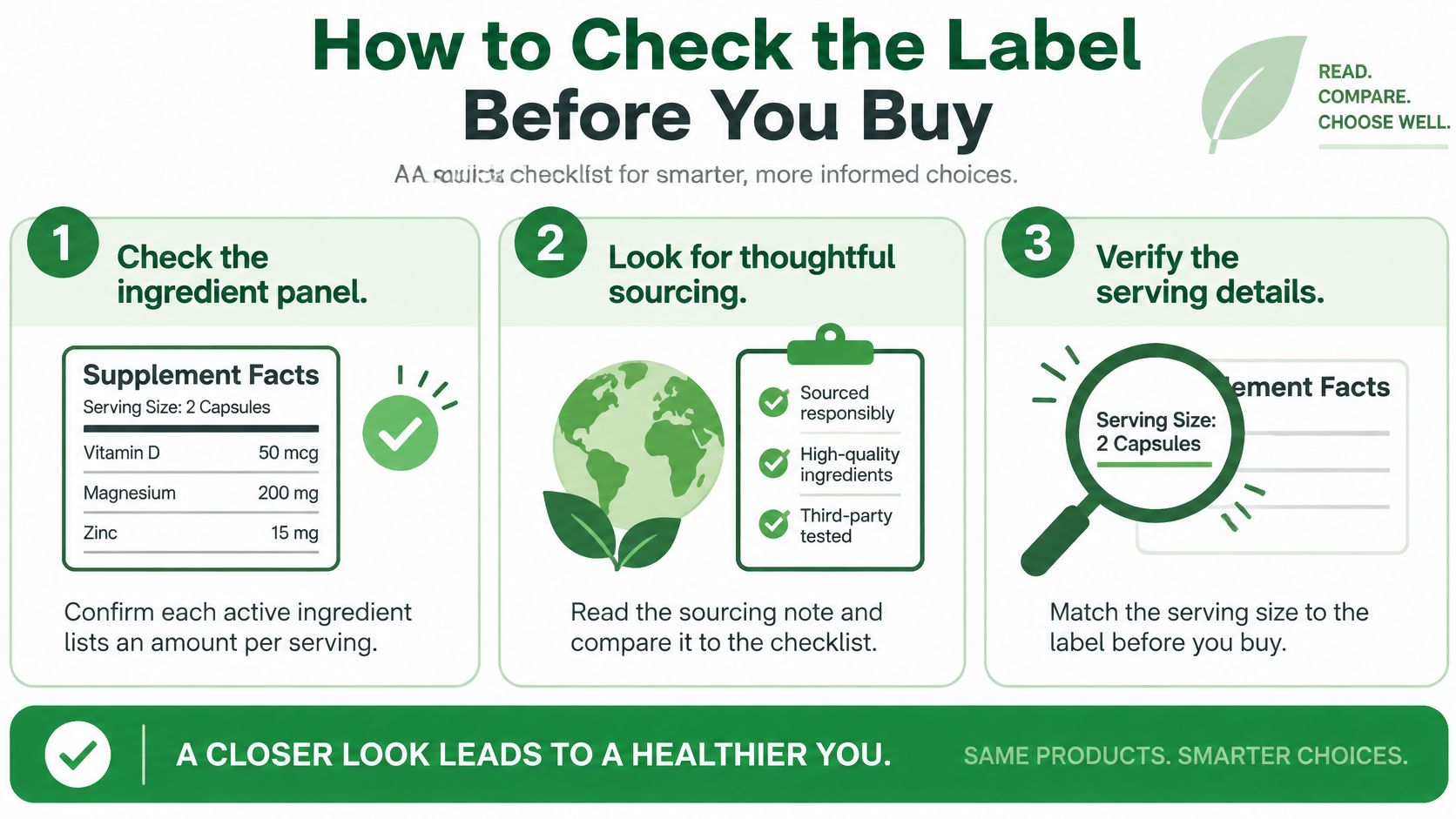
Use the same scoring sheet
Label checks for a sensual wellness gummy
| Check | Pass looks like | What it does not prove |
|---|---|---|
| Active ingredients and amounts | Every active named with an amount per serving | That the blend will change mood or intimacy |
| Finished-product evidence | Evidence cited for this formula, not only one ingredient | A guaranteed personal result |
| Serving size | One clear serving and no duplicated ingredient counts | That more gummies are better |
| Third-party mark | USP, NSF, or similar content and contaminant screening | Better confidence, libido, or connection |
| Interaction warnings | Visible cautions and a way to ask the maker | Safety with your medicines |
| Problem reporting | A stated route to report an adverse event | That no one has ever had a reaction |
Start by matching every active ingredient to an amount per serving. A sourcing statement describes where or how a manufacturer obtains materials; it doesn't tell you how much you'll take. If a blend names ingredients without individual amounts, record that as an information gap.
Next, inspect the evidence behind the claim. A study of an isolated nutrient doesn't establish that a gummy containing that nutrient produces the same result. Ask whether the evidence concerns the finished formula, its serving, and an outcome relevant to your goal.
Compare the serving information across the panel and directions. Watch for ingredients listed separately and within blends, and ask the manufacturer to explain any unclear overlap. When considering high-potency gummies, look for a clear explanation of the amount rather than treating potency language as a reason to buy.
Separate verification from effectiveness
Independent evaluation marks such as USP or NSF can help verify contents and screen for harmful ingredients. They aren't proof that a gummy improves confidence or intimate connection.
The FDA's dietary supplement guidance for women states that it doesn't review or approve dietary supplements for safety before sale and recommends checking information sources and contacting manufacturers for product details.
Read cautions and locate a customer-contact route before ordering. Also find instructions for reporting an unwanted reaction, rather than assuming a general returns page serves that purpose.
Complaint reports may come from consumers, health professionals, and companies. A voluntary report doesn't establish that a product caused an event, and an apparent absence of complaints isn't a safety guarantee. Cross-border purchases also deserve attention because labeling requirements and enforcement can differ.
If an ingredient amount, serving size, or way to contact the maker is missing, leave the question unresolved. Marketing copy isn't a substitute for an answer.
How to Choose a Sensual Wellness Gummy Safely
Interest in well-being doesn't automatically make a supplement the right next step. In 2025, 65% of women consumers surveyed in NielsenIQ research said they actively seek products or services to improve their mental well-being, a 33% increase from three years earlier. That describes demand, not evidence that a particular gummy works.
Use a decision process that allows you to stop, ask questions, or choose something other than a supplement.
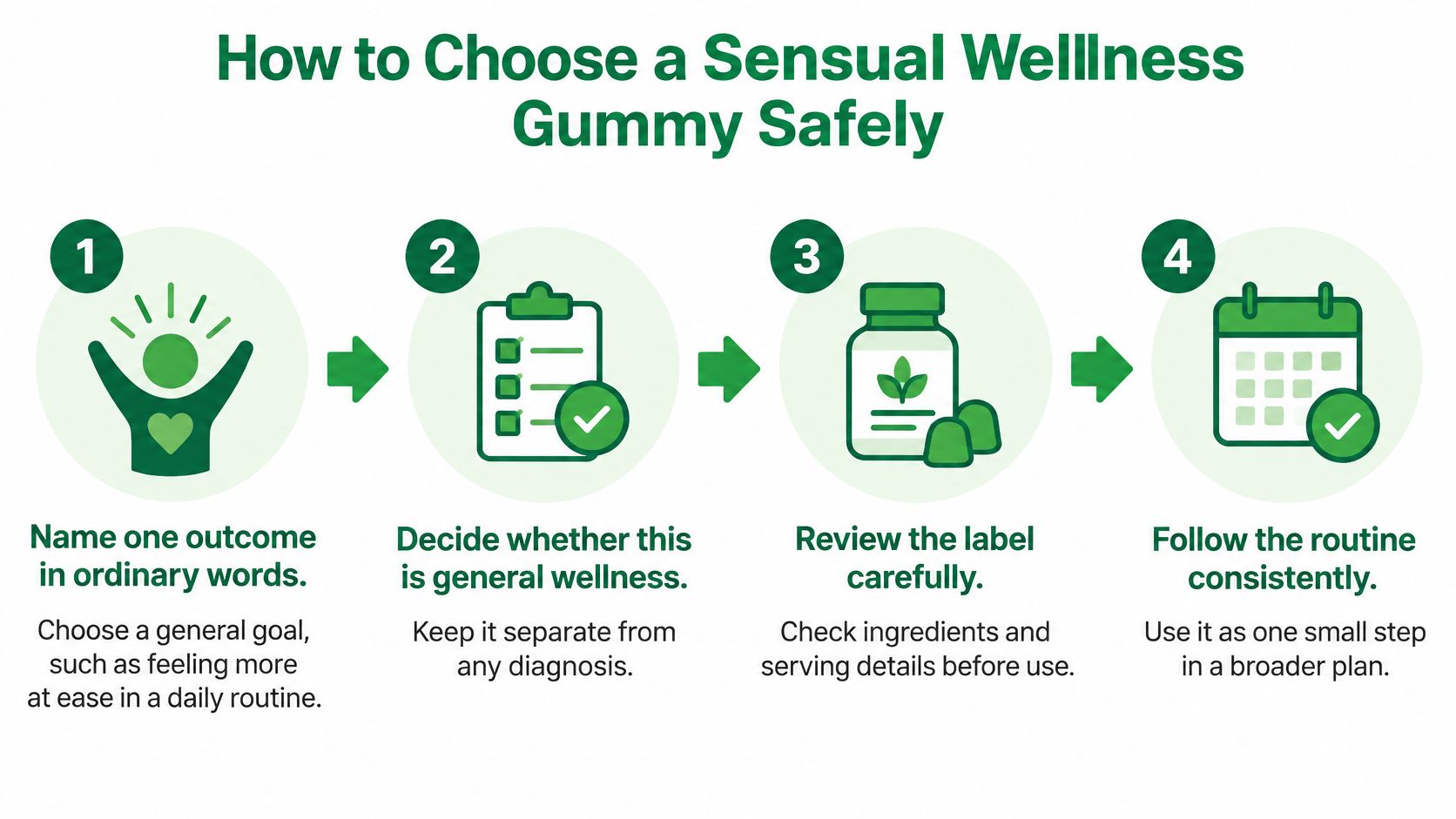
Make the health decision first
Name an everyday outcome. Choose something you can describe without diagnosing yourself. Feeling less rushed during personal time is clearer than fixing your hormones. The more specific your aim, the easier it becomes to judge whether a supplement is even relevant.
Decide whether you're seeking self-care or medical help. Persistent mood changes, pain during intimacy, or symptoms that disrupt daily life warrant a clinician conversation. Don't use a wellness purchase to postpone an assessment or replace treatment.
Check your pause points before paying. Pregnancy, breastfeeding, medication use, high doses, combining supplements, and replacing prescribed treatment all deserve review. The NIH Office of Dietary Supplements consumer guide advises asking about personal benefits, appropriate doses, timing, and medicine interactions, and warns about risks from high doses, supplement combinations, and substituting supplements for prescribed care.
Make that conversation practical. Bring the bottle or clear label photographs, the intended dose, and a complete list of medicines and supplements, including occasional products. Don't leave out something because you think of it as herbal tea, a sleep aid, or a beauty supplement.
Write down these questions before the appointment:
- Personal benefit: What benefit, if any, could reasonably apply to my goal?
- Dose suitability: Is this amount appropriate for me, and how should timing and duration be decided?
- Interaction check: What could interact with my medicines, supplements, or health conditions?
A pharmacist can help review medicine-related questions; a clinician can assess symptoms and your broader health situation. If an answer requires information the label doesn't provide, request it from the manufacturer before proceeding.
Compare, then define your stopping point
Compare only products you can inspect. Keep the label photographs beside your goal sentence. Reject comparisons based solely on flavor, packaging, botanical imagery, or an ingredient's reputation. A broader overview of women's health products can help you distinguish product categories, but your purchase decision still needs product-specific information.
Set a review date before starting. If you decide to try a suitable product, put a review on your calendar for the end of the first bottle, unless a pharmacist or clinician recommends an earlier check. This is an organizational checkpoint, not an evidence-based promise about how quickly it should work.
Define what no meaningful change would look like. For example, you may still feel just as rushed or uncomfortable in the situation you hoped to improve. Don't move the goal because you've already paid.
In 2025, 63% of women surveyed by BBH said they struggle to prioritize their health. A written decision can reduce the pressure to turn self-care into another obligation.
You're allowed to decide that a gummy isn't worth adding. Natural, botanical, and chewable describe features, not a personal safety assessment or proof of effectiveness.
Daily Gummy Routine Tips
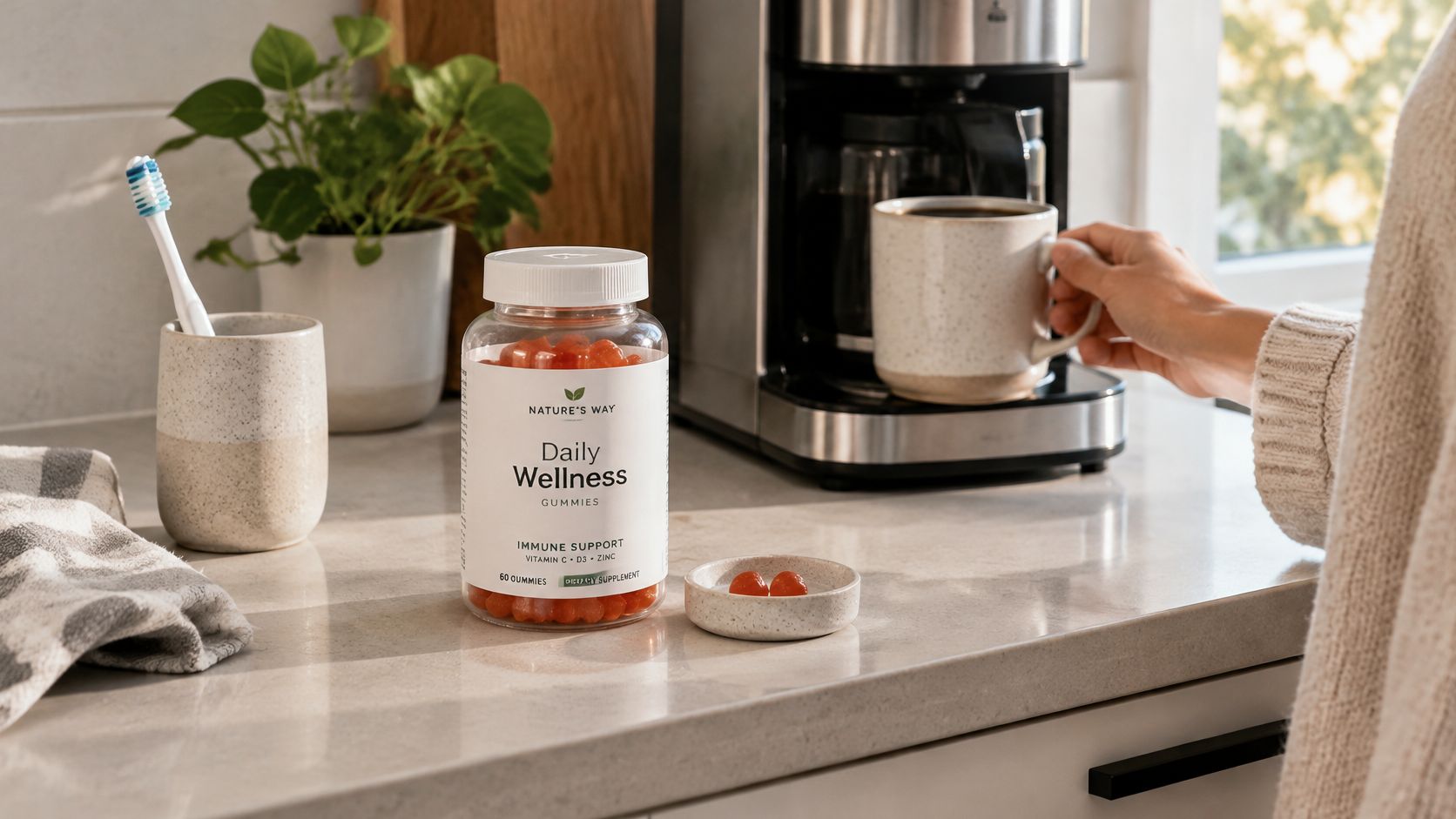
Say you've checked a product, resolved your health questions, and decided to try it. On a typical morning, you make coffee, check the day's plans, and take the labeled serving at the time permitted by the directions. Pairing it with an existing cue can make the routine easier to remember.
Keep the bottle somewhere appropriate for its storage instructions and out of children's reach, rather than automatically leaving it beside food. A convenient routine shouldn't make a supplement easy to mistake for candy.
Keep the wider routine intact
In 2025, 89% of U.S. women surveyed by Bayer reported practicing at least one self-care approach, such as maintaining a positive mindset or close personal relationships. A gummy belongs alongside meaningful habits, not in place of them.
After breakfast, that might mean protecting time for a walk or sending a message to someone you trust. Later, it could mean making room for rest instead of treating the supplement as compensation for an overloaded day.
In 2025, 33% of consumers surveyed in research reported using food, beverages, or supplements to manage stress, according to NutraIngredients. That finding describes consumer behavior, not successful stress treatment.
Keep the practical boundaries simple:
- Serving boundary: Take the labeled serving, not extra gummies because the day feels difficult.
- Combination boundary: Don't add another mood or intimacy product on impulse. Check the combination before changing your routine.
- Missed-serving boundary: Consult the directions or ask a pharmacist rather than inventing a catch-up dose.
Record your day, not just your dose
At bedtime, make a brief note about sleep, stress, and connection. Record something concrete, such as a difficult workday, uninterrupted time with a partner, or a restful night, so your later judgment reflects your circumstances.
A daily note can help you notice patterns. It can't establish that a supplement caused a change.
If intimacy is part of your aim, tell a partner what would help: less pressure, more time, or affection without an expectation of sex. A trusted friend may also help you think through what you need.
If you notice a suspected reaction, stop taking the product and seek appropriate advice. If the routine becomes a way to avoid care you know you need, pause the purchase cycle too. Ease of chewing is a convenience, not evidence.
Confirm the Goal Before You Order
If you meant a message sign-off, copper, or a credit union, search that complete phrase. Those are legitimate questions, but they lead to different answers.
If you meant a women's wellness gummy, your next decision isn't automatically which bottle to order. It's whether you have enough information to make a reasonable choice.
Choose a next step, not just a checkout button
Keep your goal sentence visible while comparing options. It can help you notice when you're drawn to a product for an appealing description rather than a relevant, inspectable formula.
Use these decision points:
- Buy now: Your questions are answered, the product fits your intended use, and no unresolved health concern requires review.
- Wait for answers: You still need ingredient details, clarification of directions, or a response from the manufacturer.
- Arrange a conversation: A symptom, medicine, pregnancy, breastfeeding, or another pause point needs professional attention before purchase.
Local availability and online convenience can help with logistics. A guide to finding a health and wellness store near you can help you plan where to inspect a bottle, but store presence isn't proof of product quality.
Neither shipping offers nor currency options answer a health question. If you visit a shop, bring the checklist and ask to see the complete package; if you order online, save the label information you relied on.
You don't need to turn uncertainty into a purchase to show that you're taking care of yourself. Waiting for a clear answer is a useful decision, especially when the alternative is guessing about something you plan to take regularly.
Save your goal sentence and checklist, then choose whether to buy, wait for label answers, or book the clinician conversation.
Eve's Eden offers women's sensual wellness supplements, including Femme Fresa Fatale, a daily gummy positioned around feminine well-being. Visit Eve's Eden to inspect the current product information and ask any unanswered ingredient or serving questions before deciding whether it fits your routine.