How Much Are Edible Gummies? Prices Explained for 2026
Wondering how much are edible gummies? See typical bottle prices, cost per gummy and per day, and what changes the price.
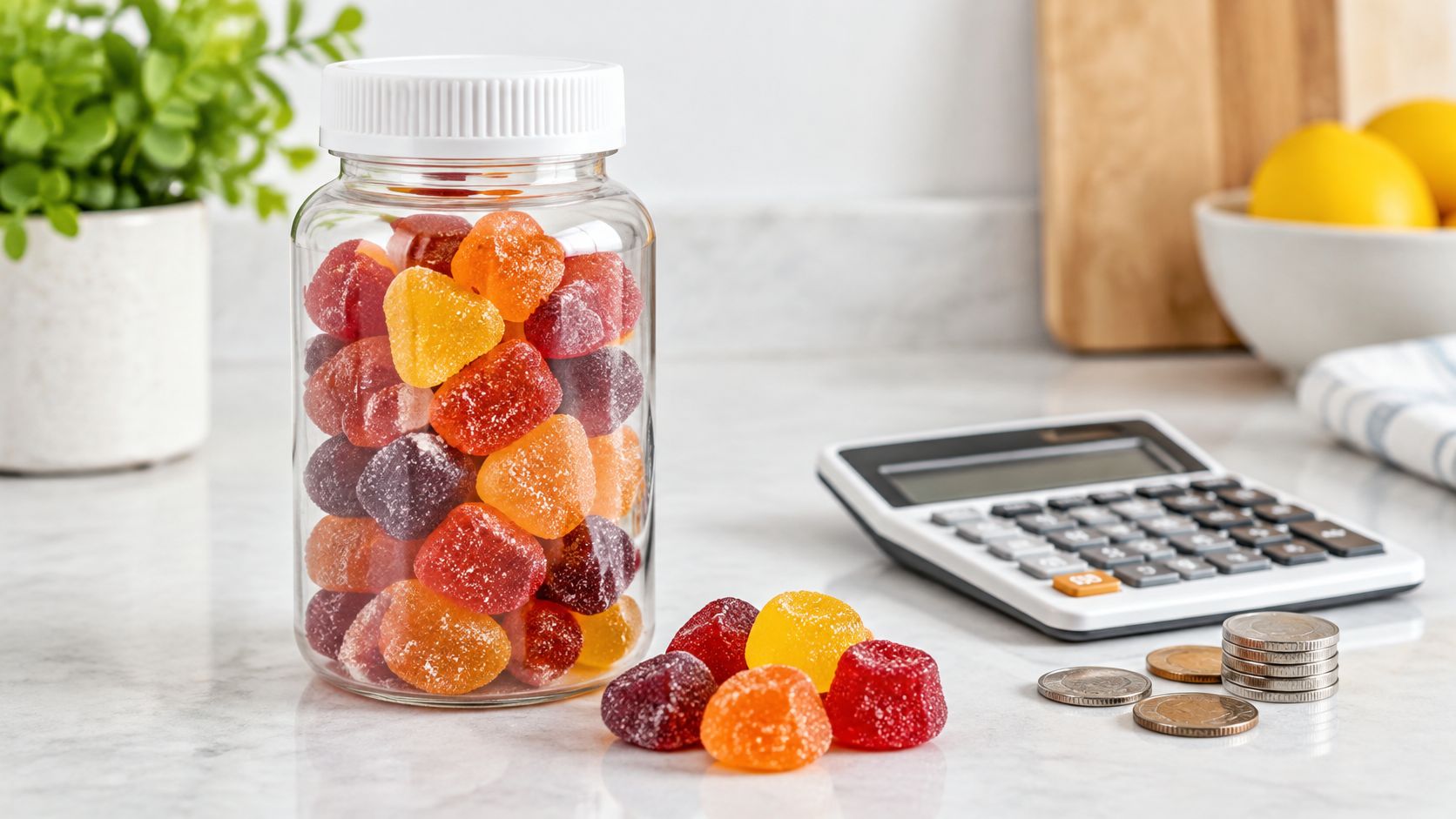
A typical 60-count adult gummy supplement bottle in the U.S. usually costs about $15 to $28, or roughly $0.25 to $0.47 per gummy. Your cost per day depends on how many gummies make up one serving, so a bottle that lasts 60 days at one gummy daily lasts 30 days at two.
That distinction answers How Much Are Edible Gummies more truthfully than any single sticker price. Shoppers mix up three questions at once, what the package costs, what each gummy costs, and what a day of use costs. You'll get a different winner depending on which one you compare. The sections below separate those numbers, show you the arithmetic, and explain why a higher bottle price sometimes reflects real manufacturing cost and sometimes only reflects positioning.
Typical Edible Gummy Prices at a Glance
Start with the shelf benchmark, then convert it to your routine. A typical retail bottle costs about $15–$28 for 60 gummies, or approximately $0.25–$0.47 per gummy assuming one gummy per serving, according to the Dataintelo adult gummy supplements market report. Treat that as a category benchmark for adult dietary gummies in the U.S., a range that helps you spot outliers rather than grade any single formula. If a bottle sits far outside it, ask what explains the gap before assuming quality or a bargain.
The per-gummy figure is only the first step. A 60-count bottle at one gummy daily covers 60 days; the same bottle at two gummies daily covers 30. Price per gummy stays fixed, while cost per day doubles from roughly $0.25–$0.47 to about $0.50–$0.94. That is why the better comparison is servings per container translated into daily cost, especially when labels define a serving differently.
Prices by market tier
Use tiers as a rough map, then verify the label.
Gummy supplement prices by market tier
| Market tier | Rough guide |
|---|---|
| Value and private-label | Usually the leanest formulas; check serving size and count first. |
| Mass-market national brands | Mid-range positioning; compare active amounts against the bottle price. |
| Premium specialty products | Higher price may reflect complex botanicals, testing, or smaller runs. |
| Prestige direct-to-consumer | Branding can be a large share of price; read the Supplement Facts panel closely. |
A value product and a prestige product can sit far apart per day. The gap may come from branded extracts, third-party testing, smaller production runs, and direct-to-consumer marketing. Packaging and branding alone can also widen it, so the tier name cannot justify the price by itself.
Practical rule: Compare products inside the same tier first. A premium formula judged against a private-label mineral gummy will always look overpriced, even when its ingredients cost more to make.
Dietary Gummies and Cannabis Edibles Are Priced Differently
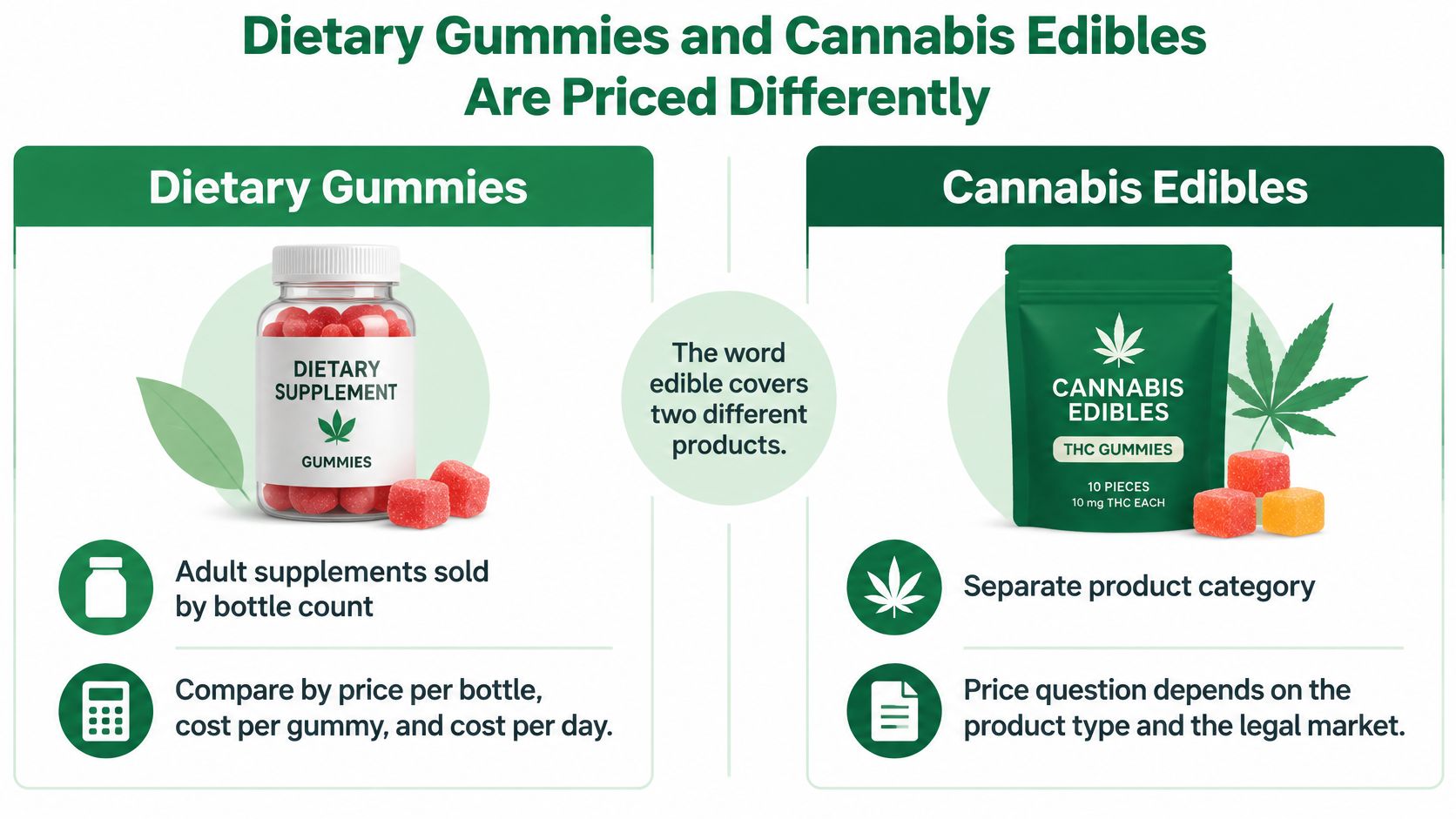
The word edible covers two different products, and they don't share a price unit. Dietary gummies are adult supplements sold by bottle count. You compare them by price per gummy and price per daily serving. Cannabis edibles are sold by milligram dose in licensed markets. You compare them by price per milligram or price per standard serving.
Averaging those into one number misleads everyone. Public dispensary-menu data cited by Headset indicate that edible products average about $11 per item in U.S. markets, commonly a 100-mg package containing ten 10-mg gummies, or roughly $1 per 10-mg serving, as summarized in Herby Bud's cannabis gummies statistics overview. An $11 cannabis package and a $24 supplement bottle are not competitors. One buys ten dosed servings, the other may buy a month of daily use.
Edible gummy prices by product type
| Product type | Typical price | Unit price |
|---|---|---|
| Adult dietary gummy supplement, 60 count | $15–$28 per bottle | about $0.25–$0.47 per gummy |
| Mineral-focused gummy supplement, 60 count | $12–$24 per bottle | about $0.20–$0.40 per gummy |
| Digestive-health gummy supplement, 60 count | $16–$28 per bottle | about $0.27–$0.47 per gummy |
| Cannabis edible, dispensary average | about $11 per item | about $1 per 10 mg serving |
Packages vary by count, active-ingredient amount, serving size, taxes, and jurisdiction, so a shelf price in one state or category doesn't transfer cleanly to another. Shoppers who search how much are edible gummies often get cannabis prices when they wanted a daily supplement, or the reverse.
The cheapest package isn't automatically the best value if it holds fewer servings or doesn't state clear quantities of active ingredients.
Split your question into four parts, cost per gummy, cost per daily serving, cost per package, and any shipping threshold. For a non-intoxicating dietary supplement, stay with the daily-serving calculation. For a dosage-based cannabis product, compare price per milligram within your legal market.
How to Work Out Cost Per Gummy and Per Day
You can run this calculation on any package in under a minute. Each step uses a number printed on the label, not a marketing claim.
- Find the count: Look for the total number of gummies in the container. A 60-count bottle is common for supplements.
- Divide price by count: Divide the bottle price by that count to get cost per gummy.
- Read the serving size: Check the Supplement Facts panel for how many gummies equal one serving, since a daily plan may use one or two.
- Multiply for daily cost: Multiply cost per gummy by gummies per day. Then divide the total count by gummies per day to get days of supply.
- Add delivery costs: Add shipping and taxes where they apply, then divide again if you want a true delivered cost per day.
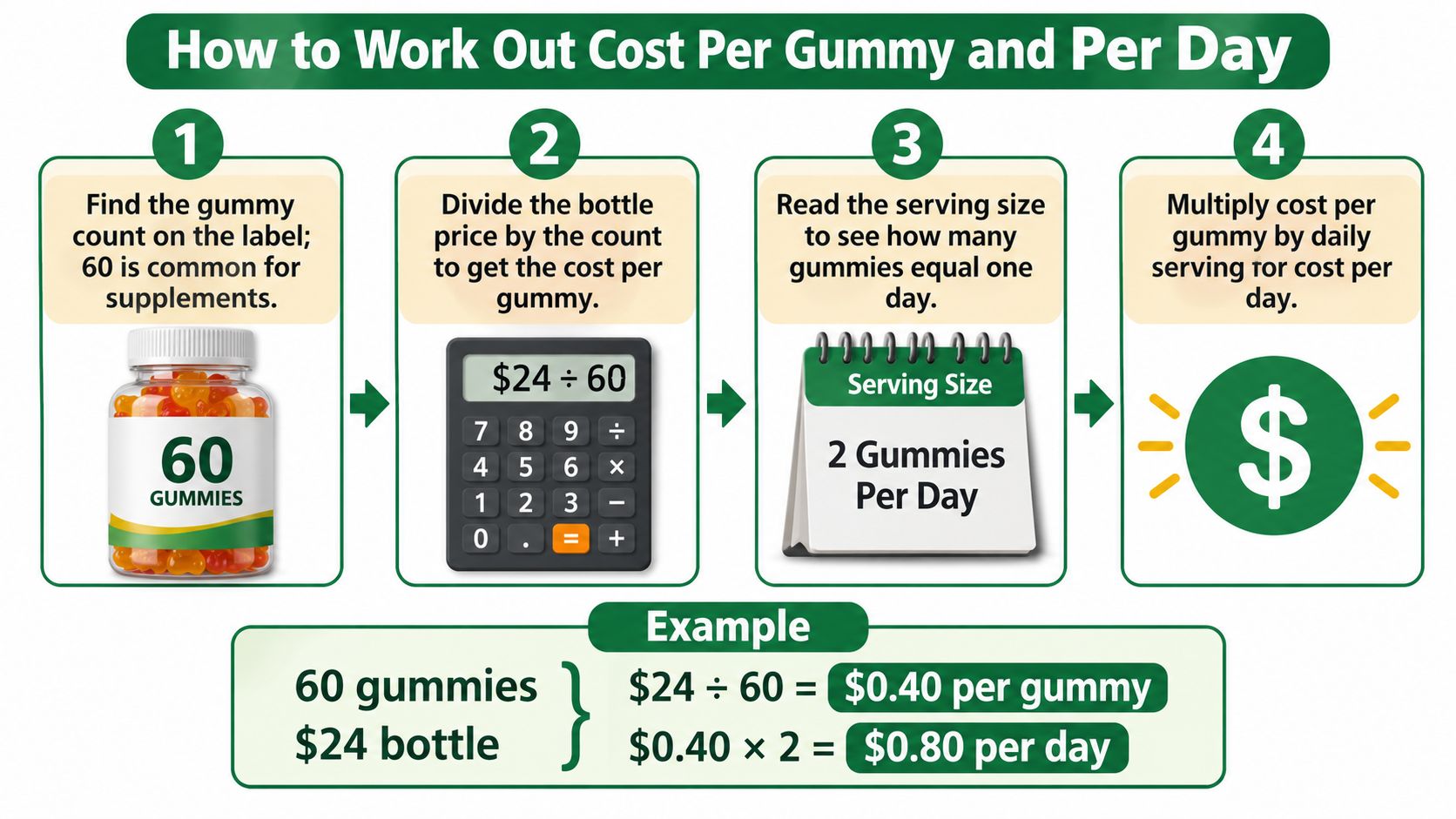
Take a $20 bottle of 60 gummies as a worked example. Twenty divided by 60 gives $0.33 per gummy. At two gummies daily, that's $0.67 per day and a 30-day supply. At one gummy daily, the same bottle costs $0.33 per day and lasts 60 days. Nothing about the product changed, only the serving instruction changed the economics.
Cost per gummy and per day for common bottle prices
| Bottle price (60 gummies) | Cost per gummy | Days supply at 2 a day |
|---|---|---|
| $15 | $0.25 | 30 days |
| $20 | $0.33 | 30 days |
| $28 | $0.47 | 30 days |
Why count alone misleads shoppers
Package count and total product weight don't tell you how many servings you're buying. Research on cannabis edible labels makes the broader point clearly. Only 14.6% of edible consumers reported knowing the standard THC serving, and approximately 6% of respondents could identify serving size when labels provided only weight or no clear dose, compared with 77% when dosage was explicitly listed, according to the PMC study on cannabis edible label comprehension.
Those findings concern THC, so don't transfer them directly to botanical supplements. The label lesson still holds. Explicit serving information prevents both dosing mistakes and bad price comparisons. If you're also comparing stronger formulas, our guide to high-potency gummies explains what potency language on a label should disclose. Compare only products that state servings per container and the amount in each serving.
What Drives the Price of Each Gummy
Start at the factory, because a gummy costs more to produce than a capsule holding similar ingredients. The process requires heated syrup handling, molding, curing, moisture control, and flavor and texture work before the product reaches specialized packaging. Each step adds equipment, time, and quality checks that a pressed tablet doesn't need.
The image below sets out those manufacturing and packaging layers.
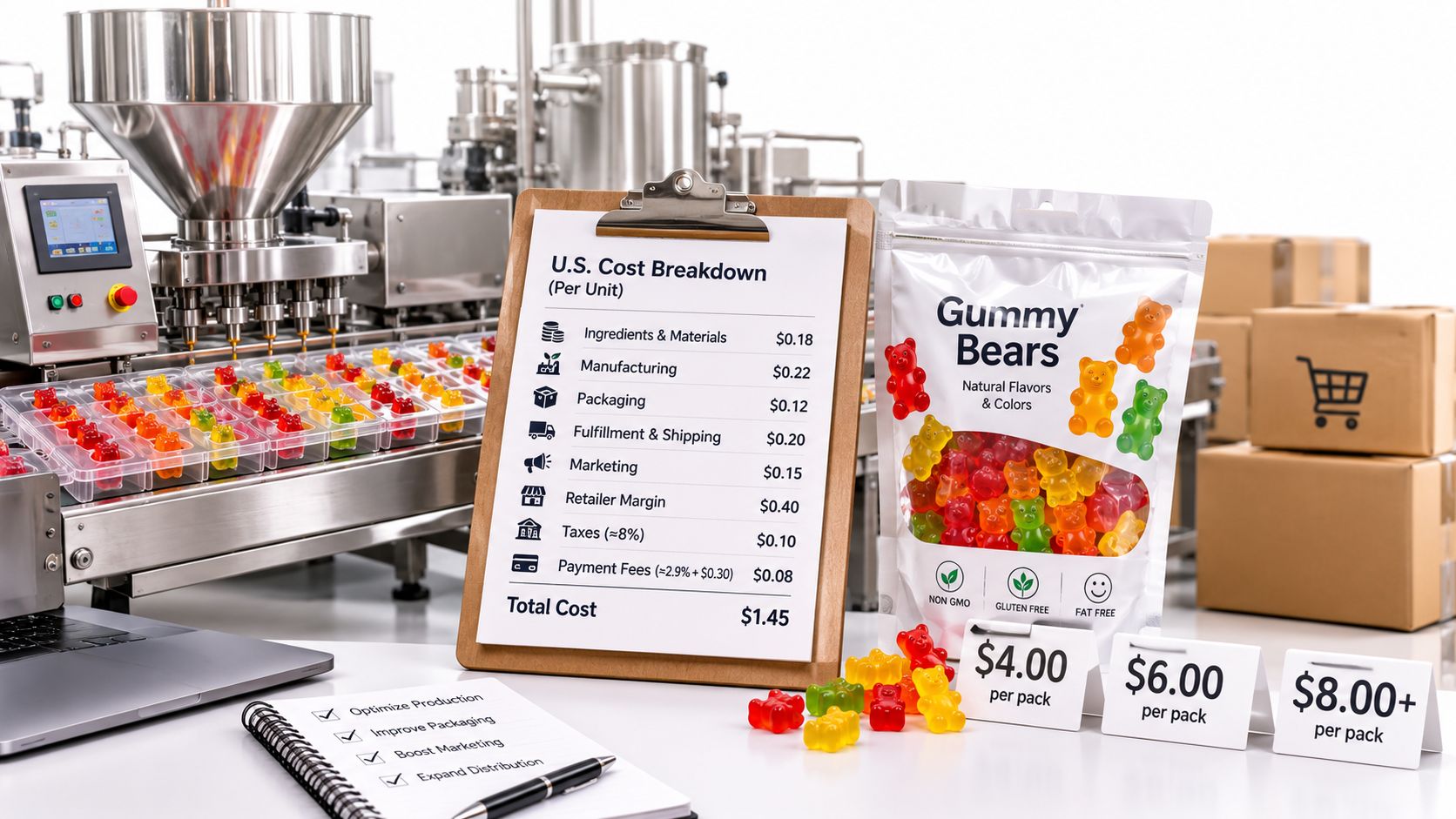
A practical U.S. planning benchmark is approximately USD $4–$8 or more in manufacturing cost per finished retail pack, before marketing, fulfillment, retailer margins, taxes, and payment fees, according to ProSafe Nutra's supplement manufacturing cost guide. Complex formulas with multiple botanicals, layered flavors, or added coatings sit toward the upper end of any manufacturing estimate, because every extra ingredient brings its own sourcing and blending work. The retail price then has to cover everything after the factory gate, which is why production cost and shelf price are never close.
Format, ingredients, and testing
Format itself carries a premium. Gummies and chewables command a 20%–40% premium over comparable tablet formulations, reflecting added manufacturing complexity and consumers' perceived convenience and appeal, according to the IndexBox U.S. vitamins, minerals, and supplements market analysis. That analysis estimates U.S. retail spending on vitamins, minerals, and supplements at $50 to $60 billion for 2026, with gummies and chewables projected at 25% to 35% of unit sales. Treat both figures as projections rather than completed results.
Ingredients push cost in either direction.
- Branded botanical extracts: Named, standardized extracts usually cost more than generic powders, and suppliers may charge for licensing and consistent potency.
- Higher active doses: More active material per gummy raises raw-material cost and can make flavor and texture harder to stabilize.
- Imported ingredients: Freight, currency, and longer lead times add cost before production even starts.
- Third-party testing: Independent checks for identity, potency, and contaminants add laboratory fees that a bare-bones formula avoids.
A short ingredient list with low disclosed amounts will usually cost less to make than a formula that lists each botanical amount and pays for testing. The higher spend raises that formula's minimum viable price. On its own, it proves nothing about whether the gummy works better.
The video below walks through gummy production, so you can see where molding and curing sit in the sequence.
Batch size and fixed costs
Scale changes the math again. At approximately 5,000 units, a first gummy run may require about $18,000–$28,000, or roughly $3.60–$5.60 per unit for production alone, while formulation and research may add $8,000–$18,000 and packaging and labels may add $3,000–$6,000, according to the Inventory Ready launch budget guide. Bulk purchasing at 5,000 or more units is reported to lower ingredient expense by approximately 25%–40%. Even so, formulation, stability testing, tooling, regulatory review, and artwork remain fixed costs that a brand spreads across however many bottles it sells.
Time costs money too. Once formulation, molding, curing, and stability screening run in sequence, a production run stretches across weeks rather than days. That screening checks whether botanical actives hold up after exposure to processing heat and storage conditions. A brand that rushes the sequence can launch sooner, but it risks gummies that lose texture, flavor, or stated potency on the shelf.
A small launch batch can carry a higher per-gummy price without proving better quality, because fixed costs are spread across fewer bottles.
For shoppers, the practical response is two questions. What batch size and testing sit behind this price, and does the label disclose enough to justify the tier? A brand should be able to separate recurring unit cost from one-time development expenses when it answers. Keep the per-gummy figure in perspective while you ask: a higher sticker price spread across more servings per container can still come out cheaper per day, which is the number your budget feels.
Why the Cheapest Gummy Is Not Always the Best Value
Say two bottles sit side by side, one at $14 and one at $24. The cheaper bottle tempts you until you count servings. If it gives you 15 days and the other gives you 30, the expensive bottle is cheaper per day. Unclear active amounts create the same trap, because you may be paying less for far less formula per serving.
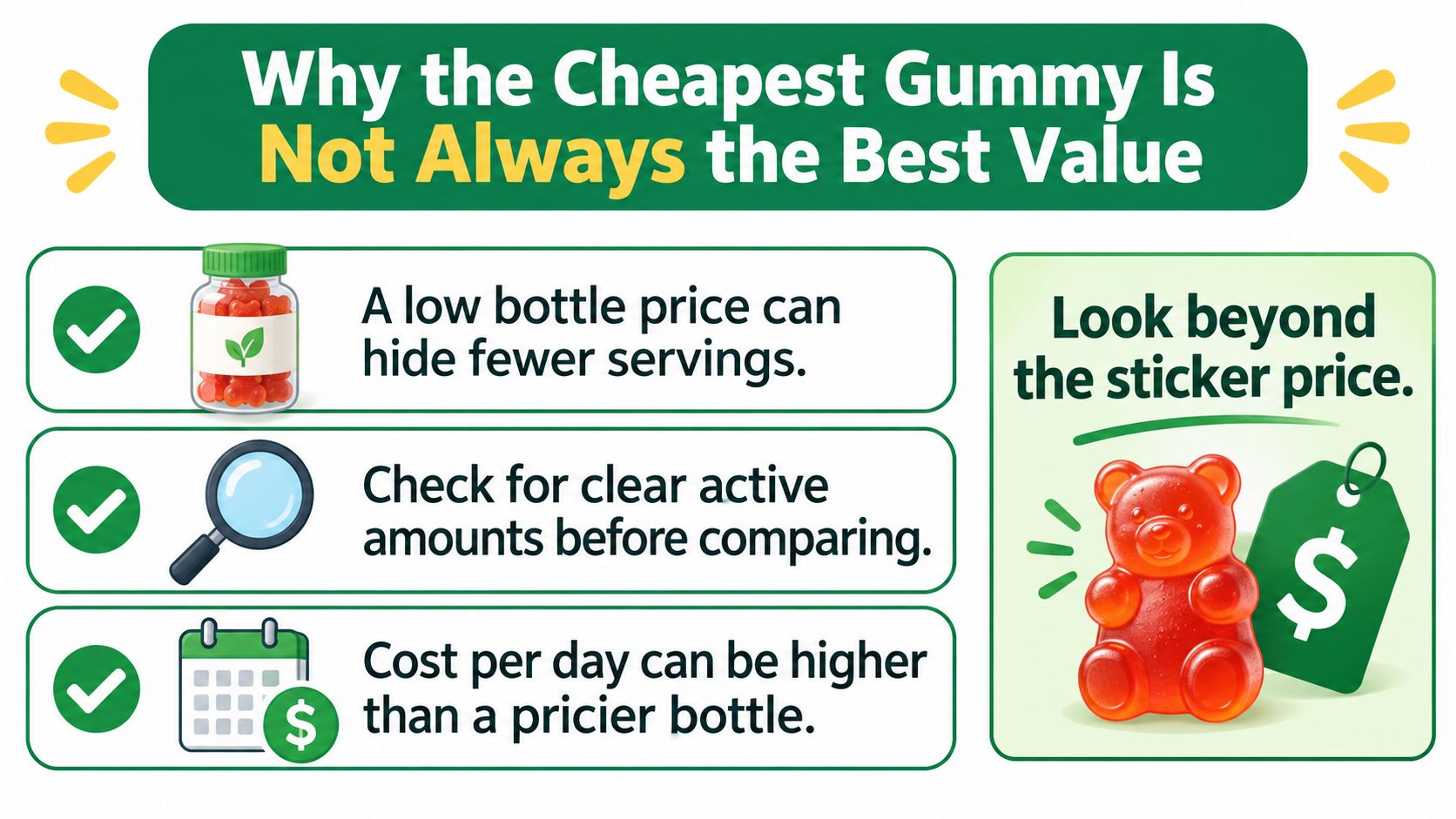
Run three checks before you compare prices. First, confirm the serving size and how many gummies each serving uses. Second, check whether each active ingredient has a listed amount per serving, rather than appearing only inside a blend total that hides individual quantities. Third, look for references to GMP manufacturing or third-party testing, and check whether the brand explains what was tested. Our explanation of how transparency works shows what complete disclosure looks like in practice.
Words on the front of the pack need careful reading. Terms such as natural, botanical, or clinically studied describe ingredients or positioning. They don't establish a clinical effect for the finished gummy in your hand, especially when a study used a different dose, extract, or population. Judge the disclosed formula and the serving schedule instead of the marketing phrase.
Before you buy: How many days does this bottle last, what exactly does each serving contain, and what does one day cost after shipping?
Safety belongs in the value calculation too. Femme Fresa Fatale gummies are for adult use only (18+), and customers should consult a healthcare professional before use, especially if pregnant, nursing, have a medical condition, or are taking medication. If you notice an adverse reaction, stop use and seek professional advice. A bargain isn't good value if the product isn't appropriate for you, and a premium price doesn't remove the need for that check.
Set Your Gummy Budget Before You Buy
Set the budget in daily terms first. Decide how many gummies per day fit your plan, then use the $15 to $28 benchmark for a 60-count bottle to set a ceiling you're comfortable paying each day. A shopper content at roughly $0.50 per day and a shopper willing to pay above $0.70 are shopping in different tiers, and both can make a sensible choice if the label supports it.
Next, run the cost-per-day calculation on every bottle you're considering, including shipping. Don't compare a delivered price against a shelf price, and don't compare a 60-day supply against a trial pack as if they were the same purchase. Keep the unit constant and let the products compete on that single measure.
Comparing our two formats on the same basis
Femme Fresa Fatale, Women's Vitality & Wellness Gummies has a regular price of $24.99. The Tease Trio, Femme Fresa Fatale Gummies (3-Pack) has a regular price of $14.99, and it holds six gummies across three sachets of two. The trio works as a short trial rather than a month's supply, so compare it as a way to test flavor and routine fit, not as a cheaper daily option.
Shipping can change the final ranking. We offer free shipping on orders over $60, which matters if you're combining a bottle with a trial pack or stocking up. If you prefer to buy in person, our store locator points to wellness stores, and our roundup of online supplement stores helps you judge delivery terms before checkout.
Confirm the daily cost fits your budget, check the Supplement Facts panel and serving count, and review the adult-use and healthcare guidance. Once those three answers are clear, you know how much are edible gummies for your routine, not just for an average shopper. Then buy with a number you can defend.
Ready to put your daily budget to work? Explore Femme Fresa Fatale and The Tease Trio at Eve's Eden, check the serving details for each format, and choose the option whose cost per day fits the routine you've planned.