De Stress Supplement: What Works, Risks and Red Flags
Learn what a de stress supplement can and cannot do, which ingredients have trial evidence, who should avoid them, and how to check label claims.
More than 80,000 dietary supplement products are on the U.S. market, roughly a twentyfold increase from about 4,000 products and $4 billion in annual sales when Congress set the rules in 1994, according to a review of supplement regulation. That scale is why a de stress supplement is a claim to audit, not a product to trust on the name alone.
Three questions decide whether the label means anything. What outcome do you want? What dose is disclosed? What is the law even allowed to promise? A calm hour after a gummy can be a ritual, a good day, or a real change in perceived stress. Those are not the same result, and a botanical origin doesn't settle which one you got.
Stress Support Ingredients at a Glance
57.6% of U.S. adults reported using dietary supplements in 2017–2018, up from about half of adults across 1999–2012, in National Health and Nutrition Examination Survey figures summarized for Congress in a Congressional Research Service brief. Women 60 and older reached 80% use in that same summary, and 34% of children and adolescents 19 or younger used supplements too. Those numbers describe supplements in general. They don't show that a stress product works.
Read the table as a checklist, not a ranking of winners. The marketed claim is what the bottle wants you to believe. The evidence column is how far human trials go. The last column is the label detail that makes the claim checkable.
| Ingredient | Common marketed claim | Evidence strength | What to check on the label |
|---|---|---|---|
| Ashwagandha | Stress relief, better sleep | Moderate; several small randomized trials of 6–8 weeks | Botanical species, extract type, withanolide standardization, daily dose |
| Magnesium | Calm, anxiety relief | Weak to conditional; mixed trials and poor study quality in reviews | Elemental magnesium amount and chemical form (citrate, glycinate, oxide) |
| L-theanine | Relaxation, calm focus | Limited; small trials with mixed results | Daily dose and source |
| B vitamins | Stress tolerance, energy | Limited; mostly small or combined-formula trials | Which B vitamins are included and amounts against daily values |
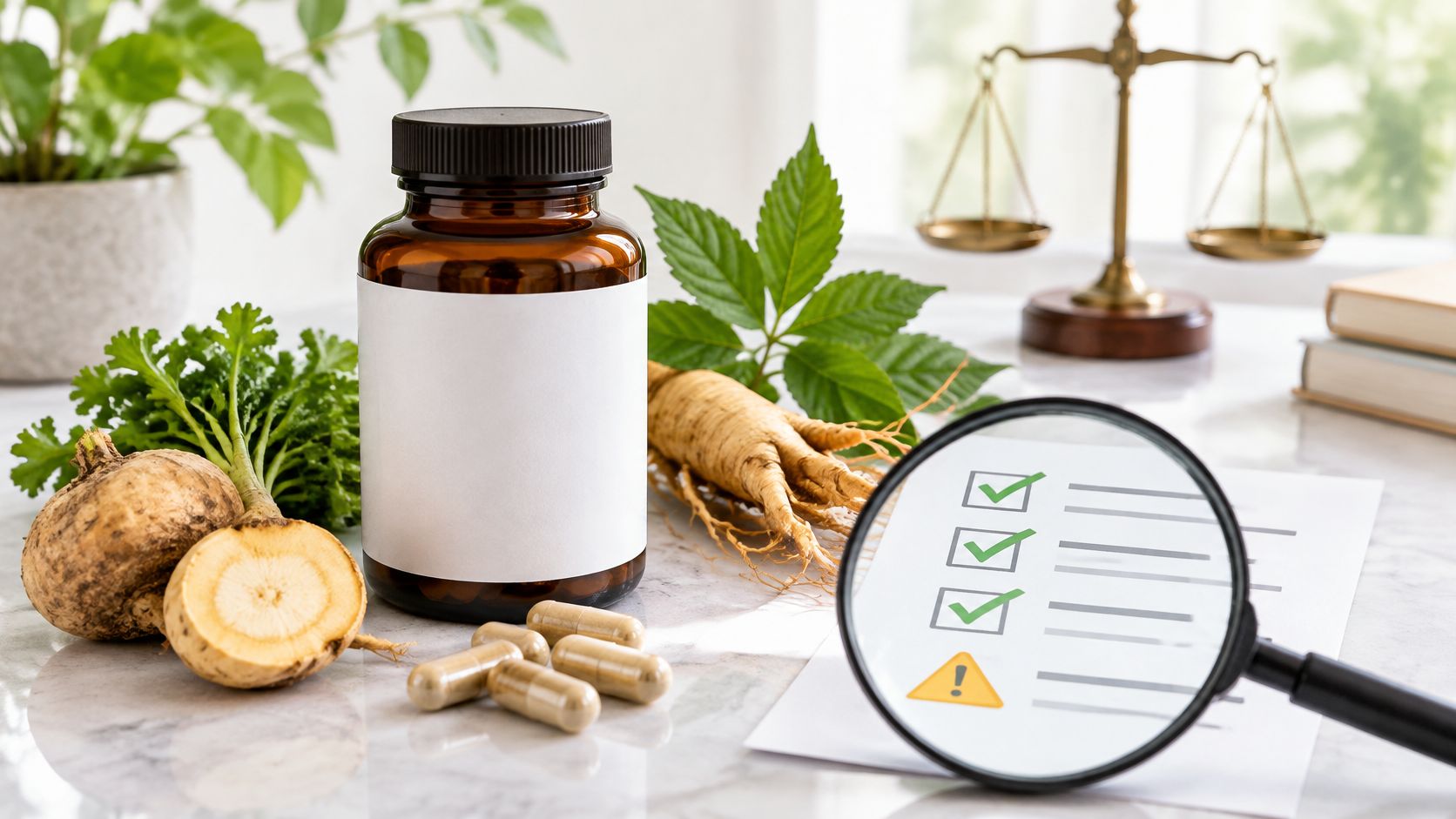
| Ginseng | Energy, stress resilience | Limited and variable across extracts | Species and ginsenoside content |
| Maca or damiana blends | Mood, vitality | Little published human research on stress outcomes | Each botanical listed separately with its amount |
An ingredient name never settles the result. Ashwagandha trials used particular extracts for a set number of weeks, so a different root powder at a different dose is a different product. Magnesium only makes sense once you see elemental milligrams, not the weight of the whole salt. A blend that prints "maca and damiana" without separate amounts can't be matched to any study at all.
What a De Stress Supplement Is and How It Is Regulated
A de stress supplement is a dietary product sold to support stress resilience or how stressed you feel. It is not a medicine approved to treat anxiety or any disorder. That legal gap is the first thing worth understanding, because it decides how much weight a label can carry.
A supplement label works like a self-written job reference. The company drafts it, and a regulator reads it closely mainly when something looks wrong, not before every bottle ships.
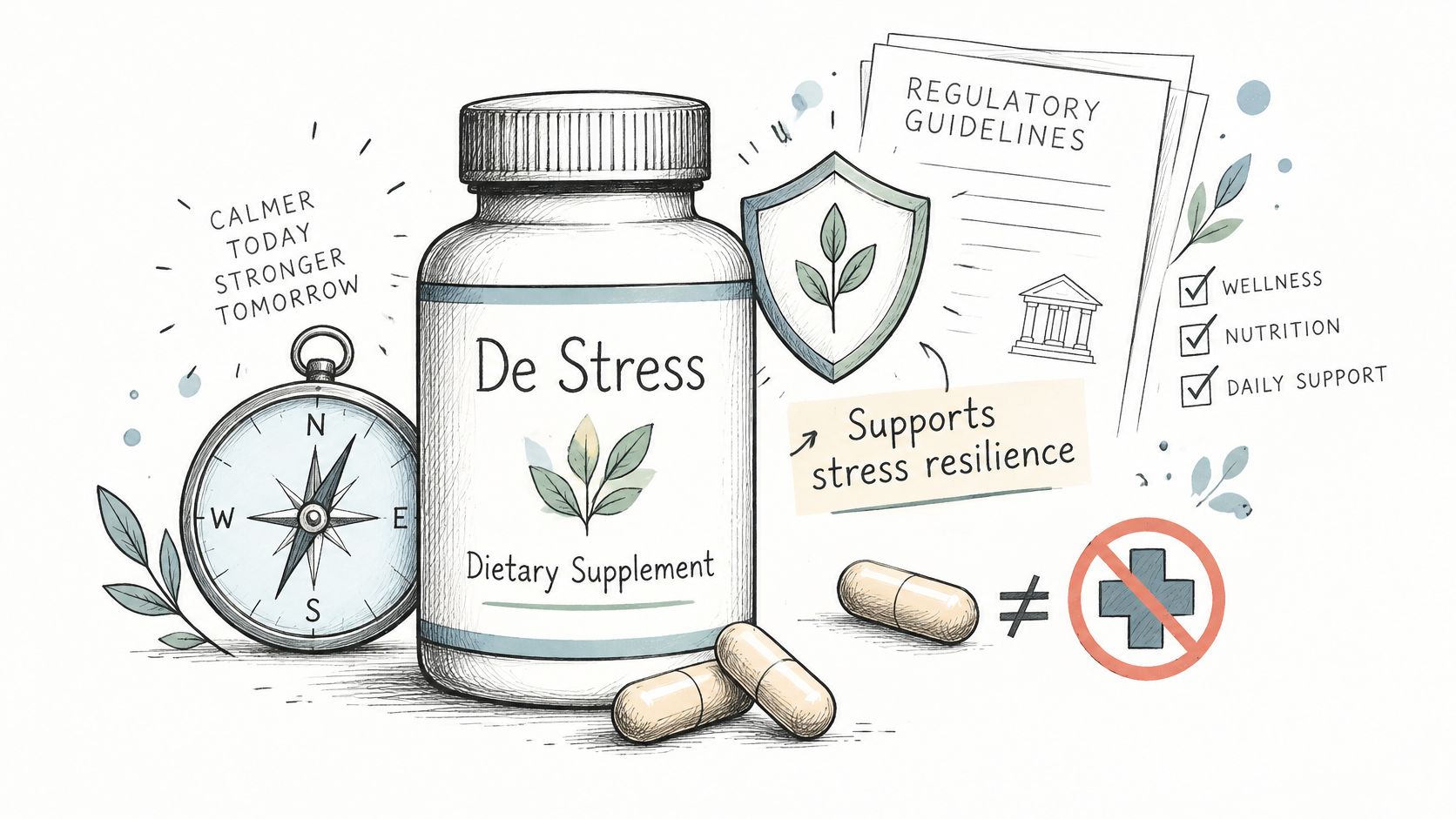
The Dietary Supplement Health and Education Act of 1994 amended the Federal Food, Drug, and Cosmetic Act. It defined dietary supplements, set labeling and new-ingredient rules, authorized manufacturing standards for supplements, and created the National Institutes of Health Office of Dietary Supplements. Under that framework, supplements sit in the food category rather than the drug category, so the FDA does not generally approve them for safety or effectiveness before they reach shelves.
The company still carries the duty. Labeling has to stay truthful and lawful, quality has to be maintained, and claims about treating or preventing a disease are off limits. When the FDA acts, it is usually after the fact, such as when a product turns out to be adulterated or misbranded, not a pre-market check that the product delivers calm.
Practical rule: A lawful label is a floor for honesty, not evidence that the product changes stress.
The claim on the front and the dose on the panel both sit inside that self-reported frame. Passing the statute means the wording stayed within the food rules. It says nothing about whether a trial showed the bottle works for the outcome you want.
That distinction matters when you compare wellness gummies with prescribed care, or with the wider range of women's health products sold for mood and daily well-being. The law decides which words are allowed on the bottle. It does not decide whether the bottle delivers what those words suggest.
Choosing Between Stress, Sleep and Mood Outcomes
Poor sleep can affect how people feel during the day, and stress or anxiety is often named as a leading sleep challenge. These outcomes overlap, but they are different targets. A product label that mentions “stress support” does not tell you whether it may affect sleep, mood, or both.
Choose one outcome to track at a time. A simple diary works like a thermometer: it gives you a consistent reading, though it cannot explain what caused a change.
| Outcome | Practical measure | Time to judge | Note |
|---|---|---|---|
| Perceived stress | Perceived Stress Scale questionnaire, completed weekly | 6–8 weeks | Used in ashwagandha trials |
| Sleep onset | Minutes to fall asleep, logged each morning | 2 weeks | Diary-based and subjective |
| Night awakenings | Number of awakenings per night in the diary | 2–4 weeks | Track alongside caffeine and screen time |
| Morning refreshment | Rating from 1 to 10 on waking | 2 weeks | Record the same rating each morning |
| Mood and confidence | Daily rating from 1 to 5 at the same time each day | 2–4 weeks | Subjective; expectation can affect ratings |
| Persistent low mood or anxiety | Clinician assessment | If symptoms persist | Supplements do not replace evaluation |
A diary before you decide
If your goal is calmer evenings rather than falling asleep faster, rate your mood from 1 to 5 at 8 p.m. for two weeks before changing anything. Then keep using the same rating for two to four more weeks while taking one product at its labeled serving. Note caffeine, screen time, and bedtime too, so a late night is less likely to be mistaken for a product effect.
A calm feeling within an hour is still a feeling, not proof that an underlying condition has changed. Expectations, the routine of taking something, and the events of the day can all influence a rating. Repeated measures over several weeks give a steadier picture than one good afternoon.
What the Evidence Shows for Ashwagandha and Magnesium
Ashwagandha has a clearer trial record than magnesium, though results from one extract or dose do not automatically apply to every product carrying the ingredient.
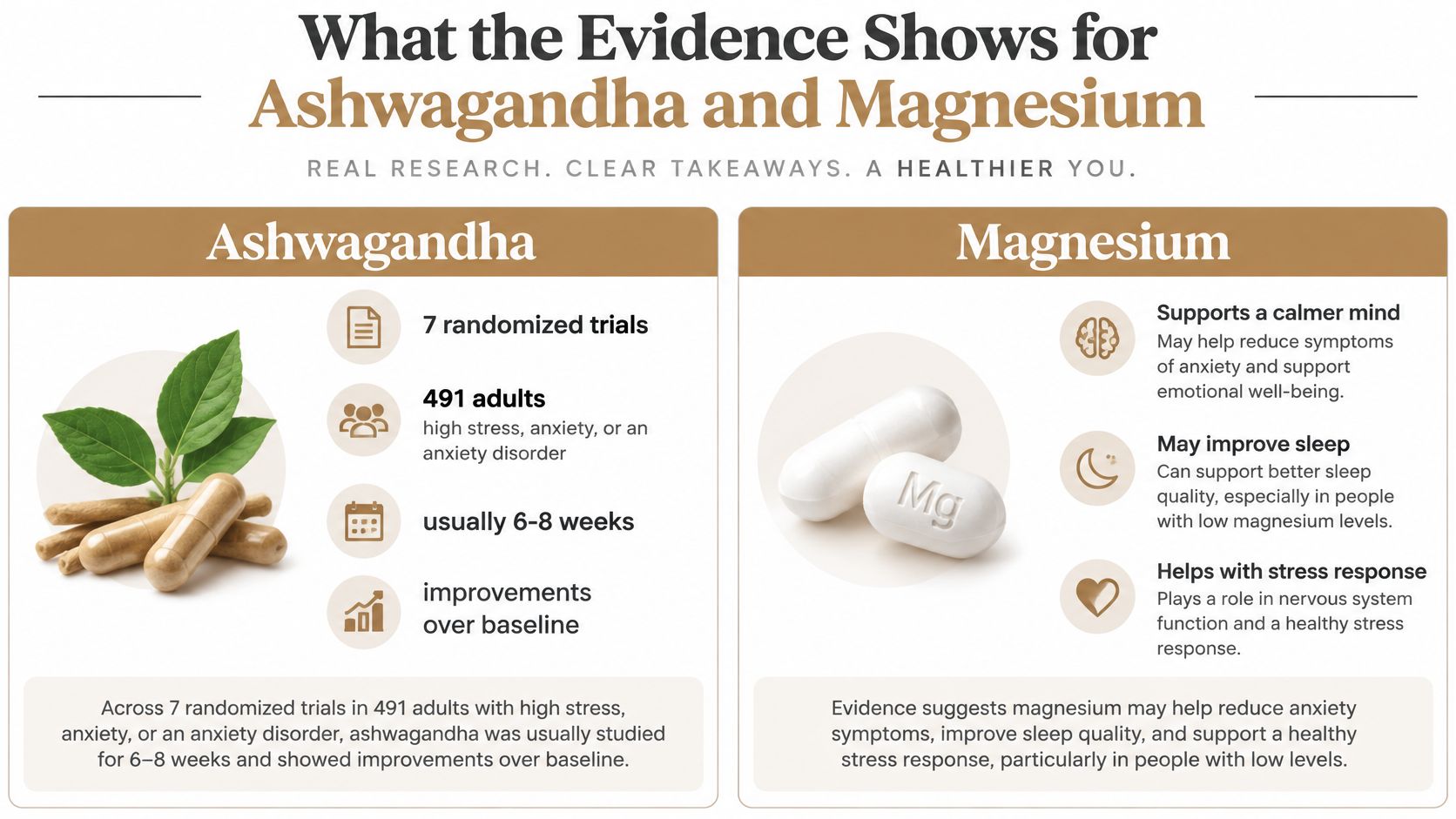
A systematic review summarized by the NIH Office of Dietary Supplements covered seven randomized studies involving 491 adults with high stress, anxiety, or an anxiety disorder. The trials generally lasted six to eight weeks. Compared with placebo, participants taking ashwagandha generally showed improvements in stress and anxiety scales, sleep complaints, fatigue, and serum cortisol. These are modest findings from particular study preparations, doses, and groups of participants, not a guarantee that an untested gummy will have the same effects.
Why magnesium is a maybe
Magnesium supports neuromuscular signaling and cellular energy production, which makes a role in stress responses plausible. Evidence from trials is less consistent. An NCBI evidence review found anxiety improvements in several placebo-controlled trials of magnesium-containing products, but some included vitamin B6 or other ingredients, so the effects cannot be attributed to magnesium alone. A separate review reported mixed results and judged the study quality poor. It found no validated subjective-stress outcome among the trials it examined.
Check the label for elemental magnesium per serving, rather than the total weight of a compound such as citrate, glycinate, or oxide. The amount of the compound is not the same as the amount of magnesium it provides. A larger dose does not necessarily mean greater stress relief; the available evidence does not establish that. People with reduced kidney function, or those taking medicine whose absorption minerals can affect, should ask a clinician before use.
A short clinical walk-through of how stress shows up in the body can help explain why cortisol is one measure researchers examine.
Who Should Avoid Stress Supplements and Why
"Natural" doesn't mean safe, and a gummy or a "no harsh chemicals" line doesn't tell you how the ingredient behaves in a body.
For ashwagandha, the NIH National Center for Complementary and Integrative Health says some preparations may help stress and insomnia, while anxiety evidence stays unclear. Short-term use looks potentially safe for up to about three months. Long-term safety isn't established. Reported effects include drowsiness and stomach symptoms, with rare liver injury. Stop and get care if those show up. NCCIH also flags interactions with thyroid, diabetes, blood-pressure, immunosuppressant, sedative, and anticonvulsant medicines, and it advises against ashwagandha in pregnancy and breastfeeding.
Magnesium raises a different flag. It can build up when kidney function is impaired, and it can change how some medicines are absorbed.
A responsible label states adult use and tells you to ask a clinician if you are pregnant, nursing, on medicine, or managing a condition. Ours do that. If low mood is the issue, a supplement aisle is the wrong first stop, and questions about serotonin and mood support supplements belong in a clinician conversation too.
| Situation | Main concern | Action |
|---|---|---|
| Pregnancy or breastfeeding | Ashwagandha advised against; limited safety data for many blends | Don't start without a clinician's approval |
| Thyroid condition or thyroid medicine | Possible interaction with thyroid function | Ask a clinician before starting |
| Diabetes or diabetes medicine | Possible effect on blood sugar control | Monitor and review with a clinician |
| Blood-pressure medicine | Possible additive effects on blood pressure | Review with a clinician first |
| Sedatives or anticonvulsants | Additive drowsiness or interaction | Avoid unless a clinician approves |
| Immunosuppressants | Possible interaction with immune-suppressing treatment | Clinician review required |
| Impaired kidney function | Magnesium may accumulate | Clinician review before any magnesium product |
| Symptoms lasting weeks | Stress, anxiety, or sleep problems may need diagnosis | Seek a clinician instead of escalating the dose |
Safety isn't something you can infer from a plant name or a fruit flavor.
How to Check a Product's Stress Claims Before Buying
Work the label in order. Each step answers one reason a claim falls apart.
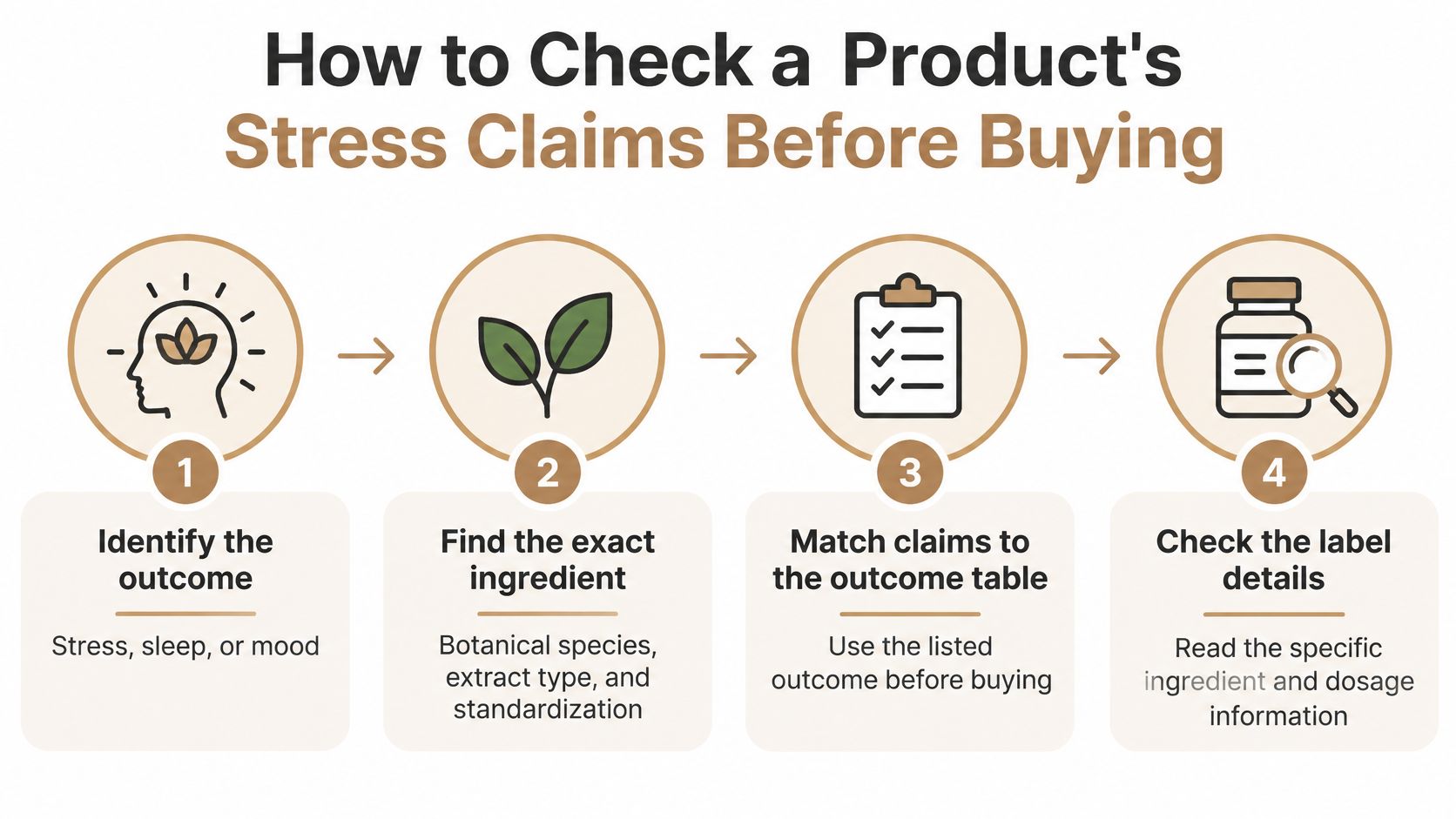
- Name the outcome. If the front says "stress," "sleep," or "mood," pick the matching row from the outcome table before you buy. A bottle that promises all three at once hasn't picked a result you can judge.
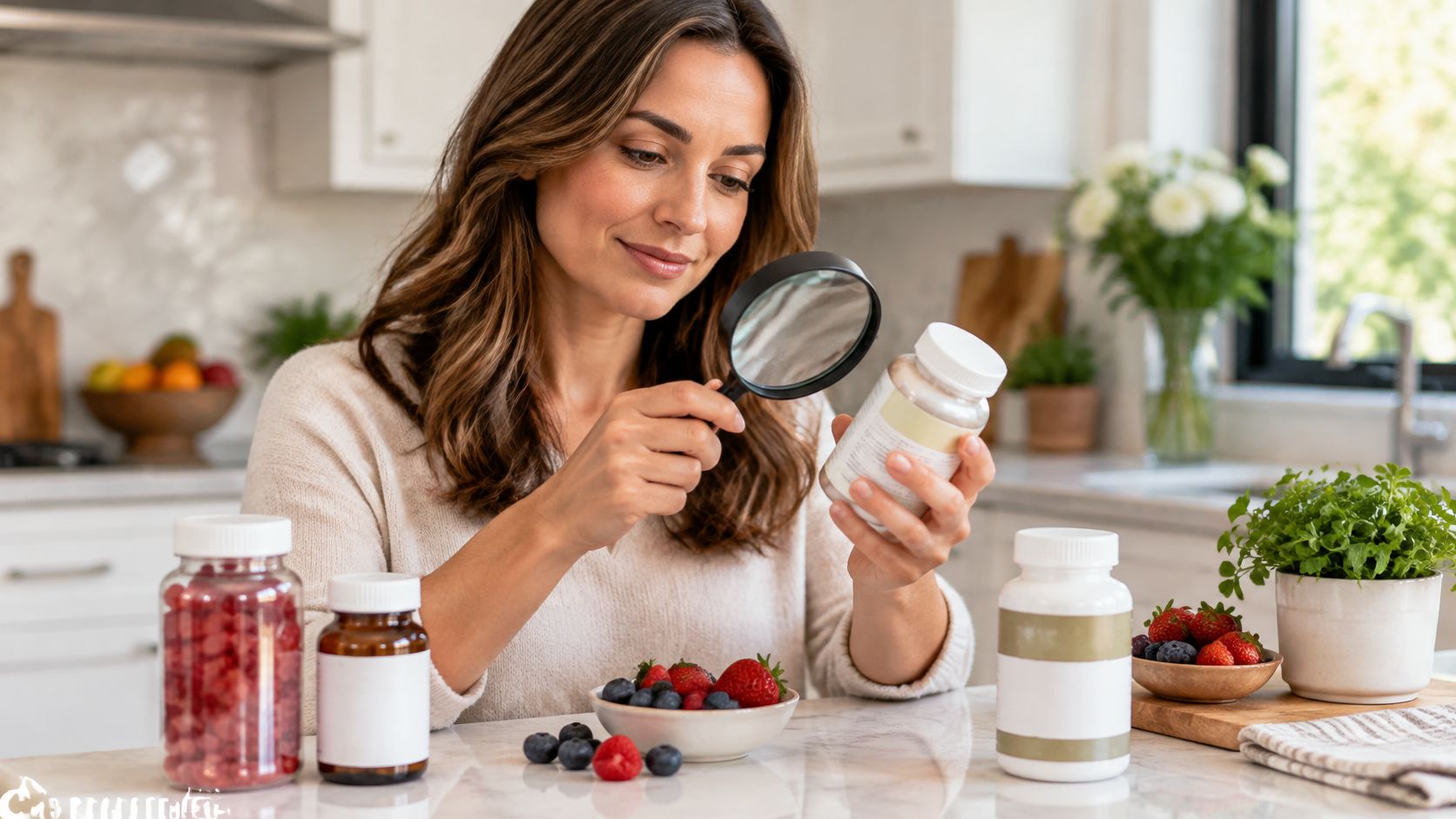
- Find the exact ingredient. You want species, extract type, and standardization, not only "ashwagandha" or "ginseng." Withanolides for ashwagandha and ginsenosides for ginseng are the lines that tie a dose to a studied material.
- Match the amount to a trial, or admit you can't. A proprietary blend that hides each milligram can't be compared with any study. Our Femme Fresa Fatale gummies name maca root, damiana, and ginseng and contain 200 mg of botanical ingredients per gummy. That disclosure is checkable. It still isn't a clinical trial of the finished gummy, and the product isn't intended to diagnose, treat, cure, or prevent any condition.
- For magnesium, read elemental amount and the salt. Citrate, glycinate, and oxide are not interchangeable on tolerance, even when the front panel says "calm."
- Separate ingredient studies from product studies. "Clinically studied ingredients" usually means someone else's extract, not this formula. Look for third-party quality testing and a real manufacturing certification, not a badge with no certifier named. Format doesn't fix a thin dose, which is the same issue with high potency gummies.
- Read the verbs. "Supports stress resilience" isn't "treats anxiety." A line that the product hasn't been evaluated by the FDA is a reason to verify, not a comfort. "Fast-acting" and "no harsh chemicals" are marketing until a disclosed measure backs them.
- Keep the two-to-four-week diary, and bring the label to a clinician if you take medicine. One product at a time. If nothing in the diary moves, raising the dose isn't the next step.
Confirm the Safe First Step Before You Start
Start with one outcome, log a two-week baseline, then try one product at the disclosed serving while the diary runs for two to four weeks.
Stop and contact a healthcare professional if:
- Drowsiness gets in the way of driving, work, or childcare.
- Stomach symptoms show up and don't settle.
- Possible liver trouble appears, including yellowing skin, dark urine, or abdominal pain.
Book a clinician visit, rather than a second bottle, if:
- Anxiety, low mood, or sleep trouble lasts beyond a few weeks.
- You start a new medicine, become pregnant, or see shifts in thyroid, blood sugar, or blood pressure.
A supplement isn't a diagnosis or a treatment plan. If thoughts of self-harm appear, contact local emergency services or a crisis line now. Don't wait for a gummy to work.
A de stress supplement may offer a modest benefit for some people. That benefit isn't proven for you, and the label is a list of questions, not a conclusion.
Eve's Eden makes sensual wellness gummies for confidence, connection, and feminine vitality, including a strawberry, plant-based gummy you can use as needed rather than as a medical treatment for stress. If you want a daily ritual built around mood and ease, with adult-only labeling and a prompt to talk with a clinician first, visit Eve's Eden and read the ingredient panel before you decide.